Ramus Height: How to Get a Higher, Sharper Jaw Angle
The ramus is the vertical back part of your lower jaw, running from the joint in front of your ear down to the corner of the jaw. When it's tall, the jaw angle sits high and far back, right under the ear, and the side profile shows a clean "L". When it's short, the angle sits lower and further forward, and the jawline slopes into the neck.
You already know the bone is set by your genes and puberty. This guide is about what you can do with the jaw you have: how to check it properly, how to make the angle as visible as possible, and which procedures actually add height when you want more.
Short answer: Get lean enough that the jaw angle shows, fix forward head posture, build your masseters and neck, and frame the angle with your beard and haircut. That alone changes how high and sharp the angle reads. For more, jaw angle filler adds height and definition temporarily, jaw angle implants add it permanently, and jaw surgery is the option when a long lower face or a bite problem comes with it.
What a short ramus actually looks like
Ramus height is the distance from the jaw joint (the condyle) to the jaw corner (gonion). It's one of the clearest differences between male and female jaws: forensic scientists use ramus measurements to tell male from female skulls, with all ramus measures differing significantly between the sexes in an Indian sample.1 That's why a tall ramus reads as masculine.
| Feature | Taller ramus | Shorter ramus |
|---|---|---|
| Jaw angle position | High and back, close under the earlobe | Lower and further forward |
| Side profile | Sharp "L" from ear to chin | Jawline slopes down toward the neck |
| Lower face | Compact, horizontal jawline | Often longer, steeper jawline |
| Front view | Visible corners at the back of the face | Jaw narrows quickly below the ears |
A lot of men who think they have a short ramus don't. Soft tissue, fat under the jaw and head posture can hide a perfectly good angle. Check before you plan anything.
Check yours in two minutes
- Take a true side photo: camera at eye height, about 1.5 m away, head level, ear over shoulder. Phone selfies at arm's length distort the jaw (the photos guide explains why).
- Find the jaw corner with your finger and mark it on the photo. Then mark the small bump just in front of your ear canal, which is roughly where the jaw joint sits.
- Compare that vertical distance to the length of your jaw from the corner to the chin. A tall ramus looks close in length to the jaw body. A short one looks clearly shorter, with the corner sitting well below the earlobe.
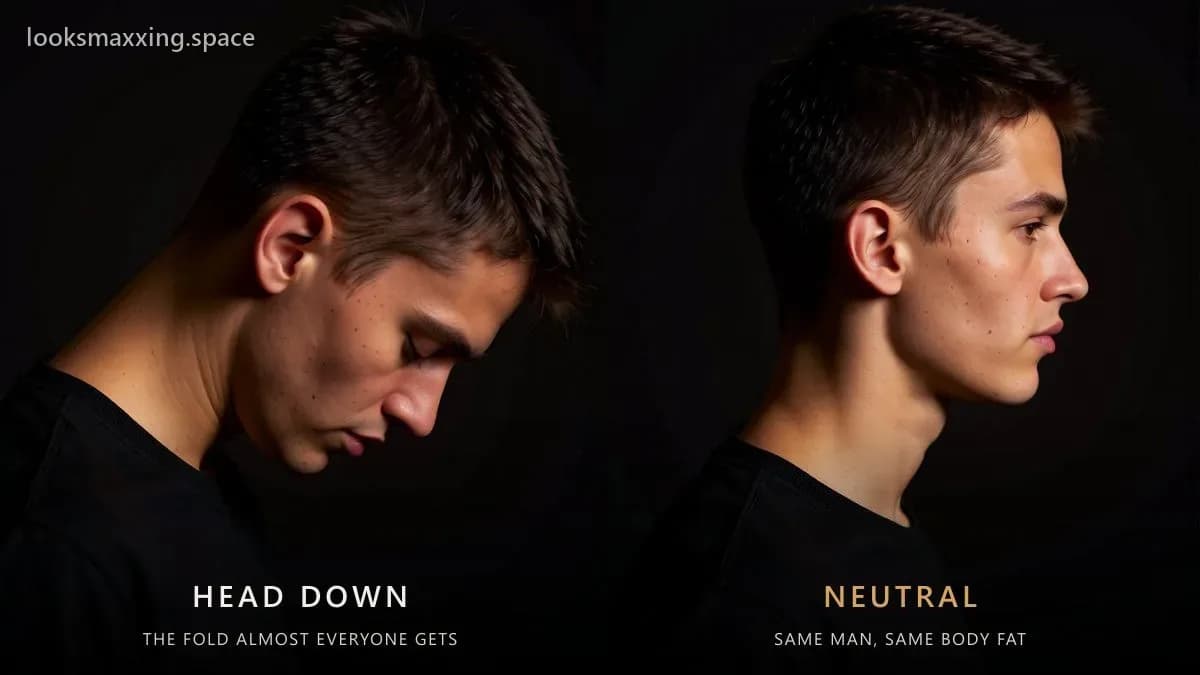
- Take a second photo with your chin slightly down and your head pulled back. If the angle suddenly appears, the problem is posture or soft tissue, not bone, and the first sections below will fix most of it.
The face analyzer gives you a jaw and lower-third read from a front photo, and the side profile guide covers the rest of the profile.
Step 1: make the angle visible (biggest return)
Get lean. Fat sits right on top of the jaw angle and under the jaw. People read body fat from faces accurately: in a review of the research, BMI estimated from faces alone correlated strongly with real BMI (r = 0.71), and more facial fat was consistently linked to lower attractiveness.2 For most men, dropping a few percent body fat does more for the jaw angle than anything else on this page. The numbers are in body fat and facial definition. Already lean and still soft under the jaw? See double chin when skinny.
Cut the bloat. Water retention from salt, alcohol and bad sleep softens the angle day to day. The debloating guide covers the quick fixes, and sleep matters more than most people think.
Fix forward head posture. When your head pokes forward, the jaw folds into the neck and the angle disappears. Pulling the head back so your ear sits over your shoulder is the fastest visible change there is. The routine is in the posture guide.
Build your neck. A thicker, more defined neck makes the jaw sit on a clear base and sharpens the drop-off below the angle. See the neck guide.
Step 2: build what sits on the bone
Train the masseters. The masseter is the chewing muscle that wraps the jaw angle. A bigger masseter fills out the back of the jaw and makes the corner look wider and more square. Muscle responds to resistance, so hard gum chewed in short daily sessions is the usual method. Start slow, stop if your jaw joint clicks or aches, and don't chew for hours. Full protocol and the evidence in the jawline gum guide.
Shape your beard around the angle. A beard is the one way to redraw your jawline without a doctor. Keep the sides tight and squared off at the jaw corner, keep the line along the jaw sharp, and set the neckline a finger or two above the Adam's apple so the angle has a clean edge. In a rating study of 8,520 women, beards and stubble changed how masculine faces were rated and raised ratings for long-term relationships.3 Details in the beard grooming guide.
Pick a haircut that adds height up top, not width at the ears. Short or faded sides keep attention on the jaw corners; bulky hair over the ears hides them. See haircuts for your face shape.
Step 3: use angles and light
The jaw angle is mostly a shadow. Light from slightly above and to the side drops a shadow under the jaw and defines the corner; flat front light erases it. Shoot from eye level or slightly above, push your head slightly forward and down toward the camera, and turn a little so the camera sees one jaw corner. The photos guide has the full setup.
Step 4: procedures that actually add height
When you've done the above and still want a higher, sharper angle, these are the options that change the shape.
| Jaw angle filler | Jaw angle implant | Jaw surgery | |
|---|---|---|---|
| What it does | Gel placed on the bone at the angle and along the jaw | Silicone or custom implant placed on the jaw angle | Jaw bones cut and repositioned |
| Adds ramus height? | Visually, a little | Yes, implants can lengthen the angle downward and widen it | Yes, when the whole jaw is repositioned |
| Permanence | Temporary, months to about a year | Permanent unless removed | Permanent |
| Downtime | A few days of swelling | Several weeks of swelling | Months of braces plus hospital recovery |
| Best for | Testing the look, mild cases | A short ramus with a normal bite | A long lower face or bite problem |
Jaw angle filler. The FDA approved a hyaluronic acid filler specifically for jawline definition in 2022, for adults over 21. In the pivotal study, 69.9% of patients (102 of 146) had improved jawline definition at six months.4 An injector can place it at the jaw corner to build a sharper, slightly higher angle. It's the best way to preview what an implant would do. Only see a licensed, trained injector, because injecting into a blood vessel is the most serious filler risk.5
Jaw angle implants. These sit on the bone at the jaw corner. There are two basic types: ones that extend the angle downward (adding height) and ones that widen it outward. The surgeon plans which you need from your ramus length and jaw width.6 In a study of 58 patients with 116 silicone jaw angle implants, 4.3% of implants got infected and 13.8% shifted, while most patients were satisfied with the result.7 Custom implants made from a CT scan fit better for larger changes and cost more. Ask any surgeon how many they do a year and to see results on men with similar faces.
Jaw surgery. If a short ramus comes with a long lower face, an open bite or a recessed jaw, orthodontics plus jaw surgery can rotate and reposition the jaw, which changes the angle at its source. It's a big undertaking planned by an orthodontist and a maxillofacial surgeon. Across 38 studies, patients generally reported better appearance satisfaction and confidence afterward.8 If your bite is off, see an orthodontist first; the weak chin guide covers how bite and jaw position interact.
What doesn't work
- Mewing for bone. Adult jaw bone doesn't grow with tongue posture. Good tongue posture can tighten the area under the chin, but it won't lengthen a ramus. The evidence is in the mewing guide.
- Bonesmashing. No scientific basis, real injury risk.
- Masseter Botox if you want a stronger angle. It shrinks the muscle that builds out the jaw corner. Studies show it reduces the width of the lower face, which is the opposite of what you're after.9
- Jaw exercisers sold as bone growers. They work the muscle like gum does, nothing more.
A realistic plan
| Timeframe | What to do |
|---|---|
| This week | Take baseline side photos, fix head posture, cut salt and alcohol, reshape your beard around the angle |
| 1 to 3 months | Get leaner, start masseter and neck training, get a haircut that keeps the sides tight |
| 3 to 6 months | Retake the same photos. Most of the change shows here |
| After that | If you want more, try jaw angle filler as a preview, then talk to surgeons about implants |
Frequently Asked Questions
Can you increase ramus height naturally? Not the bone itself in an adult. You can make the angle sit visibly higher and sharper by getting lean, fixing posture, and building your masseters and neck, which is where most of the visible difference comes from.
What causes a short ramus? Mostly genetics and how the jaw grew during puberty, when testosterone drives most of the difference between male and female jaws. Chronic mouth breathing during childhood is linked to longer, steeper lower faces; see the mouth breathing guide.
Is a tall ramus attractive? It's one of the features that makes a jaw read as masculine, because ramus height is one of the clearest male-female differences in the jaw.1 It's one part of the face though. Harmony with the rest of your features matters more; see facial structure and harmony.
Does filler or an implant look natural? Done conservatively by an experienced injector or surgeon, yes. Overdone jaw angles look artificial fast, so ask for a moderate change and build up if needed.
Should I get jaw angle implants or surgery? If your bite is normal and only the angle is short, implants are the simpler route. If you also have a long lower face, an open bite or a recessed jaw, see an orthodontist about surgery first.
The bottom line
A short ramus is set in bone, but how high and sharp your jaw angle looks is not. Get lean, fix your posture, build your masseters and neck, and frame the angle with your beard and haircut. That covers most of the visible gap. If you want more after that, filler previews a higher angle, implants make it permanent, and jaw surgery handles the cases where the bite is involved.
References
Footnotes
-
Saini V, Srivastava R, et al. Mandibular ramus: an indicator for sex in fragmentary mandible. Journal of Forensic Sciences (2011);56(Suppl 1):S13-S16. https://www.ojp.gov/ncjrs/virtual-library/abstracts/mandibular-ramus-indicator-sex-fragmentary-mandible: all ramus measurements differed significantly between males and females, with 80.2% overall accuracy for sex determination. ↩ ↩2
-
de Jager S, Coetzee N, Coetzee V. Facial Adiposity, Attractiveness, and Health: A Review. Frontiers in Psychology (2018);9:2562. https://www.frontiersin.org/journals/psychology/articles/10.3389/fpsyg.2018.02562/full: BMI estimated from faces correlated r = 0.71 with real BMI; higher facial adiposity is consistently linked to lower attractiveness. ↩
-
Dixson BJW, Sulikowski D, Gouda-Vossos A, Rantala MJ, Brooks RC. The masculinity paradox: facial masculinity and beardedness interact to determine women's ratings of men's facial attractiveness. Journal of Evolutionary Biology (2016);29(11):2311-2320. https://pubmed.ncbi.nlm.nih.gov/27488414/: in 8,520 women, stubble and beards changed attractiveness ratings of masculinized faces and raised long-term attractiveness. ↩
-
U.S. Food and Drug Administration. JUVÉDERM VOLUX XC, P110033/S065. FDA (2022). https://www.fda.gov/medical-devices/recently-approved-devices/juvederm-volux-xc-p110033s065: approved for improving jawline definition in adults over 21; jawline definition improved in 102 of 146 participants (69.9%) at six months. ↩
-
U.S. Food and Drug Administration. Dermal Fillers (Soft Tissue Fillers). FDA (2023). https://www.fda.gov/medical-devices/aesthetic-cosmetic-devices/dermal-fillers-soft-tissue-fillers: injection into a blood vessel is the most serious risk; use only licensed, trained providers. ↩
-
Review of facial implants. Thieme Connect (2021). https://www.thieme-connect.de/products/ejournals/html/10.1055/s-0041-1735307: the two widely available mandibular angle implant types lengthen the angle vertically or widen it laterally; planning should assess the jaw angle's length and width. ↩
-
Al-Jandan B, Marei HF. Mandibular angle augmentation using solid silicone implants. Dental and Medical Problems (2018);55(4):367-370. https://dmp.umw.edu.pl/en/article/2018/55/4/367/: in 58 patients (116 implants), 4.3% of implants were infected and 13.8% displaced; satisfaction was high. ↩
-
Liddle MJ, Baker SR, Smith KG, Thompson AR. Psychosocial Outcomes in Orthognathic Surgery: A Review of the Literature. Cleft Palate-Craniofacial Journal (2015);52(4):458-470. https://pubmed.ncbi.nlm.nih.gov/25191866/: across 38 studies, patients reported better appearance satisfaction, self-confidence and social functioning. ↩
-
A review on bigonial width reduction by botulinum toxin injections in masseter. (2023). https://www.ncbi.nlm.nih.gov/pmc/articles/PMC10557449/: botulinum toxin injections into the masseter reduce lower face width, with repeat treatment needed to maintain the effect. ↩