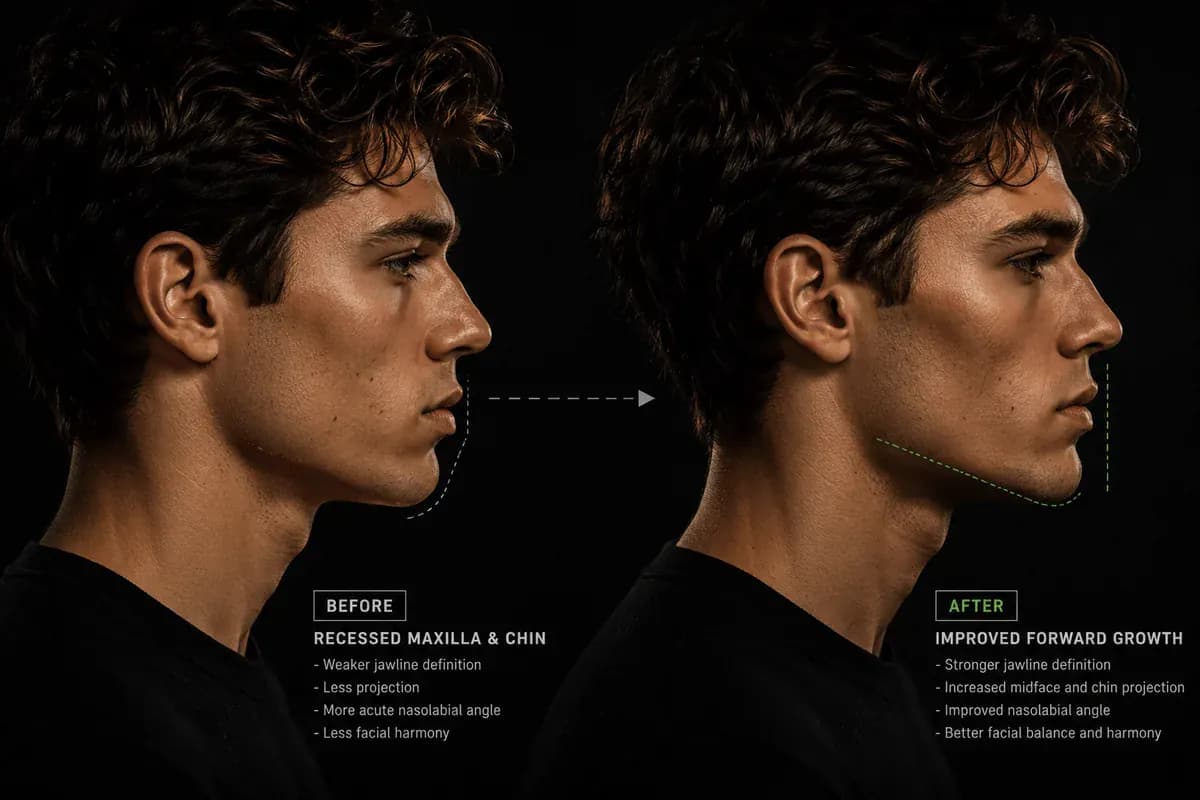
Mouth Breathing and Face Shape: What the Evidence Shows
The "mouth breathing face" is a real idea with a real research history, but most of what you see online stretches it well past the evidence. In children whose noses are blocked during growth (usually by enlarged adenoids or allergies), studies link long-term mouth breathing to a longer lower face, a jaw that grows more downward than forward, and narrower dental arches. In adults, whose facial bones have finished growing, there is no good evidence that switching to nose breathing reshapes your face.
So the useful question isn't "is mouth breathing ruining my jawline?" It's "why am I breathing through my mouth, and is that worth fixing for my health, sleep and comfort?" This guide splits the evidence into children and adults, covers the usual causes, and looks honestly at mouth taping, the trend most people land on first.
Short answer: Childhood mouth breathing from nasal obstruction is associated with measurable differences in facial growth, though the size of the effect and how much is cause versus correlation are still debated. In adults, bone doesn't change. What changes is soft tissue, lip dryness, posture and sleep quality, and those are the parts worth fixing.
The short answer on mouth breathing and face shape
Three points cover most of it:
- The link is mostly about growth. The research that underpins "mouth breathing face" was done on children and adolescents. The proposed mechanism (a blocked nose leads to an open mouth, a low tongue and a jaw that rotates downward as it grows) only has room to act while the face is still growing.
- The evidence is associational and moderate in quality. Mouth breathers and nose breathers differ on average, but the studies are mostly observational, and genetics, allergies and facial growth pattern all overlap. Some researchers still argue about which way the arrow points.
- Adults can't breathe their way into a new jaw. Once growth is done, nasal breathing is a health and comfort habit, not a bone-remodeling tool. That's the same conclusion our mewing guide reaches for tongue posture.
What's known in children ("adenoid face")
The term "adenoid face" (also called long face syndrome) describes a pattern clinicians have noticed for over a century: children with big adenoids who breathe through an open mouth, with a long lower face, a narrow upper arch, and a chin that sits back.
Where the research started. The modern debate traces back to Swedish orthodontist Sölve Linder-Aronson's 1970 study, which compared children with and without enlarged adenoids using breathing measurements and X-ray (cephalometric) analysis, and related adenoid size and breathing mode to characteristics of the facial skeleton and teeth.1 It became one of the most cited papers in the field and the basis for the idea that airway obstruction can steer facial growth.
What later studies found. A retrospective study in The Laryngoscope compared 116 child orthodontic patients: 55 with signs of nasal obstruction and mouth breathing, and 61 nose breathers.2 The mouth breathers on average had:
- A lower jaw rotated more backward and downward, with a steeper mandibular plane
- A higher palate and narrower upper and lower dental arches
- More posterior crossbite (49% vs 26%)
- More overjet (upper front teeth further ahead of the lower ones)
The authors concluded that nasal obstruction with mouth breathing during critical growth periods tends to produce a clockwise rotation of the growing jaw, a disproportionate increase in lower front face height, and a shorter back face height.2 In plain terms: a longer lower face and a less forward-looking chin. Note that this was a group of kids already in orthodontic treatment, which isn't a random sample, and it can't prove cause.
Does fixing the airway reverse it? A systematic review of 16 controlled studies (461 children aged roughly 4 to 14) looked at what happened after adenoids and/or tonsils were removed.3 After surgery, the lower jaw tended to grow more horizontally, the upper arch widened, and crossbites became less common. Upper jaw growth didn't change, and several other measures were inconsistent. The authors rated the studies as high risk of bias and said the variation between them prevents a clear conclusion.
The honest summary for kids: there's a consistent association between blocked noses in childhood and a longer, more vertical face pattern, and some sign that clearing the airway early nudges growth back. But the evidence is low to moderate in quality, the effects are measured in degrees and millimeters on X-rays, and genetics still sets most of the face. If you're a parent, the reason to act is the child's breathing and sleep, with facial growth as a secondary bonus.
What changes in adults (little bone, some soft tissue and posture)
This is where online content overreaches the most. Most "mouth breathing face change" posts and Reddit threads show adults claiming a new jawline after switching to nasal breathing. There is no direct research showing that.
Bone: essentially no change. The facial skeleton finishes most of its growth by the end of adolescence. The mechanism proposed for children (a growing jaw being steered by muscle and tongue position) doesn't have much to act on in an adult. One cross-sectional study of 77 adults aged 18 to 30 found that mouth breathers had narrower, deeper palates and worse nasal airflow than nose breathers.4 But the authors note this only shows an association at one point in time: it can't tell you whether the palate shape came from childhood breathing, from genetics, or whether the narrow palate itself contributes to the breathing problem. It certainly doesn't show that an adult's palate changed.
What can actually look different:
- Resting lip and jaw posture. If your mouth hangs open at rest, your lower face reads longer and your jawline softer, simply because the jaw is dropped. Closing your lips with teeth slightly apart changes how your face looks in that moment. This is posture, not structure, which is why it can change quickly.
- Head and neck posture. People with blocked noses often push the head forward to open the airway. Forward head posture blurs the jaw-to-neck line. The posture guide covers how to fix it.
- Lips and mouth. Breathing through the mouth, especially overnight, dries the lips and mouth. Chapped, cracked lips are one of the easiest visible negatives to fix; see the lip care guide. Cleveland Clinic also lists bad breath, dry mouth and drooling on the pillow as common signs.5
- Sleep quality and how tired you look. Mouth breathing at night often travels with snoring and, in some people, sleep apnea. Poor sleep shows up on your face as a tired, puffy look; the sleep and appearance guide explains what a good night does and doesn't change.
Mouth breathing face vs nose breathing face in adults: the visible difference between an adult who mouth-breathes and one who doesn't is mostly an open-mouth resting posture, dry lips, and a more tired look. Those are real and fixable. A recessed chin or a long midface in an adult is structural and won't change with breathing; if that's your concern, see the weak chin guide for the real options.
| Children (still growing) | Adults (growth finished) | |
|---|---|---|
| Jaw and palate bone | Associated with more vertical jaw growth and narrower arches (debated) | No evidence of change |
| Teeth and bite | Linked to crossbite and overjet | Existing bite stays; orthodontics needed to change it |
| Resting lip posture | Open mouth common | Open mouth common, changes quickly once breathing is easier |
| Lips and mouth | Dry lips, dry mouth | Dry, chapped lips; dry mouth; bad breath |
| Sleep | Snoring, possible sleep apnea, restless sleep | Snoring, possible sleep apnea, daytime tiredness |
| Who to see | Pediatrician, ENT, orthodontist | GP or ENT; dentist or orthodontist for bite |
Why people mouth-breathe
Very few people breathe through their mouths out of pure habit. Usually something makes the nose hard to use. Cleveland Clinic lists the common causes:5
- Nasal congestion from allergies, colds or chronic sinusitis. Allergic rhinitis (hay fever) is one of the most common reasons, in both kids and adults.
- Enlarged adenoids or tonsils, much more common in children.
- Deviated septum, where the wall between the nostrils leans to one side.
- Enlarged turbinates, structures inside the nose that swell with allergies or irritation.
- Nasal polyps.
- Sleep apnea.
A quick self-check. Try breathing through your nose with your lips closed for a few minutes. If that feels easy, your mouth breathing may be mostly a resting habit. If you feel short of air, one side is always blocked, or it gets much worse at night or in certain seasons, there's probably an underlying cause worth treating.
What helps and who to see
Treatment depends on the cause, which is why "just close your mouth" or "tape it shut" often fails.
For allergic congestion. The NHS recommends starting with a pharmacist: options include salt water (saline) nasal rinses, antihistamines and steroid nasal sprays, plus reducing exposure to your triggers.6 One important caution: over-the-counter decongestant sprays should not be used for more than 5 days, because longer use can make a blocked nose worse.6 See a GP if symptoms affect your sleep or daily life or don't respond to pharmacy treatment.
For structural blockage. If your nose stays blocked despite treating allergies, an ENT (ear, nose and throat) specialist can look for a deviated septum, enlarged turbinates or polyps. Cleveland Clinic lists septoplasty (straightening the septum) and turbinate reduction as surgical options for these, and adenoidectomy for children with enlarged adenoids.5 These are real operations with recovery time, decided with a surgeon for breathing reasons, not for looks.
For snoring or poor sleep. Loud snoring, gasping or stopping breathing at night, or feeling exhausted despite enough time in bed can point to obstructive sleep apnea. That needs a doctor and possibly a sleep study, not a lifestyle hack.
For children. If your child breathes through the mouth most of the time, snores, or sleeps restlessly, ask the pediatrician to check the nose and airway.5 Earlier is better, because that's the window when facial growth is still in play. An orthodontist can advise on bite and arch width.
Once your nose works: build the habit. With a clear nose, practice resting with lips closed, teeth slightly apart and tongue up on the palate. That's the useful, modest version of tongue posture described in the mewing guide. It won't move adult bone, but it helps your resting face look less slack.
Mouth taping: what the evidence says
Mouth taping (putting tape over your lips at night to force nose breathing) has gone viral, often with claims about better sleep and a sharper jaw. There's no research at all on the jaw claim. On sleep, the best summary so far is thin.
A 2025 systematic review in PLOS One found just 10 studies (around 213 to 233 participants), and rated every one of them poor quality.7 Two small studies found that taping reduced breathing interruptions in people with mild sleep apnea, and a few reported less snoring or mouth leak. Outside mild sleep apnea, the authors found the benefit minimal and not clinically significant, and concluded the evidence "does not support mouth taping" as a sound treatment for sleep-disordered breathing.7
They also flagged risks: several studies raised the possibility of suffocation in people with nasal obstruction, and of aspiration if someone vomits or has reflux with the mouth sealed. Many studies excluded people with blocked noses, so safety in exactly the group most likely to try it is poorly studied.7
The practical takeaway: taping your mouth treats the symptom, not the reason you mouth-breathe. If your nose is blocked, taping is the wrong move and potentially risky. If you suspect sleep apnea, it's not a substitute for proper diagnosis and treatment. If you still want to try it, talk to a doctor first.
Frequently Asked Questions
Can mouth breathing change your face shape as an adult? Not your bone structure. There's no evidence that adult facial bones change from breathing mode. What changes is soft-tissue posture: an open mouth at rest, a forward head, dry lips and a tired look, all of which improve once you breathe comfortably through your nose.
Is the mouth breathing face change in children reversible? Partly, and earlier is better. A systematic review found that removing enlarged adenoids or tonsils was followed by more horizontal jaw growth and wider dental arches, but the studies were low quality and results were inconsistent.3 Orthodontics can address bite and arch width.
What does a mouth breathing face vs nose breathing face look like? In children, studies describe a longer lower face, a jaw rotated downward, a higher palate and narrower arches in mouth breathers.2 These are average differences on X-rays, not a look you can diagnose from a selfie.
Is mouth breathing face structure on Reddit and TikTok accurate? Mostly no. Many before-and-after posts show adults who also lost weight, fixed their posture, closed their mouth for the photo or changed the camera angle. None of that is bone change.
Does mouth taping fix mouth breathing face development? No study has tested that. A 2025 review found poor-quality evidence for any sleep benefit outside mild sleep apnea and warned of risks if your nose is blocked.7
Should I see a doctor about mouth breathing? Yes if your nose is regularly blocked, you snore loudly, you wake up tired despite enough sleep, or your child mouth-breathes most of the time. Start with a GP or pediatrician; an ENT handles structural causes.
The bottom line
The mouth breathing face is a childhood story. In growing kids, a blocked nose is linked to a longer, more vertical face and narrower arches, and clearing the airway early may help, though the evidence is weaker than clinic blogs suggest. In adults, bone is set. What you can change is why you mouth-breathe (allergies, a deviated septum, sleep apnea), and with it your resting lip posture, dry lips and how rested you look. Treat the nose, not the face, and skip the tape unless a doctor says otherwise.
References
Footnotes
-
Linder-Aronson S. Adenoids. Their effect on mode of breathing and nasal airflow and their relationship to characteristics of the facial skeleton and the dentition. A biometric, rhino-manometric and cephalometro-radiographic study on children with and without adenoids. Acta Otolaryngologica Supplementum (1970);265:1-132. https://pubmed.ncbi.nlm.nih.gov/5272140/: The foundational study comparing children with and without enlarged adenoids on breathing, facial skeleton and teeth. ↩
-
Harari D, Redlich M, Miri S, Hamud T, Gross M. The effect of mouth breathing versus nasal breathing on dentofacial and craniofacial development in orthodontic patients. The Laryngoscope (2010);120(10):2089-2093. https://pubmed.ncbi.nlm.nih.gov/20824738/: In 116 child orthodontic patients, mouth breathers had more backward-downward jaw rotation, higher palates, narrower arches and more crossbite. ↩ ↩2 ↩3
-
Becking BE, Verweij JP, Kalf-Scholte SM, Valkenburg C, Bakker EWP, van Merkesteyn JPR. Impact of adenotonsillectomy on the dentofacial development of obstructed children: a systematic review and meta-analysis. European Journal of Orthodontics (2017);39(5):509-518. https://academic.oup.com/ejo/article/39/5/509/3097539: After adenoid or tonsil removal, jaw growth became more horizontal and arches widened, but the 16 studies had high risk of bias. ↩ ↩2
-
Trevisan ME, Bellinaso JH, Pacheco AB, Augé LB, Silva AMT, Corrêa ECR. Respiratory mode, nasal patency and palatine dimensions. CoDAS (2015);27(2). https://scielo.br/j/codas/a/VqcMPQKT787fFyVHj9TJLnr/?lang=en: Adult mouth breathers (18 to 30) had lower nasal airflow and narrower, deeper palates than nose breathers; cross-sectional, so no causation. ↩
-
Cleveland Clinic. Mouth Breathing. (Medically reviewed 2025). https://my.clevelandclinic.org/health/diseases/22734-mouth-breathing: Lists causes (deviated septum, enlarged adenoids, allergies, polyps), symptoms, and treatments including nasal sprays and septoplasty. ↩ ↩2 ↩3 ↩4
-
NHS. Allergic rhinitis. https://www.nhs.uk/conditions/allergic-rhinitis/: Recommends saline rinses, antihistamines and steroid sprays via a pharmacist, and warns not to use decongestant sprays for more than 5 days. ↩ ↩2
-
Rhee J, Iansavitchene A, Mannala S, Graham ME, Rotenberg B. Breaking social media fads and uncovering the safety and efficacy of mouth taping in patients with mouth breathing, sleep disordered breathing, or obstructive sleep apnea: A systematic review. PLOS One (2025);20(5):e0323643. https://pmc.ncbi.nlm.nih.gov/articles/PMC12094774: Ten poor-quality studies; small benefit only in mild sleep apnea, with risks for people with nasal obstruction. ↩ ↩2 ↩3 ↩4