Facial Structure & Harmony: How the Bones of Your Face Actually Work
Most facial-aesthetics content online picks one feature — the jaw, the cheekbones, the eye tilt — and treats it as the thing that makes a face. That's backwards. Faces are read as whole configurations, and the single most robust finding in facial-attractiveness research is that no lone measurement predicts attractiveness well. This guide covers the real structural anatomy of the male face, feature by feature, and is honest about how strong (or weak) the evidence is that any given feature "makes or breaks" a face — and about the narrow set of things you can actually change.
What this guide is and isn't. This explains anatomy and the current state of the research. It is not medical advice, and it deliberately avoids the confident "ideal ratios" that populate most looksmaxxing content, because those ratios are mostly aesthetic conventions, not validated predictors of attractiveness.
Contents
- The one honest summary of the evidence
- The framework: facial thirds
- Sexual dimorphism: masculine vs. feminine structure
- The lower third: jaw, gonial angle, ramus, chin
- The midface: cheekbones and midface length
- The upper third and brow
- The eye area and canthal tilt
- FWHR: the "power ratio," honestly
- What you can actually change
- Limits, surgery, and perspective
The one honest summary of the evidence
Because it's repeated below, here's the through-line up front:
- Attractiveness is driven more by "averageness" and overall harmony than by any single strong feature. When researchers separate the contributions of symmetry, averageness, and sexual dimorphism, averageness consistently predicts attractiveness, while masculinity in male faces often does not.1
- The idea that a more masculine male face is reliably more attractive is not well supported. Across cultures and studies the evidence is genuinely mixed — some populations show a preference, many show none, and some prefer slightly feminized male faces.21
- Bone structure is largely fixed in adulthood. What you can move is how visible your existing structure is: body fat, posture, grooming, skin, and soft tissue.
- Most dramatic "before/after" transformations are lighting, angle, leanness, and posture — not bone change.
Keep that in mind as you read the feature-by-feature anatomy below. Understanding the parts is useful; treating any one of them as a scorecard is not.
The framework: facial thirds
Clinicians and artists divide the face into three vertical sections, a convention that goes back to Renaissance "neoclassical canons":
- Upper third: hairline to brow.
- Middle third (midface): brow to the base of the nose.
- Lower third: base of the nose to the bottom of the chin.
In the classical canon these are roughly equal, and the lower third is often subdivided (upper lip ≈ one-third, lower lip and chin ≈ two-thirds). Useful caveat: these canons are descriptive conventions, not laws of attractiveness. Real attractive faces vary widely around them, and studies of these neoclassical proportions find they're frequently not met even in conventionally attractive people. Treat "balanced thirds" as a rough sense of proportion, not a target to hit to the millimetre.
The value of the framework is relational: a feature rarely reads as "too big" or "too small" on its own — it reads that way relative to the regions around it. A strong jaw can look overbearing under a delicate midface; a flat midface can make an average jaw look weak. Harmony is about the relationships, which is exactly why single-feature fixation misleads.
Sexual dimorphism: masculine vs. feminine structure
Sexual dimorphism just means the average structural differences between male and female faces, most of which are driven by pubertal hormone exposure.
Features that trend masculine (on average):
- A larger, wider mandible and more defined jaw angles
- A more prominent brow ridge (supraorbital ridge)
- Longer, broader midface and more laterally set cheekbones
- A larger chin and generally larger nose
- Thicker facial skin and, post-puberty, facial hair
Features that trend feminine (on average):
- Softer, rounder contours and a smaller jaw and chin
- Higher, more arched brows with more visible upper-eyelid space
- Larger-appearing eyes relative to the face
- Fuller cheeks
These are population averages with enormous overlap, not rules — plenty of attractive faces sit far from the average for their sex.
Here's the part most content gets wrong: it's widely assumed that "more masculine = more attractive for men." The research does not clearly support that. When masculinity is isolated as a variable, it often fails to predict male attractiveness, and averageness and even slight femininity frequently predict it better.12 Cross-cultural work finds women prefer more masculine male faces in some populations and not others.2 And the once-popular claim that women's masculinity preference tracks their menstrual-cycle hormones failed to replicate in the largest study to date.3 So: masculine facial structure is real and describable, but "maximize masculinity" is not evidence-based advice.
The lower third: jaw, gonial angle, ramus, chin
The lower third does a lot of visual work — it frames the jaw-to-neck transition and contributes strongly to perceived masculinity. Its main structural components:
The mandible (jawbone) and jaw width. The horizontal body of the mandible sets the width and the "frame" of the lower face. Wider, more defined mandibles read as more masculine.
The gonial angle. This is the angle at the gonion — the back corner of the jaw where the horizontal body meets the vertical ramus. A sharper (smaller) gonial angle produces a more angular, defined jaw–ramus transition; a more open (larger) angle produces a softer, rounder line. Neither is "better" in the abstract; sharper angles simply read as more angular/masculine.
Ramus height. The ramus is the vertical part of the mandible connecting the jaw to the skull. A taller ramus lengthens the back of the jawline and tends to accompany sharper-looking angles; a short ramus compresses the lower face. Ramus height and gonial angle interact — the same angle looks more defined on a taller ramus.
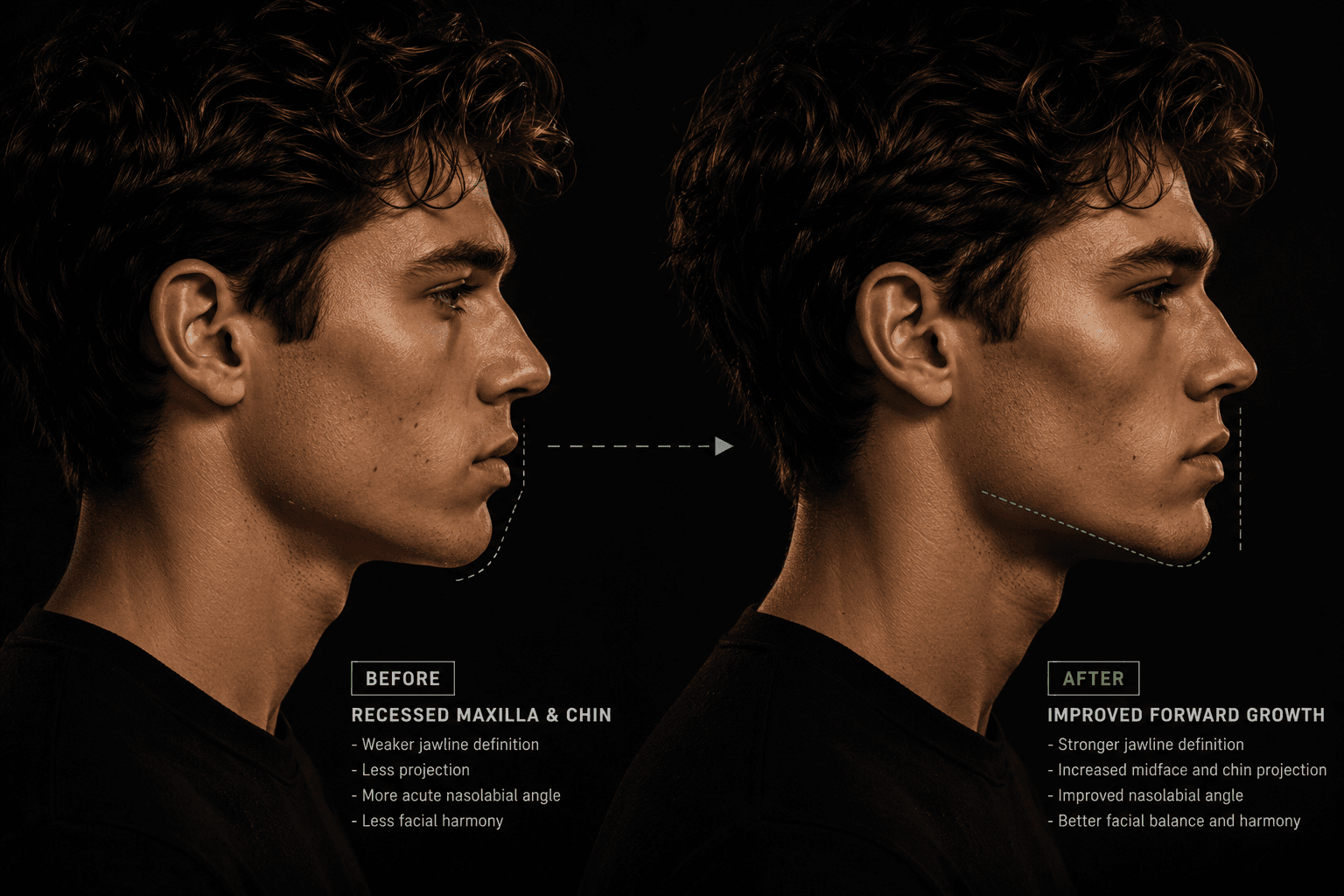
Chin projection. The chin (formed by the mental protuberance of the mandible) anchors the profile. Its job is proportional projection: a chin that sits well back of the lip–nose line makes the profile look recessed; an over-projected chin looks jutting. The goal isn't maximum projection, it's a smooth nose–lip–chin transition and a clean cervicomental angle (the angle between the underside of the jaw and the neck), which is what makes the jaw separate cleanly from the neck.
The honest note on all four: these are skeletal. In adults you cannot change the bone through exercise, "mewing," or chewing gum — see the mewing guide for why the adult-bone claims don't hold up. What changes their appearance is covered in What you can actually change.
The midface: cheekbones and midface length
Cheekbones (the zygomatic complex). The zygomatic bones and arches define the widest part of many faces and set how light falls across the face. Laterally projecting, well-supported cheekbones create the classic "structured" midface and give the eye area more support from below. Cheekbone prominence is one of the more visually impactful structural features — but, again, it's the relationship to the rest of the face (not raw height) that reads as harmonious.
Midface length. This is roughly the vertical distance from the lower eyelid to the base of the nose. A shorter ("compact") midface tends to make cheekbones read as more prominent and the face as more concentrated; a longer midface can make the face read as elongated, especially if the lower third is also long. There's a genuine aesthetic tendency here, but note two things: (1) "compact = youthful/better" is an aesthetic generalization, not a hard rule, and (2) midface length is set by the maxilla and surrounding bone and isn't adjustable in adults without surgery.
The maxilla (upper jaw) is the keystone of the midface: its forward growth supports the cheekbones, influences the nose and the position of the eyes, and affects how "forward-grown" the whole midface looks. Maxillary growth is largely complete in adolescence.
The upper third and brow
The upper third gets less attention but frames everything below it. The key structure is the supraorbital (brow) ridge. A more developed brow ridge sets the brows lower and closer to the eyes, deepens the set of the eyes, and reads as more masculine and "intense." Higher, more arched brows with more visible eyelid read as softer and more open.
Two practical points that matter more than the bone here:
- Brow position vs. brow grooming. You can't move the ridge, but eyebrow shape and grooming meaningfully change how the brow area frames the eyes (see What you can change).
- Forehead and hairline are part of this third, which is why hairline recession changes perceived facial proportions — covered in the hair guide.
The eye area and canthal tilt
Humans fixate on the eyes first, so the periorbital area carries disproportionate weight in first impressions. The structural pieces:
Canthal tilt is the angle of a line drawn from the inner corner (medial canthus) to the outer corner (lateral canthus) of the eye:
- Positive tilt: outer corner sits higher than inner. Reads as alert, youthful, defined.
- Neutral tilt: corners roughly level. Extremely common and perfectly balanced with the right supporting features.
- Negative tilt: outer corner sits lower. Can read as tired or downturned — but this depends heavily on the surrounding cheekbone and lower-lid support, and plenty of attractive faces have neutral-to-slightly-negative tilt.
Tilt is set by the orbital bone shape and the position of the lateral canthal tendon, which anchors the outer eyelid. It's largely fixed; the aesthetic-medicine procedures that change it (canthoplasty/"almond eye" surgery) are real surgeries with real risks, not casual tweaks.
Supporting structures matter as much as the tilt itself: orbital depth (how deep-set the eyes are), cheekbone/infraorbital support (which resists the "tired, hollow" look and scleral show), and upper-eyelid exposure. The online "hunter eyes" concept is just shorthand for a bundle of these — some positive tilt, deep-set eyes, a strong brow, and good cheekbone support — but it's a description of a look, not a target you can build in an adult face.
What you can influence around the eyes — sleep, fluid retention, skin quality, and brow grooming — is in the next section and in the dedicated dark-circles guide.
FWHR: the "power ratio," honestly
The facial width-to-height ratio (bizygomatic width ÷ upper-face height) is the most-researched single facial metric, and it's worth understanding because it's so often overstated.
What the meta-analyses actually show:
- FWHR is slightly larger in men than women, and it tracks masculinity judgements and body mass.45
- Its links to aggression and dominance are real but small, and several studies have failed to replicate them — this is an actively contested literature, not a settled fact.45
- Crucially for a looks context: larger FWHR is judged more dominant/threatening but less attractive, especially by women.5
So the popular framing of FWHR as a "power ratio" you should want to maximize is doubly misleading: the behavioral links are weak and disputed, and to the extent FWHR does anything to attractiveness ratings, a high ratio tends to lower them. It's a good example of why single-metric thinking fails.
What you can actually change
Your bones are set, but the visible output of your face is not just bone. In rough order of impact:
1. Body fat. This is the highest-leverage lever for facial definition, full stop. Facial fat blurs the jaw–neck transition, softens cheekbones, and fills the space under the chin; getting leaner reveals whatever structure you have. This is why the same person looks structurally different at 25% vs. 12% body fat. Details and realistic ranges are in the body fat & facial definition guide.
2. Posture. Forward-head posture blurs the jawline, shortens the neck, and can create a "double chin" at low body fat. Correcting it is one of the fastest visible improvements available and it's genuinely changeable — see the posture guide.
3. Skin quality. Clear, healthy skin changes how "sharp" a face reads more than most people expect. See skincare and acne.
4. Grooming and framing. Eyebrow shape frames the eyes and can subtly rebalance the upper face; a haircut chosen for your face shape changes apparent proportions; well-maintained facial hair can add density and definition to the lower third (beards can visually reinforce the jaw, but an unkempt beard obscures it). None of this changes bone — all of it changes the read.
5. Sleep, hydration, and sodium/alcohol control. These drive short-term facial puffiness and under-eye appearance. See debloating your face.
6. Soft-tissue and skin treatments (optional, evidence-varied). Retinoids for skin texture have good evidence; more aggressive options (microneedling, peels, lasers, fillers) range from modest to significant and belong in a clinician conversation, not a DIY routine.
Limits, surgery, and perspective
Two honest closing points.
On surgery. Procedures that genuinely change bone or its coverage — orthognathic (jaw) surgery, genioplasty, implants, canthoplasty, buccal-fat removal — are real and can be transformative, but they are actual surgery: cost, downtime, and non-trivial risk. They're appropriate for significant functional or structural concerns, evaluated by a qualified surgeon — not something to pursue off a ratio you measured from a selfie.
On perspective. The research keeps landing on the same place: harmony and averageness beat extreme single features, masculinity is not the reliable attractiveness lever the internet claims, and the changeable levers (leanness, posture, skin, grooming, sleep) are exactly the boring ones. Understanding your bone structure is genuinely useful for choosing a haircut, a beard style, or whether a given concern is worth a clinician's opinion. It is not useful as a scorecard, and treating it that way is a reliable route to dissatisfaction with a face that's probably fine.
References
Footnotes
-
Lee AJ, et al. Further evidence that averageness and femininity, rather than symmetry and masculinity, predict facial attractiveness judgments. Scientific Reports (2025). https://www.nature.com/articles/s41598-025-86974-0 ↩ ↩2 ↩3
-
Kleisner K, et al. Facial attractiveness and preference of sexual dimorphism: A comparison across five populations. Evolutionary Human Sciences / Cambridge (2021). https://www.ncbi.nlm.nih.gov/pmc/articles/PMC10427909/ ↩ ↩2 ↩3
-
Jones BC, et al. No Compelling Evidence that Preferences for Facial Masculinity Track Changes in Women's Hormonal Status. Psychological Science (2018). https://www.ncbi.nlm.nih.gov/pmc/articles/PMC6099988/ ↩
-
Haselhuhn MP, Ormiston ME, Wong EM. Men's Facial Width-to-Height Ratio Predicts Aggression: A Meta-Analysis. PLOS ONE (2015). https://journals.plos.org/plosone/article?id=10.1371/journal.pone.0122637 ↩ ↩2
-
Geniole SN, et al. Evidence from Meta-Analyses of the Facial Width-to-Height Ratio as an Evolved Cue of Threat. PLOS ONE (2015). https://www.ncbi.nlm.nih.gov/pmc/articles/PMC4504483/ ↩ ↩2 ↩3