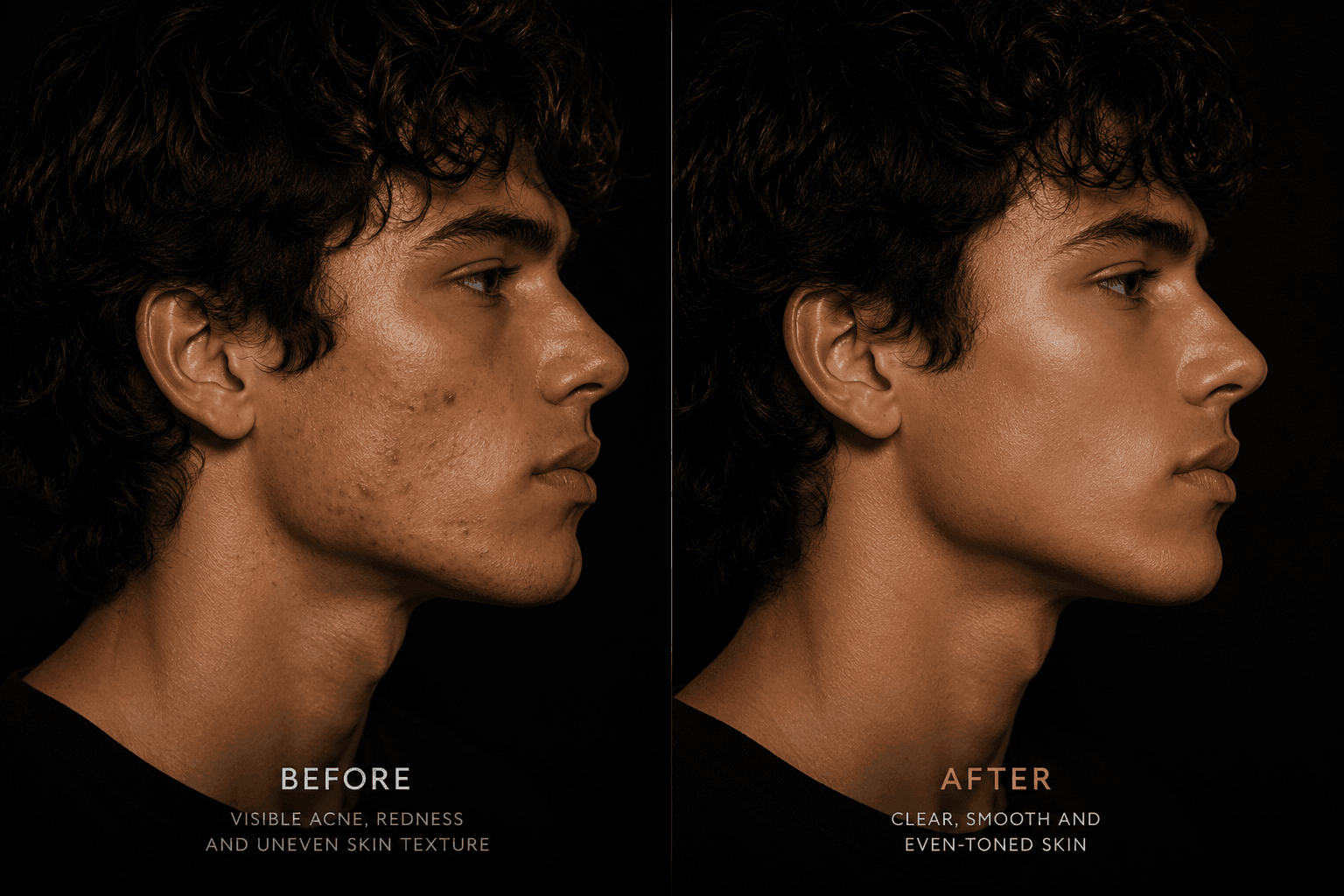
A Science-Based Skincare Routine (That Isn't Complicated)
Good skincare is short, cheap, and consistent. A handful of ingredients have real clinical evidence; almost everything else is marketing. This guide covers the routine worth doing and why each step is there. If your main concern is acne specifically, read the dedicated acne guide — this page is the general routine and skips the acne treatment ladder covered there.
The core routine
Five steps, only two of which are non-negotiable for most people (a moisturizer/cleanser as tolerated, and sunscreen):
- Cleanser — morning and night, gentle.
- A retinoid — at night, the single highest-evidence "active" for skin quality.
- Moisturizer — daily, to support the skin barrier.
- Sunscreen — daily, the highest-evidence anti-aging step there is.
- (Optional) an exfoliating acid or vitamin C — useful for specific goals, not essential.
The principle throughout: consistency beats sophistication. A simple routine done daily for a year beats an elaborate one done sporadically.
Step 1: Cleanser
Cleansing removes oil, sweat, sunscreen, and debris. Twice daily is plenty; over-washing strips the skin and can trigger rebound oiliness and irritation. Use a gentle, non-stripping cleanser (gel or cream depending on how oily your skin runs). You do not need a harsh "squeaky clean" feeling — that usually means you've over-cleansed.
Step 2: A retinoid (the highest-evidence active)
If you do one "active," make it a retinoid. Topical tretinoin (a prescription retinoid) has the strongest evidence in dermatology: randomized controlled trials consistently show it improves the clinical signs of photoaging — fine wrinkling, mottled pigmentation, and rough texture — by regulating skin-cell turnover and stimulating new collagen.12 Over-the-counter retinol is a milder relative that works by the same pathway more gently.
How to use it without wrecking your skin:
- Start 2–3 nights a week, a pea-sized amount for the whole face, and build up as tolerated.
- Expect an adjustment period (dryness, mild peeling, sometimes a temporary purge). Buffer with moisturizer; don't quit at the first flaking.
- Retinoids increase sun sensitivity, which makes daily sunscreen (below) mandatory.
- Skip during pregnancy (topical retinoids are generally avoided then — check with a doctor).
Give it 12+ weeks before judging results; collagen changes are slow.
Step 3: Moisturizer
Moisturizer supports the skin barrier and offsets the dryness from actives. Match it to your skin: lighter gel-creams for oily skin, richer creams for dry skin. "Non-comedogenic" (won't clog pores) is a reasonable thing to look for if you're breakout-prone. This step is simple and doesn't need to be expensive — barrier ingredients like ceramides and glycerin are in plenty of budget products.
Step 4: Sunscreen (the best anti-aging step, full stop)
This is the highest-evidence anti-aging intervention available, and it's not close. In a landmark randomized controlled trial, adults assigned to daily sunscreen use showed 24% less skin aging over 4.5 years than those using it only when they felt like it.3 UV exposure drives most visible aging — wrinkles, pigmentation, loss of firmness — so daily protection does more for how your skin ages than any serum.
Practical version: a broad-spectrum SPF 30+ every morning, reapplied if you're outdoors for extended periods. Any formula you'll actually wear daily beats a "better" one you skip.
Step 5 (optional): acids and vitamin C
- Chemical exfoliants (BHA/AHA). Salicylic acid (BHA) suits oily/acne-prone skin; glycolic/lactic acid (AHA) helps texture and mild pigmentation. Useful 1–3× a week, but optional — and don't stack aggressive exfoliation on top of a retinoid nightly, or you'll irritate your skin. Alternate instead.
- Vitamin C. An antioxidant serum can support brightness and works alongside sunscreen. Reasonable to add if you have a pigmentation goal; not essential.
Common problems, briefly
- Acne (mild to severe): handled properly in the acne guide — that's where the benzoyl peroxide / adapalene / prescription ladder lives.
- Dryness or flaking from actives: scale back frequency, buffer with moisturizer, and rebuild slowly.
- Persistent redness/sensitivity: simplify to cleanser + moisturizer + sunscreen and reintroduce actives one at a time.
- Dark spots / uneven tone: sunscreen first (it prevents them worsening), then a retinoid and/or vitamin C; stubborn cases are a dermatology conversation.
What to skip
Most 10-step routines, "pore-shrinking" gimmicks, and expensive serums with no active ingredient add cost, not results. The evidence clusters around retinoids, sunscreen, and a decent barrier moisturizer — build around those and add extras only for a specific goal.
The honest bottom line
A good routine is cheap and boring: cleanse, use a retinoid at night, moisturize, and wear sunscreen every day. Do that consistently and you'll get the large majority of the achievable benefit. Everything else is optimization at the margins.
References
Footnotes
-
Ho D, et al. Topical tretinoin for treating photoaging: A systematic review of randomized controlled trials. Int J Womens Dermatol (2022). https://pubmed.ncbi.nlm.nih.gov/35620028/ ↩
-
An Updated Review of Topical Tretinoin in Dermatology: From Acne and Photoaging to Skin Cancer. (RCT and systematic-review evidence for photoaging.) https://www.ncbi.nlm.nih.gov/pmc/articles/PMC12653878/ ↩
-
Hughes MCB, Williams GM, Baker P, Green AC. Sunscreen and Prevention of Skin Aging: A Randomized Trial. Annals of Internal Medicine (2013);158(11):781–790. https://www.acpjournals.org/doi/10.7326/0003-4819-158-11-201306040-00002 ↩