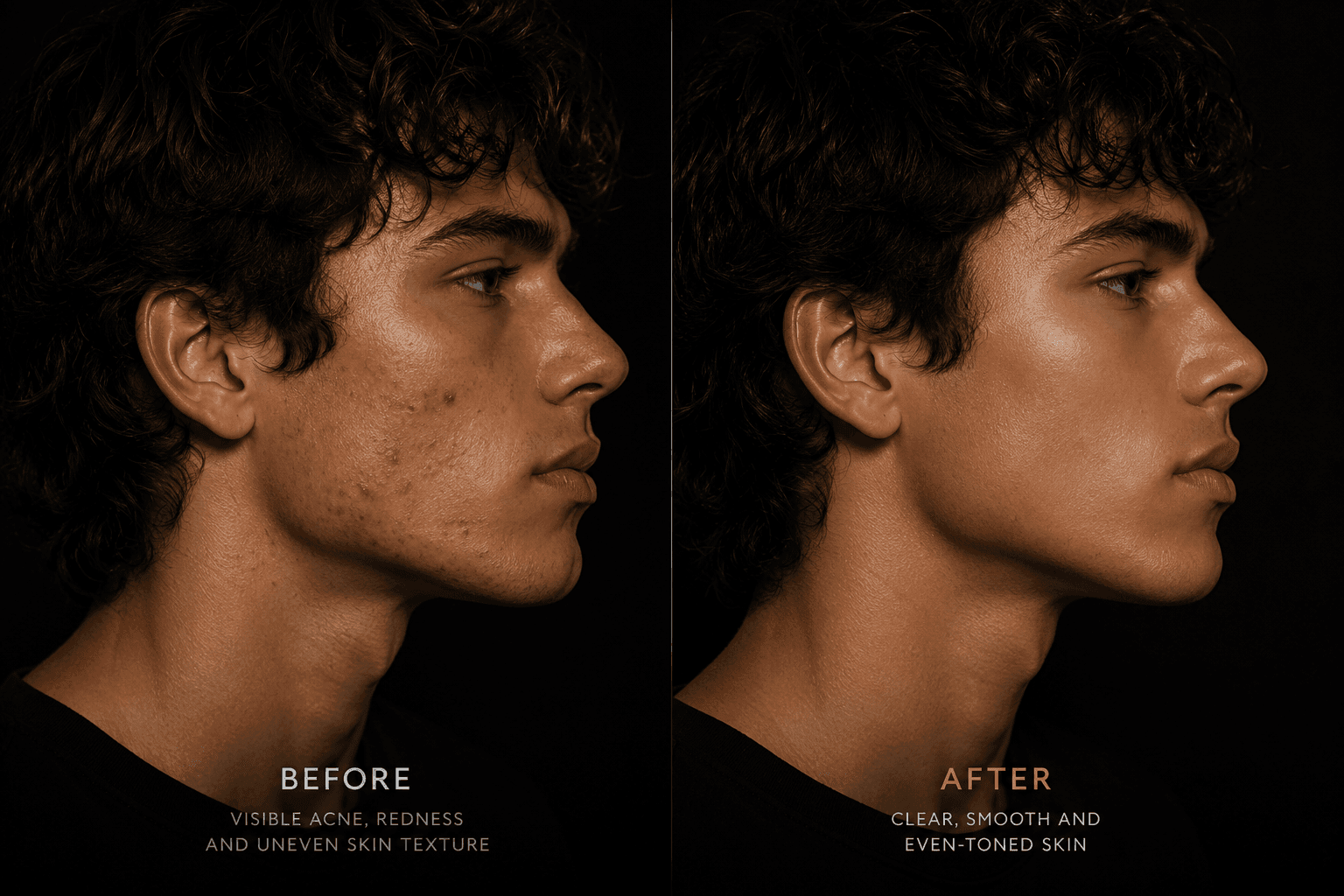
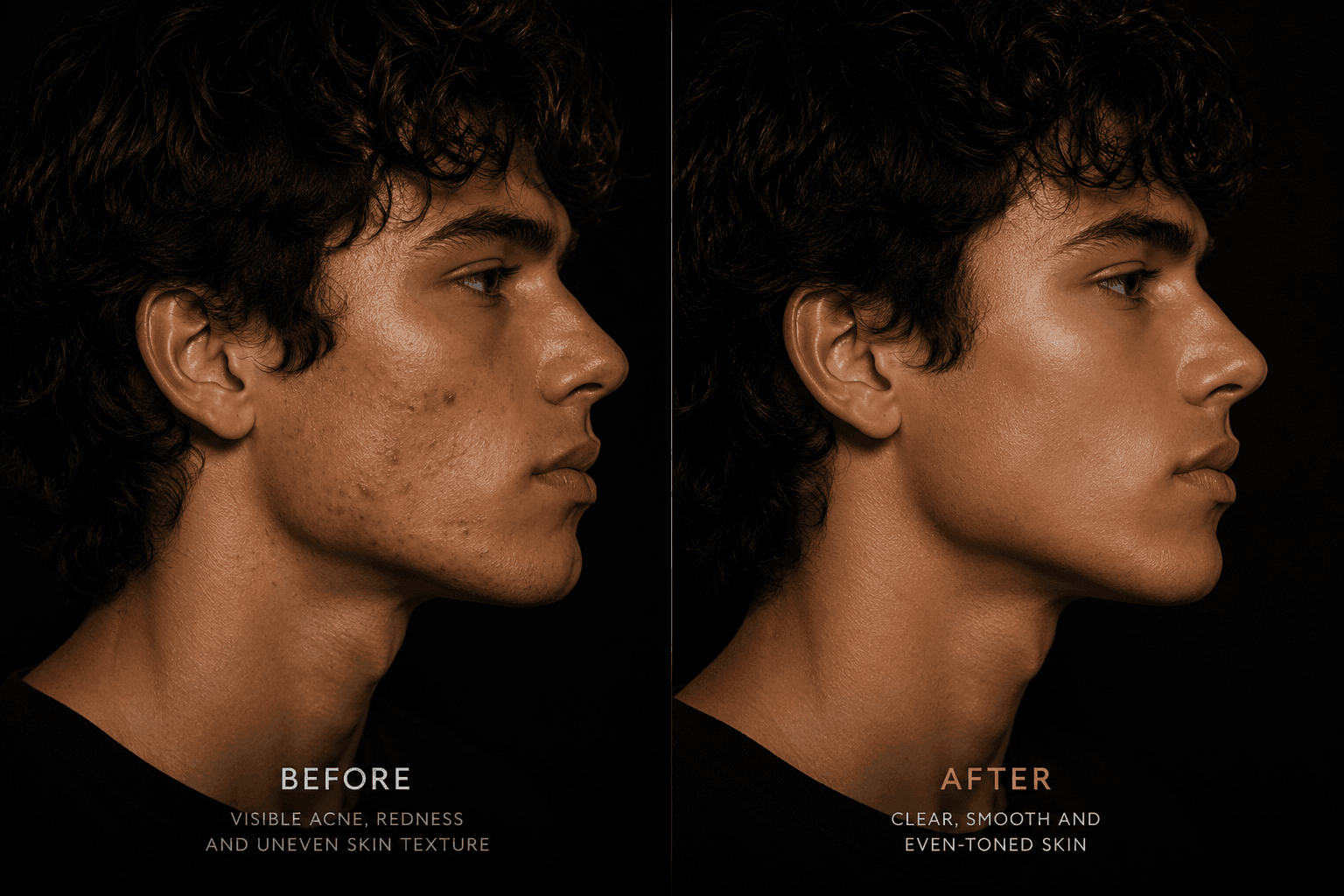
Sun Protection: The Highest-Leverage Step for Preventing Skin Aging and Uneven Tone
If you only ever adopt one skincare habit, make it daily sun protection. It's the single most evidence-backed thing you can do for how your skin looks in ten and twenty years — better than any serum, and it does double duty: it prevents both the wrinkling-and-sagging kind of aging and the sun spots, blotchiness, and uneven tone that make skin look older and less healthy. Yet it's the step most people skip, men especially. And there's a particular irony worth naming up front: people who want clearer, more even, brighter-looking skin often sabotage exactly that goal by neglecting sun protection.
The one-paragraph case
Most of the facial aging you can see is not the calendar — it's the sun. Dermatology research and organizations like the Skin Cancer Foundation attribute roughly 80% of visible facial aging to UV exposure rather than chronological aging.1 The most striking demonstration is a real case published in the New England Journal of Medicine: a truck driver whose left side faced the window for 28 years developed deep wrinkles, sagging, and thickened skin on that side while his right side looked decades younger — same man, same genetics, the only difference being cumulative UV through the glass.2 And it's preventable: in a randomized controlled trial, adults who used broad-spectrum sunscreen daily showed about 24% less skin aging after 4.5 years than those who used it only when they felt like it — the daily group showed no detectable increase in aging at all.3 No cream you apply after the damage matches preventing it in the first place.
Why UV ages skin
Sunlight reaches your skin as two relevant bands of ultraviolet:
- UVA penetrates deep into the dermis, where it breaks down collagen and elastin — the proteins that keep skin firm and springy. This is the wrinkling, sagging, "leathery" kind of aging. UVA passes through window glass and clouds and is present all year, which is why sun damage accumulates even when you're not at the beach.
- UVB hits the surface, causes sunburn, and is the main driver of the DNA damage behind skin cancer. It's largely blocked by glass.
You want protection against both — "broad-spectrum" — because between them they produce the whole picture of photoaging: fine lines and wrinkles, loss of firmness, thickened or rough texture, and the pigment changes we'll get to next.
The part people chasing "clearer skin" miss
Here's the point that matters if your goal is an even, bright complexion rather than wrinkle prevention. UV stimulates the skin's pigment cells to produce more melanin — that's the tan — but it does so unevenly, which over time produces sun spots (solar lentigines), blotchy patches, and overall uneven tone, and it triggers or worsens melasma and post-inflammatory hyperpigmentation (the dark marks left behind by acne or irritation).
So sun protection isn't optional for tone goals — it's the foundation the entire thing rests on. Sunscreen doesn't erase existing pigmentation on its own, but it prevents new pigment from forming and stops existing patches from darkening, which is what allows any brightening or evening treatment to actually hold. Dermatologists see the failure mode constantly: people do everything to fade pigmentation, skip diligent sun protection, and watch it relapse within weeks. Trying to lighten or even your skin without protecting it from the sun is self-defeating.
One nuance that's easy to miss, and matters most for medium-to-deep skin tones: standard SPF ratings measure UVB protection only, and visible light — the ordinary light you can see — also drives pigmentation, especially in Fitzpatrick skin types III–VI. Regular sunscreen doesn't block it. The evidence-based fix is a tinted sunscreen containing iron oxides, which do block visible light; reviews find these prevent pigmentation relapse better than untinted sunscreen and can even improve the results of depigmenting treatments.4 If pigmentation or melasma is your concern, a tinted iron-oxide sunscreen is the specific tool to reach for.
A brief responsible note: some aggressive skin-bleaching products sold online contain unsafe or unregulated ingredients, and prescription-strength lightening agents belong under a professional's supervision. The safe, legitimate goal here is even, healthy, clear skin — and daily sun protection is the part of that anyone can start today without risk.
Why men especially need to hear this
Sun protection has been coded as a women's concern, and the numbers show it. Men are far less likely to use sunscreen — one study found roughly 18% of men regularly protect their face with sunscreen versus about 43% of women — and they're less likely to wear hats, seek shade, or check their skin.5 That neglect has real consequences: from age 50 on, men develop melanoma at higher rates than women, and men are roughly twice as likely to die from it, in part because of less protection, less screening, and later detection.1 Add that men are more likely to work or play outdoors for long stretches, and the cumulative UV load adds up quietly for years before anything shows.
None of this is "for women." If anything, the higher stakes make daily protection more worthwhile for men, not less.
It's not just cosmetic
Beyond looks, this is the highest-value cancer-prevention habit for your skin. Regular daily use of an SPF 15 or higher sunscreen is associated with roughly a 50% reduction in melanoma risk, and it reduces other skin cancers too.1 The appearance benefits and the health benefits come from the exact same habit — which makes it an easy call.
How to actually protect your skin
The habit is simple; the consistency is the hard part.
- Wear broad-spectrum SPF 30+ every day. SPF 30 blocks about 97% of UVB, SPF 50 about 98% — either is fine; what matters is that it's broad-spectrum and that you actually wear it. Daily means daily: UVA comes through windows and clouds year-round, so overcast days and desk jobs near windows still count.
- Apply enough, and reapply. Most people apply far less than the amount sunscreens are tested at, which quietly cuts real-world protection well below the label number — so be generous. Reapply every two hours when you're outdoors, and after swimming or heavy sweating.
- Pick pigmentation protection if you need it. For hyperpigmentation-prone or medium-to-deep skin, choose a tinted, iron-oxide sunscreen for visible-light coverage.
- Mineral or chemical — pick what you'll wear. Mineral filters (zinc oxide, titanium dioxide) sit on top and suit sensitive skin; chemical filters absorb UV and tend to feel lighter. Both work. The best sunscreen is the one you'll use every day, so texture and finish matter more than the debate.
- Don't rely on sunscreen alone. A brimmed hat, UV-protective clothing, sunglasses, shade, and avoiding peak midday sun all stack on top. And skip tanning beds entirely — they're concentrated UVA and a direct route to both aging and cancer.
- Lips count too. They have little natural sun defense and are a common site of sun damage — see the lip care guide for why an SPF lip balm belongs in the routine.
Sun protection is the foundation; the rest of a good routine — a retinoid for repair, vitamin C as an antioxidant — builds on top of it, as covered in the skincare guide. If your interest in tone comes from the tanning-versus-natural-color question specifically, the coloring guide covers why a dietary "golden" glow is a safer route to warmth than UV.
What sun protection can and can't do
Honest expectations:
- It is preventive. It slows and prevents future damage and keeps pigmentation from worsening; it does not erase wrinkles or sun spots you already have. Reversing established damage is the territory of retinoids, professional treatments, and lasers — a separate conversation, and one for a dermatologist.
- The payoff is long-term and mostly invisible — you're buying the absence of future damage, which never announces itself. That's exactly why it's easy to skip and worth the discipline.
- It can't replace skin checks. A new spot or mole, or one that's changing, growing, or not healing, should be seen by a doctor — that's how skin cancers are caught early, when they're highly treatable. This guide is general information, not a diagnosis.
The bottom line
Sun protection is the rare habit that's both the best anti-aging step and a serious health measure, and it's the non-negotiable foundation for even, clear skin — without it, hyperpigmentation builds and any brightening effort unravels. Wear a broad-spectrum SPF 30+ every day, apply enough and reapply, reach for a tinted iron-oxide formula if pigmentation is your concern, and back it up with hats and shade. It's the highest-leverage, lowest-effort thing you can do for your skin — and the one men most often skip. Start now; the version of your skin that benefits is the one a decade from today.
References
Footnotes
-
Skin Cancer Foundation. Skin Cancer Facts & Statistics. https://www.skincancer.org/skin-cancer-information/skin-cancer-facts/ — an estimated 80% of visible skin aging is attributed to the sun; daily SPF 15+ use is associated with ~50% lower melanoma risk and ~24% less skin aging; men have higher melanoma incidence and mortality from mid-life on. ↩ ↩2 ↩3
-
Gordon JR, Brieva JC. Unilateral Dermatoheliosis. New England Journal of Medicine (2012);366:e25. https://www.nejm.org/doi/full/10.1056/NEJMicm1104059 — a case of severe photoaging on one side of the face from 28 years of occupational UVA exposure through a vehicle window. ↩
-
Hughes MCB, Williams GM, Baker P, Green AC. Sunscreen and prevention of skin aging: a randomized trial. Annals of Internal Medicine (2013);158(11):781–790. https://pubmed.ncbi.nlm.nih.gov/23732711/ — daily broad-spectrum sunscreen use produced ~24% less photoaging than discretionary use over 4.5 years. ↩
-
He M, Chen X, Jin S, Zhang C. Visible Light Protection: An Updated Review of Tinted Sunscreens. Photodermatology, Photoimmunology & Photomedicine (2025). https://doi.org/10.1111/phpp.70033 — iron-oxide tinted sunscreens block visible light (which UV filters don't), reducing melasma/hyperpigmentation and relapse, particularly in darker skin types. ↩
-
Sá Fortes Rodrigues MA, et al. Evaluation of how facial sunscreens are applied by the population. (2025). https://www.ncbi.nlm.nih.gov/pmc/articles/PMC11745782/ — men apply sunscreen to less of the face and use it less regularly than women; related surveys report a large majority of men do not use sunscreen daily. ↩