Hollow Cheeks and the Ogee Curve: What Actually Creates Them
Hollow cheeks — the sculpted concavity below the cheekbone — and the "ogee curve" are among the most requested facial looks. They depend on a specific interaction of bone, fat, and skin, and most of that is genetic or age-related rather than trainable. This guide explains what actually creates the look, what you can realistically influence, and gives an honest account of the cosmetic options, including one popular procedure that can look great at 25 and badly age you by 40.
Not medical advice. Procedures and medications mentioned here require a qualified clinician. This is an educational overview to help you understand the trade-offs, not a recommendation to pursue any of them.
What the ogee curve and hollow cheeks actually are
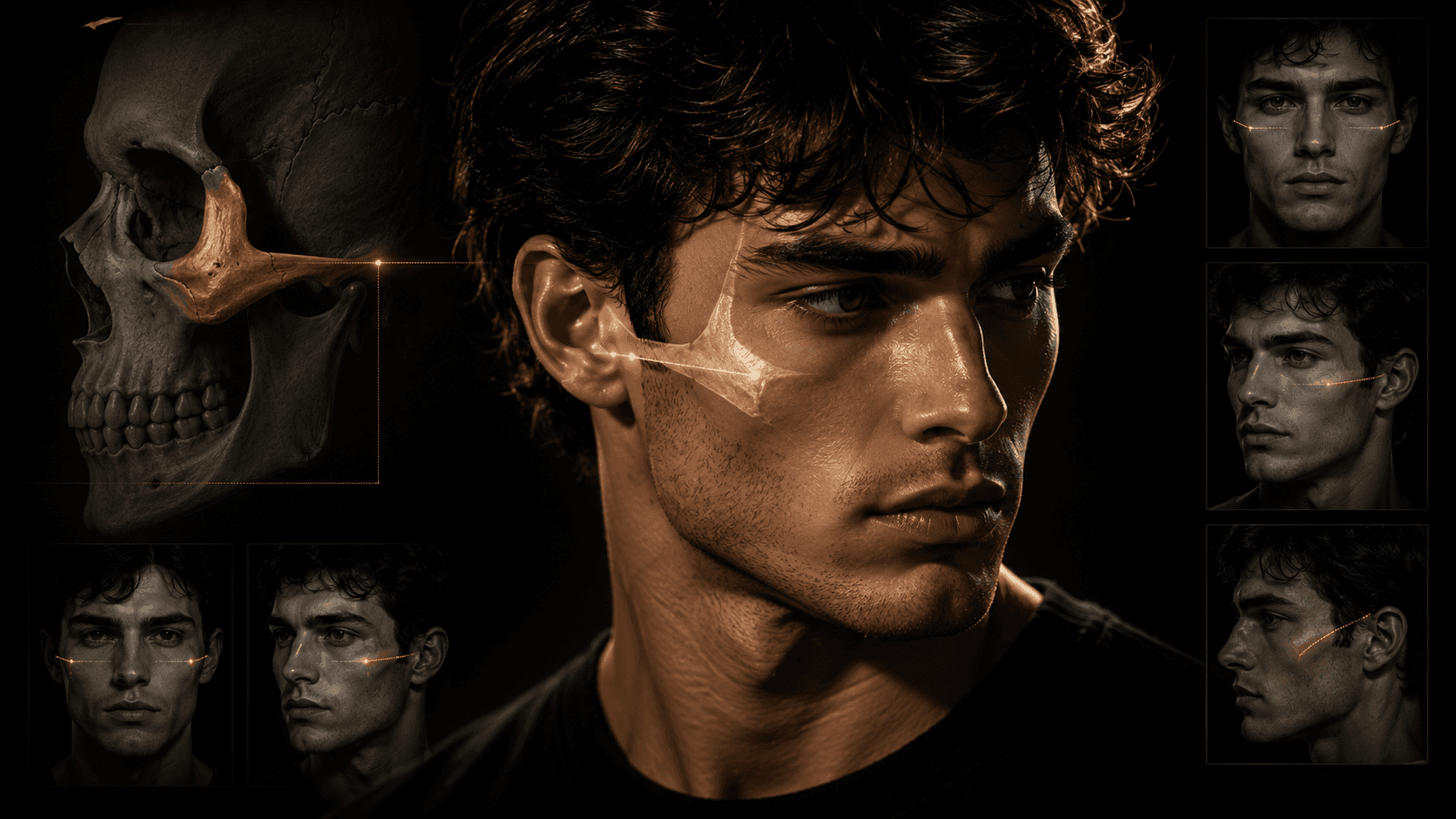
The ogee curve is a term borrowed from architecture for an S-shaped contour: viewed from a three-quarter angle, an attractive face often shows a smooth convex-to-concave curve running from the cheekbone out and then in toward the lower face. Hollow cheeks are the concave part — the slight sinking of the area between the cheekbone and the jaw.
Three things create this look:
- Bone: prominent, well-positioned cheekbones (the zygomatic complex) and good maxillary (upper-jaw) support. This is the skeletal foundation and it's fixed in adulthood.
- Fat: how much fat sits in the cheeks — especially the buccal fat pad, a discrete pad of fat deep in the lower cheek — plus overall subcutaneous facial fat.
- Skin: firmness and thickness, which change with age.
The people with naturally hollow cheeks usually have some combination of prominent cheekbones, a smaller buccal fat pad, and lower facial fat. Most of that is genetic.
What determines it — and what's fixed
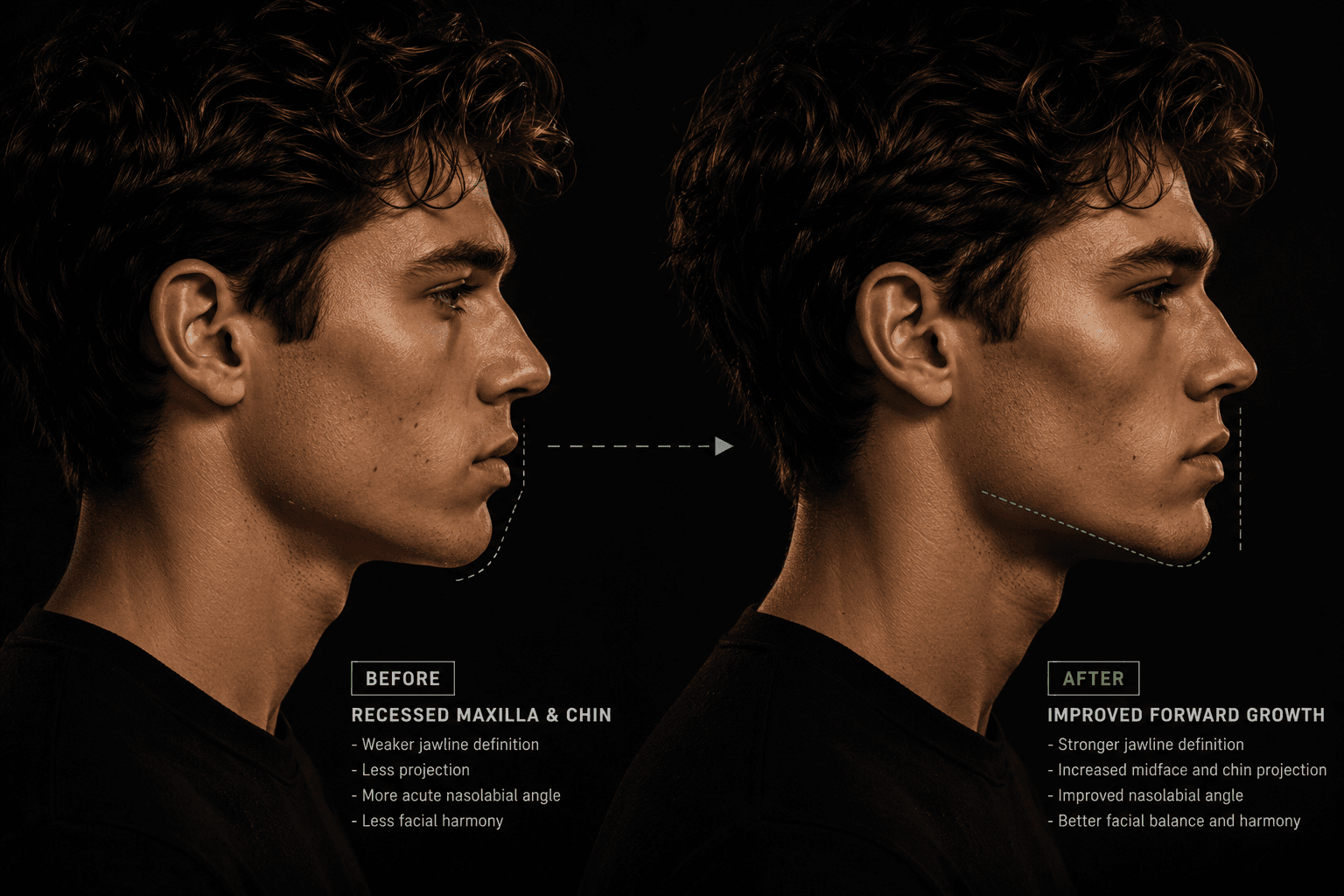
Bone structure is genetic and set in adulthood. You cannot grow your cheekbones or push your maxilla forward as an adult through any exercise, "mewing," or gum-chewing routine — the honest evidence on that is covered in the mewing & facial growth guide and the facial structure guide. Orthodontic and surgical palate-expansion procedures (RPE, SARPE, MARPE) and jaw surgery can change bone, but they are clinical interventions with real recovery and risk, evaluated by specialists — not DIY looksmaxxing.
Buccal fat pad size is largely genetic and, notably, changes little until late in life — the pads mostly descend with age rather than shrinking, contributing to jowls rather than fullness.1 So a fuller lower cheek at 25 often slims naturally by the mid-30s without any intervention.
Overall body fat is the big changeable lever (below).
Age thins skin and redistributes facial fat, which is why hollowing tends to increase over time — a double-edged fact when considering procedures.
What you can realistically do without surgery
For most people, two levers do almost all of the achievable, safe work:
1. Get leaner. Overall body fat is the single biggest factor in how much your cheek and cheekbone structure shows. Leaner faces read as more defined and healthier — perceived facial fatness independently predicts attractiveness and health.2 The full picture, including the important caveat that there's such a thing as too lean (a gaunt face reads as less healthy, not more attractive), is in the body fat & facial definition guide. Getting to a sustainable lean range is where most people see real change.
2. Reduce facial puffiness. Day-to-day fluid retention from sodium, alcohol, and poor sleep can mask whatever definition you have. This is genuinely improvable in days — the practical protocol is in debloating your face rather than repeated here. (Persistent, non-fluctuating facial puffiness can occasionally reflect a medical issue like thyroid dysfunction and is worth a doctor's check — see that guide.)
Beyond these, effects are marginal. "Facial exercises" and gua sha are sometimes promoted for cheek definition, but evidence for lasting structural change is limited; at most they offer temporary effects. Don't expect them to create hollow cheeks.
The cosmetic and surgical options, honestly
If structure is the limiting factor and non-invasive routes have been exhausted, several procedures exist. All carry cost and risk and belong in a conversation with a board-certified surgeon.
- Dermal fillers (hyaluronic acid) can add projection to the cheekbone to enhance the ogee curve; temporary (roughly 6–24 months) and reversible.
- Fat grafting transfers your own fat to add cheekbone volume — a surgical procedure with more permanence and more variability.
- Cheek implants add permanent projection to the cheekbone; surgical, with implant-related risks.
- Buccal fat removal (bichectomy) — the trendy one, and the one to be most careful with (see below).
A serious caution on buccal fat removal
Buccal fat removal permanently extracts part of the lower-cheek fat pad to create hollowing. It can look good initially — but plastic surgeons increasingly warn against it in the wrong candidate, for a specific reason: because the face naturally loses fat and volume with age, removing buccal fat early can accelerate a hollow, gaunt, prematurely aged look in your 30s–40s, and the removal is permanent and hard to reverse.31 Reported complication rates are non-trivial, and many people seeking it aren't good candidates.1 Because facial fullness at 25 often slims on its own by the mid-30s, the conservative view among many surgeons is to preserve buccal fat rather than chase a trend that may not age well. If you're considering it, weigh it against your likely future face — not just today's selfie.
Realistic expectations
- Hollow cheeks are mostly bone + genetics + body fat + age — much of it isn't trainable.
- The safe, high-leverage moves are getting lean and reducing puffiness — do these before considering anything invasive.
- You can't change facial bone as an adult without surgery, and adult "forward growth" hacks don't work — see the mewing guide.
- Procedures can deliver real change but carry real risk and cost, and buccal fat removal in particular can backfire with age.31
- A fuller face in your 20s often slims naturally — sometimes the best move is patience, not surgery.
Get lean, manage puffiness, and let your structure show. Consider procedures only with a qualified surgeon and a clear-eyed view of the trade-offs — especially the permanent ones.
References
Footnotes
-
Clinician reviews of buccal fat removal candidacy and aging (buccal fat pads change little until late in life and descend rather than shrink; over-resection risks a gaunt, prematurely aged look; careful patient selection needed). E.g., https://saxonmd.com/blog/does-buccal-fat-removal-age-you/ ↩ ↩2 ↩3 ↩4
-
Coetzee V, Perrett DI, Stephen ID. Facial Adiposity: A Cue to Health? Perception (2009);38:1700–1711. https://journals.sagepub.com/doi/10.1068/p6423 · See also de Jager S, et al., Facial Adiposity, Attractiveness, and Health: A Review, Frontiers in Psychology (2018): https://www.ncbi.nlm.nih.gov/pmc/articles/PMC6308207/ ↩
-
Plastic Surgery Group of Memphis. Why We Don't Recommend Buccal Fat Removal (clinician discussion of premature-aging risk and irreversibility). https://www.memphisplasticsurgery.com/blog/why-we-dont-recommend-buccal-fat-removal/ ↩ ↩2