Body Fat and Facial Definition: What Leanness Does to Your Face
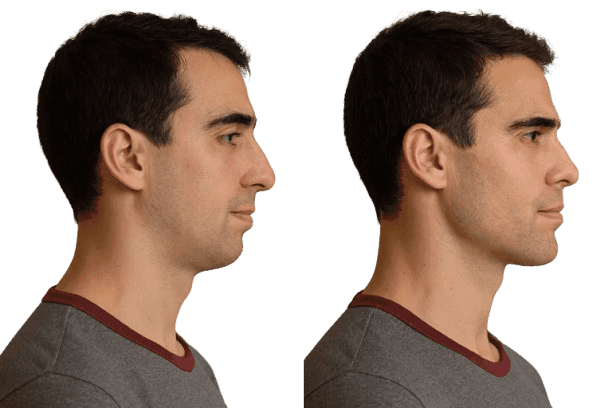
Of everything that affects how your face looks, body-fat level is the single biggest factor you can actually change. Your bone structure is fixed, but how visible that structure is depends heavily on the layer of fat over it. This is why the same person can look soft and undefined at a higher body fat and sharp and structured at a lower one — same skull, different covering. This guide explains what the research actually shows, why facial fat behaves differently between people, and — importantly — the point where getting leaner stops helping and can start to hurt.
The face genuinely broadcasts body fat
This isn't just gym folklore. People can estimate someone's body mass from their face alone with surprising accuracy — a meta-analysis found perceived facial adiposity correlates with actual BMI at about r = 0.71.1 And "facial adiposity" (how much weight the face appears to carry) independently predicts both perceived attractiveness and perceived health, and tracks real health measures like cardiovascular indicators and infection frequency.2 In other words, a leaner face reads as healthier and more attractive partly because facial fatness is a genuine, visible cue to health.
That's the mechanism behind the aesthetic advice: reduce facial fat and you improve a cue people are demonstrably sensitive to.
What changes as facial fat drops
Fat sits over and around the structures that create definition — the jawline, the area under the chin, the cheeks, and the hollow beneath the cheekbones. As overall body fat falls:
- The jawline separates more cleanly from the neck as submental (under-chin) fat reduces.
- Cheekbones become more visible as the fat pad over and below them thins.
- The midface and eye area look less puffy.
- Overall, the face reads as more "structured" because the underlying bone is less obscured.
Two honest caveats. First, this reveals the structure you have — leanness makes an existing jaw or cheekbone show; it doesn't create one that isn't there. Second, none of this requires knowing your body-fat percentage to the decimal (see limitations below).
Why facial fat loss varies so much between people
A frequent frustration: two people lose the same weight, and one's face transforms while the other's barely changes. Several reasons, all normal:
- Fat-distribution genetics. Where you store and lose fat first is largely genetic. Some people hold fat in the face and lose it early in a cut; others store little facially but keep it there stubbornly.
- The face isn't always first to lean out. For many people facial fat is neither the first nor the last to go, and it doesn't track perfectly with abdominal fat.
- Fluid and puffiness overlay the fat picture. Sleep, sodium, and alcohol change facial fullness day to day independent of actual fat — see debloating your face — which can mask or exaggerate progress.
- Age and skin. Skin laxity and age-related fat-pad changes affect how the face responds to fat loss.
The practical implication: judge facial changes over months, from consistent photos, not day to day — and accept that your face's response to leaning out is partly out of your control.
The part most guides get wrong: leaner isn't always better
Here's the honest limit. The relationship between facial fat and looking healthy is curvilinear, not a straight line — perceived health peaks at an intermediate level of facial adiposity and declines at both extremes.3 A face that's too gaunt reads as less healthy, because significant thinness is also associated (correctly) with illness. There's a nuance for attractiveness specifically: some studies find the "most attractive" level of facial fat is slightly lower than the "healthiest-looking" level, but even that optimum is not "as lean as possible."23
So getting leaner improves facial definition up to a point — and past that point the face starts to look drawn, hollow, and older rather than sharper. Chasing extremely low body fat for your face is counterproductive, and doing it year-round also carries real costs to training, recovery, and hormones (see the hormones guide).
Why this guide won't give you exact body-fat thresholds
You'll see confident claims like "abs at 12%, jawline at 10%." Treat those with caution. The research links facial appearance to perceived adiposity and BMI, not to precise body-fat-percentage cutoffs for specific facial features — and body-fat estimates themselves are imprecise:
- Consumer methods (scales, calipers, visual estimates) have wide error margins; even DEXA varies.
- The body fat at which your face changes depends on your personal fat distribution, so any universal number is fiction.
A more honest framing than chasing a number: for most men there's a general lean range where the face looks defined and healthy without looking gaunt. Use the mirror and photos over months as your guide, not a decimal.
Realistic expectations
- Getting leaner is the highest-leverage change for facial definition — do this before worrying about most other facial "hacks."
- It reveals your structure; it doesn't rebuild it. Manage expectations about what leanness can do for a given feature.
- Your face's response is partly genetic and won't match someone else's on the same cut.
- There's a floor, not just a ceiling. Past a moderate lean point, further fat loss makes the face look worse, not better, and isn't worth the cost.
- Fluid and sleep confound the picture — track the trend, not the day.
Get to a sustainable lean range, keep your sleep and sodium in check, and let your bone structure show. That's the whole strategy — and "leaner forever" is not part of it.
References
Footnotes
-
de Jager S, Coetzee N, Coetzee V. Facial Adiposity, Attractiveness, and Health: A Review. Frontiers in Psychology (2018) — meta-analysis: people estimate BMI from facial cues at r ≈ 0.71. https://www.ncbi.nlm.nih.gov/pmc/articles/PMC6308207/ ↩
-
Coetzee V, Perrett DI, Stephen ID. Facial Adiposity: A Cue to Health? Perception (2009);38:1700–1711. https://journals.sagepub.com/doi/10.1068/p6423 ↩ ↩2
-
Perception of health from facial cues. Philosophical Transactions of the Royal Society B (2016) — perceived health shows a curvilinear (quadratic) relationship with facial adiposity, declining at both high and very low weight. https://royalsocietypublishing.org/rstb/article/371/1693/20150380/22887/ ↩ ↩2