Weak or Recessed Chin: Causes, What Helps, and Real Options
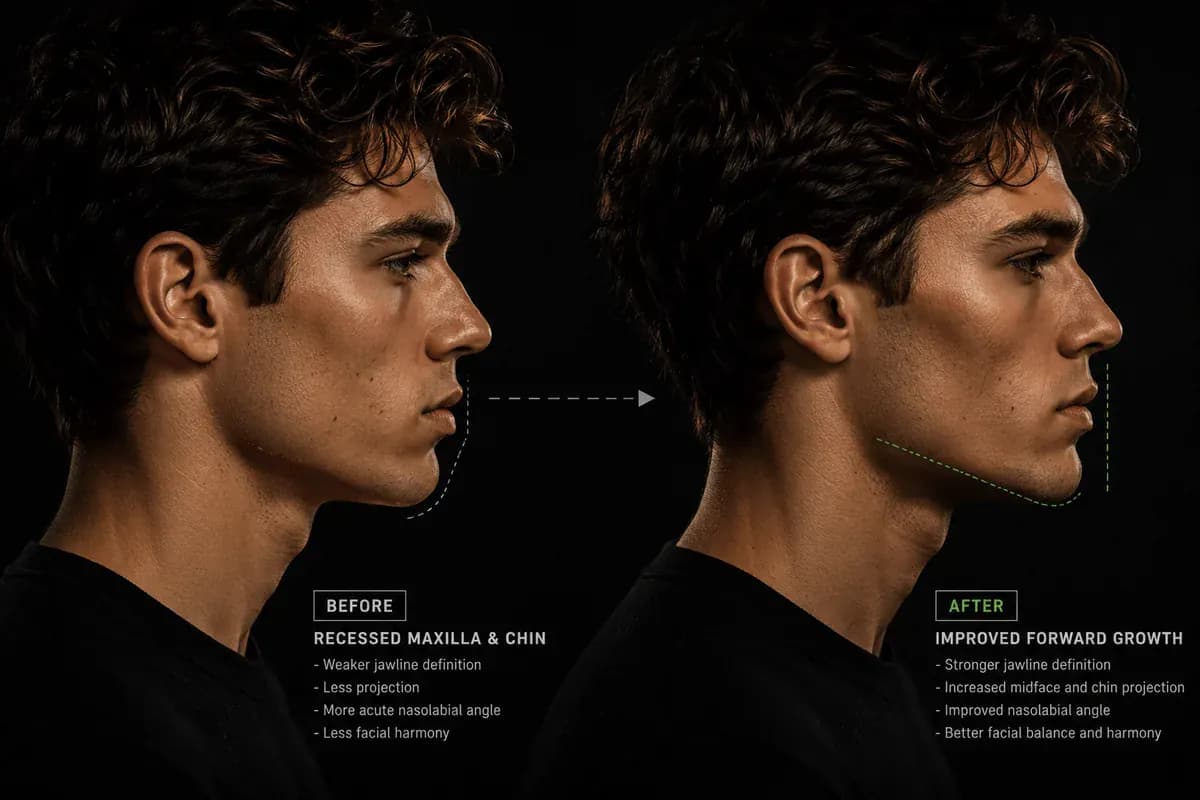
A weak chin is a chin that sits too far back, or is too small, relative to your lips and nose in side profile. Sometimes the chin bone itself is small. Sometimes the whole lower jaw sits back because of your bite. And sometimes the bone is fine and forward head posture or fat under the jaw makes it look weak. Those need completely different fixes, so the first job is working out which one you have.
The good news: small differences are much less visible to other people than they are to you in a side-on selfie. The honest news: if the bone really is set back, no exercise moves it in an adult. This guide sorts out the causes, the free fixes, and how each medical option compares on permanence, downtime and risk.
Short answer: Check your profile properly, fix posture and body fat, and use beard shape to balance the chin. If your teeth don't meet properly, see an orthodontist before anyone else. Filler previews a bigger chin temporarily; an implant or genioplasty changes it for good; jaw surgery is for when the bite is the real problem.
Weak chin vs recessed jaw vs posture: tell them apart
People use "weak chin," "recessed chin" and "recessed jaw" interchangeably. Clinically they differ. A small chin bone is called microgenia. A lower jaw positioned too far back is retrognathia; there the chin can be average-sized but the whole jaw sits behind where it should be.1
| What you have | What's going on | Clues | What changes it |
|---|---|---|---|
| Small chin (microgenia) | The chin point of the jawbone is underdeveloped | Bite is normal; only the chin looks short or flat | Beard, filler, implant, genioplasty |
| Recessed lower jaw (retrognathia) | The whole lower jaw sits back relative to the upper | Upper front teeth sit well ahead of the lower ones; lips strain to close; often snoring or mouth breathing | Orthodontics, often with jaw surgery |
| Posture or soft tissue | Forward head posture, or fat under the jaw | Profile improves a lot when you pull your head back; looks worse in photos from below | Posture work, fat loss, grooming |
Many men have a mix of all three, which is why diagnosis matters more than picking a procedure.
A quick self-check:
- Take a true side photo at eye height from about 1.5 m away, head level. The side profile guide has a full photo setup.
- Close your back teeth normally. Do your upper front teeth sit just in front of the lower ones, or far in front? A large gap points to the bite.
- Take a second photo with your head drawn straight back, ear over shoulder. If most of the "weak chin" disappears, posture was a big part of it.
- Compare chin to lips. A chin slightly behind the lower lip is normal. Far behind it, with a deep fold under the lip, suggests real recession.
Recessed chin vs normal: how much is actually noticeable?
Most people overestimate their problem. In a study by Naini and colleagues, the chin on an idealized profile was moved in 2 mm steps, from 24 mm back to 12 mm forward, and rated by orthognathic patients, clinicians and laypeople. Changes up to about 4 mm either way were essentially unnoticeable. Raters only wanted surgery once the chin was more than about 10 mm too far back or 6 mm too far forward. The authors suggested the soft-tissue chin sitting on or just behind a vertical line through the base of the nose as a reasonable target.2
Two takeaways. A mildly recessed profile is within normal, and others mostly don't register it. And more chin is not better: over-projection was penalized faster than recession. If a clinic pushes a large augmentation, question it. For how the chin fits with the rest of the face, see facial structure and harmony.
Why it happens: genetics, bite and development
Most recessed chins are congenital, often inherited. Less often they're acquired from facial trauma or surgery, and childhood habits such as prolonged thumb sucking can play a role. A small number are part of genetic syndromes, which is why severe cases in children see specialists.1
The bite matters. A recessed lower jaw is a common type of malocclusion, usually the Class II pattern where the upper teeth sit well ahead of the lower ones. Because your lips rest on your teeth, a big overjet pushes the upper lip forward and makes the chin look even further back.
It can matter for health too. Cleveland Clinic lists snoring, mouth breathing, jaw pain and trouble closing the lips among the symptoms, and notes untreated retrognathia can contribute to sleep apnea and jaw joint (TMJ) problems.1 If those apply, treat it as a medical question first.
What doesn't fix it: adult bone doesn't move with mewing, jaw exercisers or chewing; the mewing guide covers the evidence. Bonesmashing has no scientific basis and is a good way to injure yourself.
What helps without procedures: posture, beard and body fat
None of these change bone. They change how much of your chin and jaw line shows, which for a mild case is often enough.
Posture. Forward head posture folds the jaw into the neck and makes any chin look weaker. Drawing the head back is the fastest visible change available, and it's free. No trial has measured how posture correction changes rated chin attractiveness; this rests on simple mechanics you can see in your own two photos. The routine is in the posture guide.
Body fat. Fat under the chin blurs the chin-to-neck line. People read body fat from faces well: a meta-analysis of seven studies found BMI estimated from faces alone correlated strongly with real BMI (r = 0.71), and higher facial adiposity was consistently linked to lower attractiveness ratings.3 If you're above a lean range, getting leaner sharpens the whole lower third; see body fat and facial definition. If you're already lean and still soft under the chin, the double chin when skinny guide covers other causes.
Beard shaping. A beard is the only way to change your chin outline without a doctor. Keep more length at the chin and shorter sides, which visually extends the chin forward and down, and set a clean neckline a finger or two above the Adam's apple. In a rating study of 8,520 women viewing digitally altered faces, stubble and beards reduced the penalty for faces made very masculine or very feminine, and facial hair raised ratings for long-term relationships.4 That's an edited-photo study: beards shift perception, but they don't suit every face. Details are in the beard grooming guide.
Orthodontics and when the bite is the real issue
If your teeth don't meet properly, see an orthodontist before a surgeon or injector. A chin implant on top of an untreated bite problem hides it instead of fixing it.
If you're still growing. A Cochrane review of randomized trials found low-quality evidence that functional appliances in adolescence reduce how far the upper teeth stick out compared with no treatment. Early treatment (ages 7 to 11) mainly reduced front-tooth injuries; by the end of treatment, skeletal and overjet results were similar to treating later.5 Appliances help the bite, but don't expect them to dramatically "grow a chin."
If you're an adult, there are two main routes for a skeletal Class II bite with a recessed lower jaw:
- Orthodontic camouflage: braces move the teeth to hide the jaw difference. The jaw stays where it is.
- Braces plus jaw (orthognathic) surgery: the lower jaw is cut and moved forward, with braces before and after.
A meta-analysis comparing the two in adults found surgery did more for the skeletal measurements and for the soft-tissue profile including the nose, but found no significant difference for lower-lip position or the profile excluding the nose. The studies were few and non-randomized.6
Jaw surgery is a big undertaking: months of braces, a hospital procedure and real risks. A review of 38 studies found patients generally reported better appearance satisfaction, self-confidence and social functioning afterward, lasting years, though a small share struggled to adjust to their new face even without complications.7 It's done after jaw growth stops and is planned by an orthodontist with an oral and maxillofacial surgeon.1 For the teeth side, see teeth and smile.
Chin filler vs implant vs genioplasty, compared
If your bite is fine and the chin bone itself is small, these are the three main options.
| Chin filler (hyaluronic acid) | Chin implant | Sliding genioplasty | |
|---|---|---|---|
| What it does | Injected gel adds projection on top of the bone | A preformed implant (often silicone) sits on the bone | The chin bone is cut, moved forward and fixed |
| Permanence | Temporary; in the main trial, still evident at 12 months | Permanent unless removed | Permanent |
| Downtime | Minimal; tenderness and swelling for days | Swelling for several weeks | Swelling up to about 2 weeks; most back to normal in 7 to 10 days |
| Typical risks | Bruising, firmness; rare blood vessel blockage | Infection, shifting, reoperation | Chin or lower-lip numbness, infection, bleeding |
| Reversible? | Yes, can be dissolved | Removable with another operation | No |
| Relative cost | Lowest per session, but repeats | Higher, one-off | Higher, one-off |
| Makes most sense for | Mild cases, or previewing a bigger chin | Mild to moderate small chin | Larger or more complex moves, improving the neck angle |
Chin filler. In a randomized trial of 192 adults with chin retrusion, 56.3% of treated patients improved by at least one point on a chin retrusion scale at 6 months, versus 27.5% of untreated controls, with benefit still evident at 12 months. The most common reactions were tenderness (81.1%) and firmness (75.1%); one person had serious reactions that resolved. The trial tested one product and was industry-run.8 The FDA warns that the most serious filler risk is accidental injection into a blood vessel, which can cause tissue death, vision loss or stroke, and says only licensed, trained providers should inject.9 Filler is a good way to preview more chin before surgery, but the cost adds up.
Implant vs genioplasty. A 2025 systematic review of seven studies (1,126 patients) found high satisfaction with both, trending higher after genioplasty. Implants carried more infection and wound problems; in single studies infection reached 23.8% and reoperation up to 19%, though rates varied widely. Genioplasty was linked to numbness: temporary changes were very common, and persistent numbness was reported in 7.4% to 12.5% of patients in some studies. About 85% of a genioplasty's bone movement showed in the soft tissue, against about 66% for implants, and only genioplasty improved the angle under the chin. The authors saw implants as suited to mild to moderate cases and genioplasty to larger corrections, and noted the evidence is mostly small and retrospective.10 A sliding genioplasty reshapes your own bone; an implant adds a piece on top.11
Jaw surgery isn't in the table because it's not a chin procedure. If your whole lower jaw and bite are back, a chin-only fix can look odd and leaves the bite untreated.
Questions to ask a surgeon
See a board-certified facial plastic surgeon, plastic surgeon or oral and maxillofacial surgeon, get more than one opinion, and bring an honest side photo. Ask:
- Is my problem the chin, the whole jaw, or my bite? A good surgeon checks your teeth and may take X-rays.
- Should I see an orthodontist first? A yes is a sign of a careful clinician.
- Why this option over the others, for my face?
- How many projection millimeters are you planning? Under about 4 mm is hard for others to notice, and over-projection looks worse than mild recession.2
- How many of these do you do, and can I see results on men with similar faces?
- What are your complication and revision rates, and who pays for a revision?
- What's the full cost (surgeon, anesthesia, facility, follow-up, or filler top-ups)?
Walk away from same-day booking pressure, "decide now" discounts, or anyone who doesn't ask about your bite.
When to see a doctor
See a dentist or orthodontist if your teeth don't meet properly, your jaw clicks or hurts, or you struggle to close your lips. See a doctor if you snore loudly, have been told you stop breathing in your sleep, or wake unrefreshed, since a recessed jaw can be linked to sleep apnea.1 A chin or jaw that changes shape in adulthood also needs checking. This guide is general information, not a diagnosis.
Frequently Asked Questions
How do I fix a recessed chin? Find out why first. Posture or fat: fix those. Small chin bone with a normal bite: filler, implant or genioplasty. Lower jaw and bite set back: orthodontics, sometimes with jaw surgery.
Is there a weak chin fix without surgery? Within limits. Posture, fat loss and a beard with more length at the chin change how it reads. Filler is non-surgical but temporary. None of these move bone.
Is a weak chin in men a big deal? Usually not. Mild recession is a normal variation, and differences of a few millimeters aren't noticed by most people.2
Recessed chin side profile vs normal: what's the difference? In a normal profile the chin sits roughly in line with, or slightly behind, the lower lip. In a recessed one it sits well behind the lips, often with a soft angle under the jaw.
Chin filler vs implant vs genioplasty: which should I pick? Filler for mild cases or a preview, knowing it wears off. An implant for a mild to moderate small chin if you want a simpler permanent fix. A genioplasty for larger moves or if you also want a cleaner neck angle. None fixes a bite problem.
The bottom line
A weak chin can mean a small chin bone, a recessed jaw or plain bad posture, and you need to know which before spending money. Fix posture and body fat, use your beard to balance the chin, and see an orthodontist if your bite is off. If a clear structural problem remains, filler can preview the change, while an implant or genioplasty makes it permanent, each with real trade-offs. A few millimeters are rarely noticed by anyone else, so pick a surgeon who checks your bite and doesn't oversell.
References
Footnotes
-
Cleveland Clinic. Retrognathia: Causes and Treatment. Cleveland Clinic (2025). https://my.clevelandclinic.org/health/diseases/retrognathia: a receding chin from a jaw set too far back, mostly congenital, linked to snoring, sleep apnea and TMJ problems; treated with orthodontics and, in severe cases after growth, jaw surgery. ↩ ↩2 ↩3 ↩4 ↩5
-
Naini FB, Donaldson ANA, McDonald F, Cobourne MT. Assessing the influence of chin prominence on perceived attractiveness in the orthognathic patient, clinician and layperson. International Journal of Oral and Maxillofacial Surgery (2012);41(7):839-846. https://pubmed.ncbi.nlm.nih.gov/22340990/: chin changes up to 4 mm were essentially unnoticeable; surgery was desired for retrusion over 10 mm and protrusion over 6 mm. ↩ ↩2 ↩3
-
de Jager S, Coetzee N, Coetzee V. Facial Adiposity, Attractiveness, and Health: A Review. Frontiers in Psychology (2018);9:2562. https://www.frontiersin.org/journals/psychology/articles/10.3389/fpsyg.2018.02562/full: BMI estimated from faces correlated r = 0.71 with real BMI; higher facial adiposity is consistently linked to lower attractiveness. ↩
-
Dixson BJW, Sulikowski D, Gouda-Vossos A, Rantala MJ, Brooks RC. The masculinity paradox: facial masculinity and beardedness interact to determine women's ratings of men's facial attractiveness. Journal of Evolutionary Biology (2016);29(11):2311-2320. https://pubmed.ncbi.nlm.nih.gov/27488414/: in 8,520 women, stubble and beards reduced the penalty for extreme masculinity or femininity and raised long-term attractiveness. ↩
-
Batista KBSL, Thiruvenkatachari B, Harrison JE, O'Brien KD. Orthodontic treatment for prominent upper front teeth (Class II malocclusion) in children and adolescents. Cochrane Database of Systematic Reviews (2018);(3):CD003452. https://www.cochrane.org/evidence/CD003452_orthodontic-treatment-prominent-upper-front-teeth-children: functional appliances in adolescence reduce overjet versus no treatment (low-quality evidence); early treatment mainly reduces incisor trauma. ↩
-
Raposo R, Peleteiro B, Paço M, Pinho T. Orthodontic camouflage versus orthodontic-orthognathic surgical treatment in class II malocclusion: a systematic review and meta-analysis. International Journal of Oral and Maxillofacial Surgery (2018);47(4):445-455. https://pubmed.ncbi.nlm.nih.gov/28966066/: surgery improved skeletal measures and the soft-tissue profile including the nose more; no difference for lower-lip position or profile excluding the nose. ↩
-
Liddle MJ, Baker SR, Smith KG, Thompson AR. Psychosocial Outcomes in Orthognathic Surgery: A Review of the Literature. Cleft Palate-Craniofacial Journal (2015);52(4):458-470. https://pubmed.ncbi.nlm.nih.gov/25191866/: across 38 studies, patients reported better appearance satisfaction, self-confidence and social functioning; a small share struggled to adjust. ↩
-
Beer K, Kaufman-Janette J, Bank D, et al. Safe and Effective Chin Augmentation With the Hyaluronic Acid Injectable Filler, VYC-20L. Dermatologic Surgery (2021);47(1):80-85. https://pubmed.ncbi.nlm.nih.gov/33347003/: 56.3% of treated vs 27.5% of control patients responded at 6 months; benefit remained at 12 months; tenderness and firmness were the most common reactions. ↩
-
U.S. Food and Drug Administration. Dermal Fillers (Soft Tissue Fillers). FDA (2023). https://www.fda.gov/medical-devices/aesthetic-cosmetic-devices/dermal-fillers-soft-tissue-fillers: injection into a blood vessel is the most serious risk and can cause tissue death, blindness or stroke; use only licensed, trained providers. ↩
-
Kauke-Navarro M, Knoedler L, Allam O, et al. Implant-Based Chin Augmentation Vs Osseous Genioplasty: A Systematic Review of Indications and Outcomes. Aesthetic Surgery Journal Open Forum (2025);7:ojaf048. https://academic.oup.com/asjopenforum/article/doi/10.1093/asjof/ojaf048/8174361: in 1,126 patients both had high satisfaction; implants had more infection and dehiscence, genioplasty more neurosensory change and better soft-tissue predictability. ↩
-
Cleveland Clinic. Sliding Genioplasty: Procedure, Recovery, Results and Risks. Cleveland Clinic (2022). https://my.clevelandclinic.org/health/treatments/24041-sliding-genioplasty: genioplasty cuts and moves the chin bone; swelling up to two weeks, most return to normal activity in 7 to 10 days; risks include chin or lower-lip numbness. ↩