How to Improve Your Side Profile (Without Surgery First)
If you want to know how to improve your side profile, start with the cheap levers in the right order: fix your head position, get leaner if you have fat to lose, groom your beard and hair to balance the outline, and only then look at orthodontics, filler or surgery. For most men the first two change the profile more than anything else short of an operation, because they decide whether the jaw separates cleanly from the neck.
The profile is also the view you almost never see, which makes it easy to misjudge. A side photo taken at arm's length with your head tipped down will look worse than you do in person. So this guide starts with what a strong profile actually is, then gives you a repeatable way to photograph yours, then ranks every lever by effort, cost, size of change and how good the evidence is.
Short answer: posture and body fat first, grooming second, dental work if your bite is involved, and filler or surgery only for a structural problem that's still there after all of that. Adult bone doesn't change with mewing, jaw exercisers or chin straps.
What makes a strong side profile
Three relationships do most of the work. None of them is a hard rule; they're ranges.
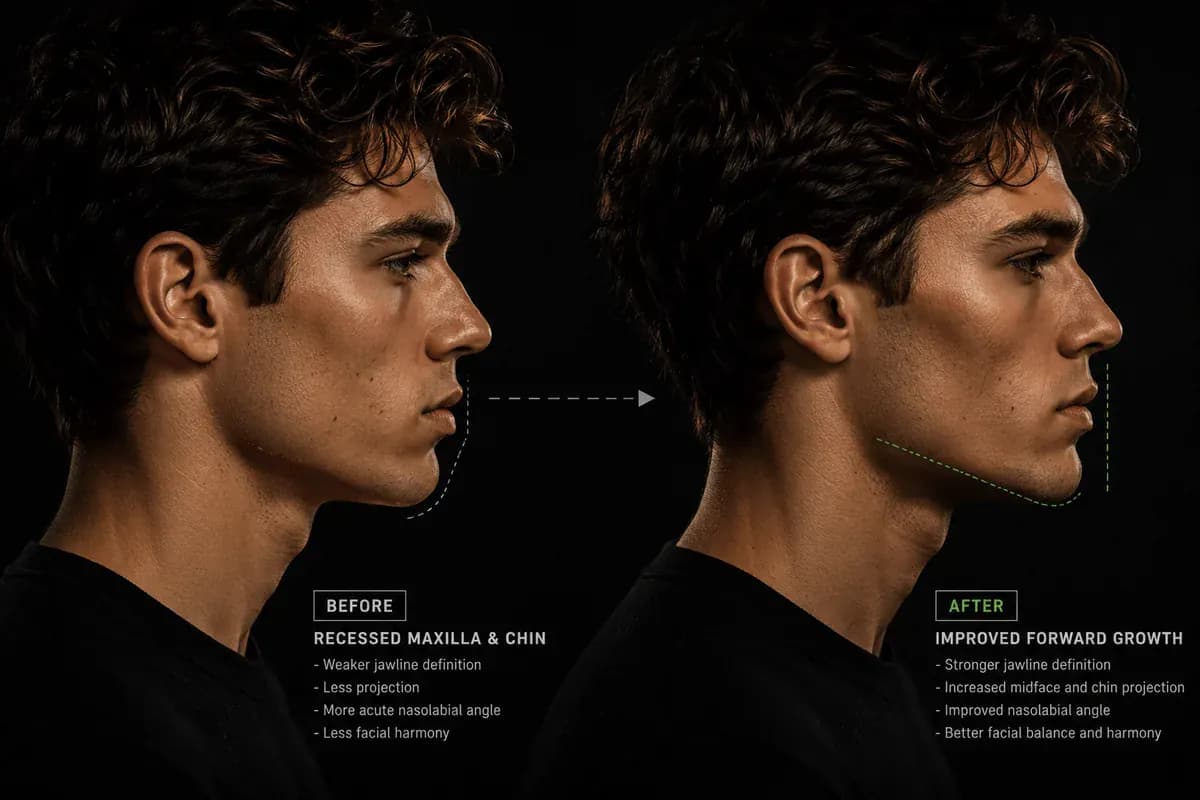
Start with the nose, lips and chin. In profile, the chin should sit roughly in line with the lips, not well behind them and not jutting past them. In a study that moved the chin of an idealized male profile in 2 mm steps, from 24 mm back to 12 mm forward, changes of up to about 4 mm were essentially unnoticeable to patients, clinicians and laypeople. Raters only started wanting surgery for retrusions beyond about 10 mm or protrusions beyond about 6 mm.1 The authors placed the ideal with the soft-tissue chin on or just behind a vertical line dropped through the base of the nose. Two takeaways: a "recessed chin" has to be fairly large before other people notice it, and more chin is not better.
Next is the jaw-to-neck angle, known as the cervicomental (or submental-cervical) angle. It's where the underside of your jaw meets the front of your neck. In a silhouette study, angles of roughly 90 to 105 degrees were rated acceptable, and 125 to 130 degrees very unattractive by everyone. Patients wanted surgery at about 110 degrees, laypeople at 115 and clinicians at 125.2 So people who already worry about their profile judge themselves harder than anyone else does. This angle is the one most affected by posture and body fat, which is why those two levers rank so high.
The third element is a defined lower jaw border. Surgeons have used Ellenbogen and Karlin's 1980 visual criteria for a youthful neck for decades. Their paper argued those criteria can be met in most neck-lift patients, even those with a low-lying hyoid bone.3 It was written for facelift patients, not 25-year-old men, so treat it as a description of a clean neckline, not a scorecard.
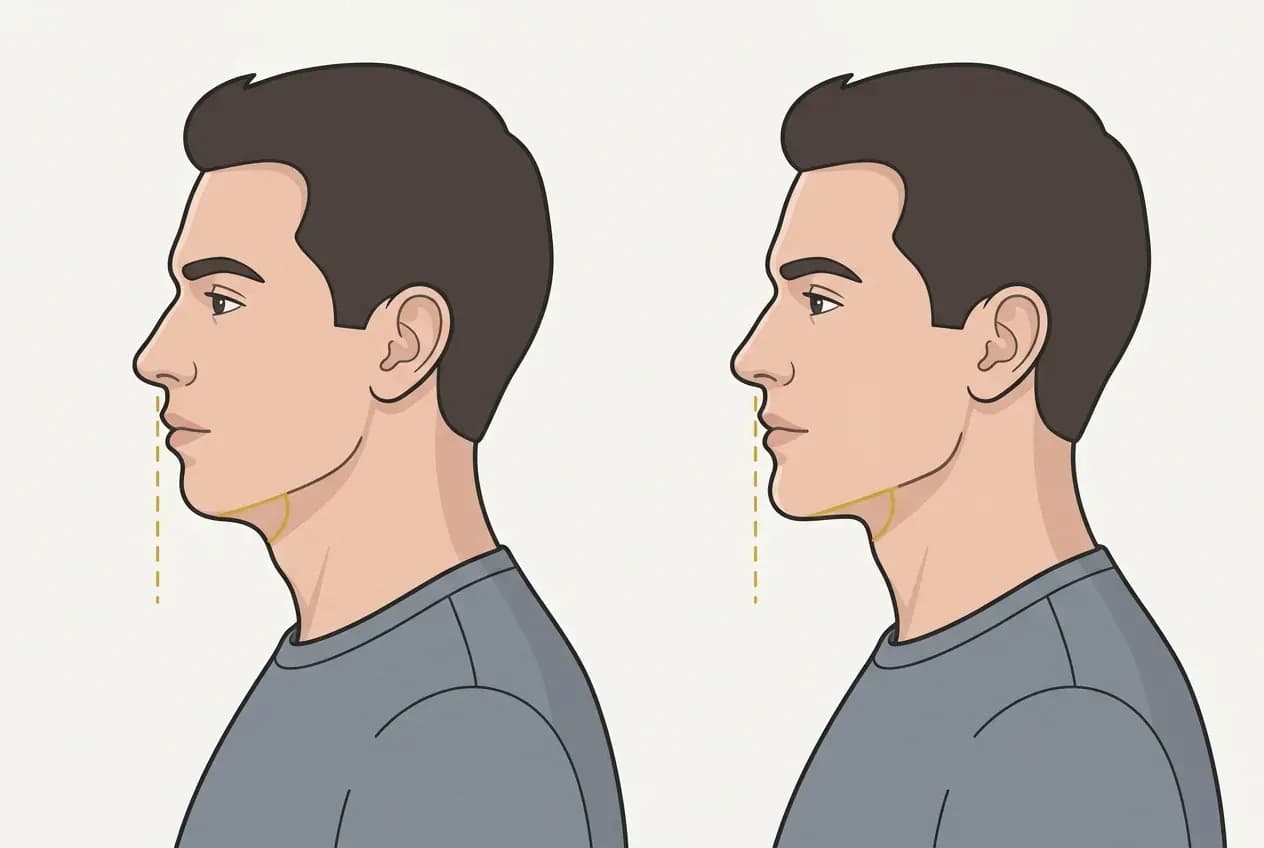
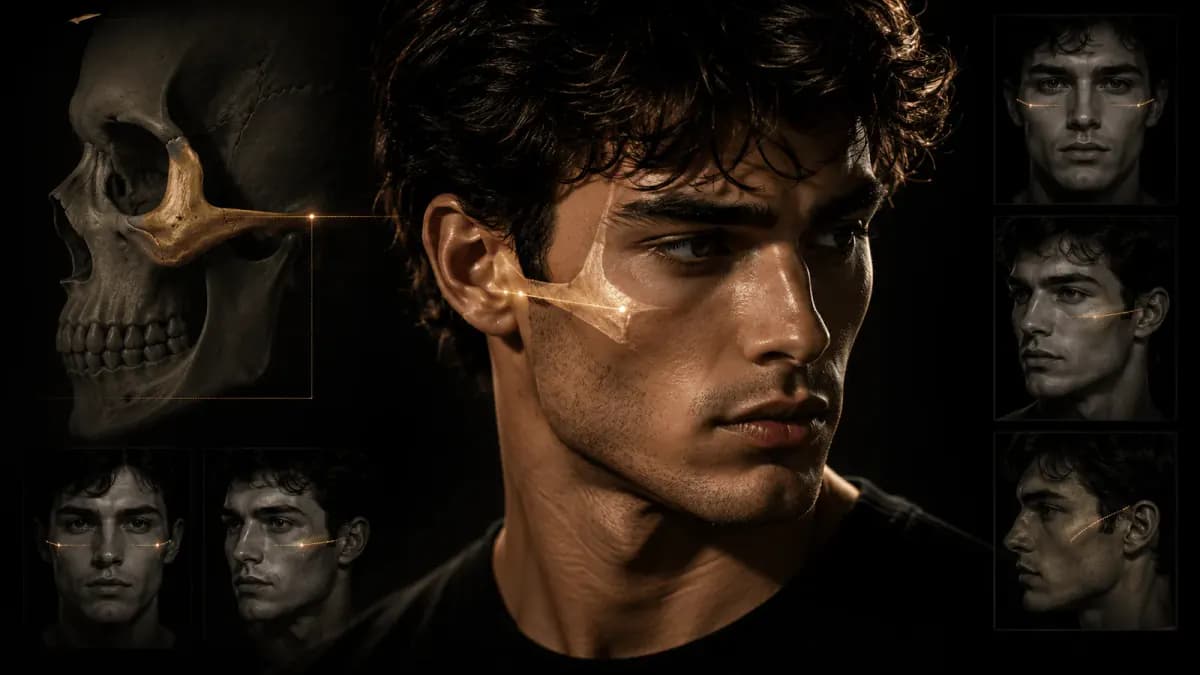
The skeleton behind all this (chin projection, ramus height, gonial angle, the maxilla) is covered in facial structure and harmony. The short version: the bone is mostly set in adulthood, but how much of it shows is not.
How to photograph your side profile accurately
You can't fix what you can't measure, and most profile photos are useless for judging anything. Use the same setup every time:
- Distance: have someone stand about 1.5 m (5 feet) away and zoom in, or use a tripod and timer. Faces photographed from within personal space are rated less attractive than the same faces from farther away, and viewers usually don't notice why.4
- Camera height: lens at the height of your ear, pointing straight at you. Not from below, not from above.
- Exactly side-on: turn until only one eye is visible. A partial three-quarter view hides the chin-lip relationship.
- Head level: look straight ahead at something at eye height. If you tilt your chin down even slightly, the jaw folds into the neck.
- Relaxed face: lips lightly together, teeth apart, no clenching, no smiling, no pushing the tongue into the palate.
- Two posture shots: one standing as you normally do, one with your head drawn straight back so your ear sits over your shoulder. The difference between them is your posture lever.
- Plain background and even light: a wall, a window in front of you, no overhead light.
- Same conditions every 4 to 8 weeks if you're tracking a change.
This is a measuring photo, not a flattering one. For the flattering version (chin slightly forward and down, light from the side), see how to look better in photos.
How to improve your side profile: the levers ranked
| Lever | Effort | Cost | Size of change | Evidence |
|---|---|---|---|---|
| Posture and head position | Low to medium, daily habit | Free | Medium, visible immediately | Mechanism clear; no trial on profile looks |
| Body fat | High, months | Free to low | Medium to large if you're above lean | Good for face and weight perception |
| Grooming (beard, hair) | Low | Low | Small to medium | Some rating studies on beards; hair is practice-based |
| Orthodontics | High, 1 to 3 years | High | Small to medium, mostly lips and teeth | Moderate, mostly non-randomized |
| Chin or jaw filler | Low | Medium, repeats | Small to medium, temporary | Clinical experience; limited male-specific data |
| Chin implant or genioplasty | High, surgery | High | Medium to large | Older retrospective data, high satisfaction |
| Jaw (orthognathic) surgery | Very high | Very high | Large | Good psychosocial data, real risks |
Work down the table. Each step up costs more and is harder to undo.
Lever 1: Posture and head position
Forward head posture is the fastest way to ruin a profile. When your head drifts in front of your shoulders, the space between jaw and collarbone shortens, the tissue under the chin bunches up, and the jaw-to-neck angle opens. Draw the head straight back and the same jaw suddenly has an edge.
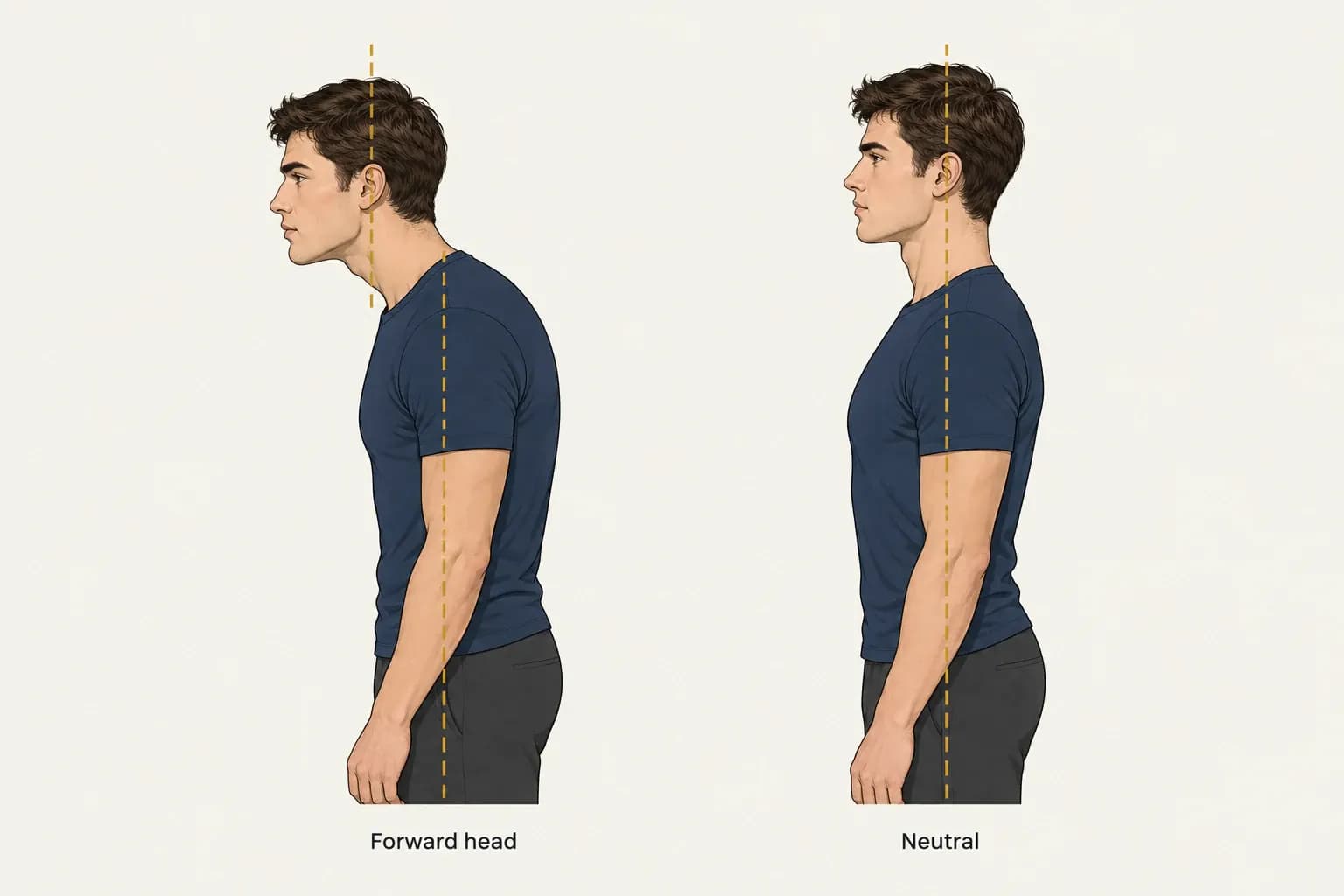
Clinicians measure this with the craniovertebral angle, and a phone app has been validated against clinical photogrammetry for it, so the side photo above doubles as a posture check.5 No study has measured how correcting posture changes rated profile attractiveness, so this rests on simple mechanics, not trials. You can see it for yourself in the two posture shots.
What to do:
- Chin tucks through the day: slide your head straight back with your eyes level, hold 2 to 3 seconds.
- Upper-back training (rows, rear-delt flyes, face pulls) so you can hold the position without thinking about it.
- Screens at eye level: raise the phone instead of dropping your head, put the top of the monitor near eye height.
The full routine and timeline are in the posture guide. Once your posture is sorted, a stronger neck can sharpen the line further; the neck training guide has a safe starter routine.
Lever 2: Body fat and the neck angle
Fat under the chin and along the jaw blurs exactly the angle that makes a profile look sharp. People are good at reading body fat from faces: a meta-analysis of seven studies found estimates of BMI from faces alone correlated strongly with the real figure (r = 0.71), and lower facial adiposity is consistently linked to higher attractiveness ratings, up to a point where faces start to look underweight and unhealthy.6
If you're above a lean range, getting leaner is probably the single biggest profile change you can make without a doctor. It's slow (months, not weeks) and you can't spot-reduce the chin with exercises. Don't chase very low body fat for your profile either; past a point the face looks gaunt and older. Realistic ranges are in body fat and facial definition.
If you're already lean and still see a soft neck, the cause is more likely chin position, a low hyoid, posture or a small genetic fat pocket.
Lever 3: Grooming (beard line and hair volume)
A beard is the one way to change your chin outline without a procedure. A short, full beard can add visual length and depth to a weak chin and hide a soft jaw-to-neck transition. In a study of 8,520 women rating digitally altered faces, stubble and beards dampened the penalty for both very masculine and very feminine faces, and facial hair raised ratings for long-term relationships but not short-term ones.7 That's a rating study with edited photos, so it tells you beards shift perception, not that they suit every face.
Practical rules for the profile:
- Keep length at the chin, shorter on the sides. That extends the chin forward and down.
- Set the neckline about a finger or two above the Adam's apple, following a line from just behind the jaw corner. Too high and you shave away the jaw; too low and the beard runs down your neck.
- Keep the lower edge clean. A fuzzy neckline erases the jaw edge you're trying to show.
The shaping and trimming details are in the beard grooming guide.
Hair matters too, though there's no research on haircuts and profile attractiveness, so this part is barbershop logic. A profile reads as a balance between front and back. A little height or volume on top and at the crown balances a prominent nose or a strong chin; a very flat top or a forward fringe can make a recessed chin look further back.
Lever 4: Dental and orthodontic
Your lips sit on your teeth, so tooth position changes your profile. A big overjet (upper teeth well in front of the lower) pushes the upper lip forward and makes the chin look further back than it is. A deep bite can strain the muscles of the lower lip and chin.
If your bite is the problem, an orthodontist is the right first stop. For adults with a skeletal Class II bite and a retrusive lower jaw, the options are orthodontic "camouflage" (moving teeth to hide the jaw difference) or braces combined with jaw surgery. A 2018 meta-analysis found surgery did more for the skeletal measurements and for the soft-tissue profile including the nose, but the two approaches did not differ significantly on several other measures, including lip position and the soft-tissue profile excluding the nose.8 The included studies were few and non-randomized, so how much camouflage can do depends on your case.
The bottom line for most men: braces change lips and teeth, not the chin bone. They're worth it for a real bite problem, not as a jawline project. The smile side of this is in teeth and smile.
Injectables and surgery: what each changes
These are real medical procedures. Get a consultation with a board-certified facial plastic surgeon, plastic surgeon, oral and maxillofacial surgeon or dermatologist, and make sure they assess your bite, chin position and neck before recommending anything.
Hyaluronic acid filler can add a few millimeters of projection to the chin or definition at the jaw angle. It's quick and reversible but temporary, so it costs money again every time it wears off. Rare but serious complications include filler blocking a blood vessel. It's a reasonable way to preview what more chin would look like before surgery. It doesn't fix fat or posture.
Deoxycholic acid injections and liposuction remove fat under the chin. They only help if a real fat pocket is the problem.
For a bigger chin change, the choice is usually a chin implant or a sliding genioplasty. An implant sits on the chin bone; a genioplasty cuts the chin bone and moves it forward. In an older retrospective comparison of 76 patients, both groups were highly satisfied, but the bone procedure gave more predictable soft-tissue results and improved the cervicomental angle more.9 It's one 1990 study, so treat that as a rough guide, but it fits why surgeons often prefer genioplasty for larger moves.
When the whole lower jaw sits back because of your bite, moving the jaw itself (orthognathic surgery) is the structural fix. A review of 38 studies found patients reported better satisfaction with their appearance, self-confidence and social functioning afterward, with benefits lasting years, though a small percentage struggled to adjust to their new face even without complications.10 It means months of braces, a hospital stay and real risks such as numbness, so it's for real skeletal or functional problems.
Rhinoplasty is the indirect option. A large nose dominates a profile, and reducing it can make the chin look stronger without touching it. It's major cosmetic surgery with a long healing period; it belongs in the same consultation, not as an impulse.
Bring photos taken with the protocol above when you consult. Remember the chin study: changes under about 4 mm are hard for other people to notice.1
What's overhyped: mewing, jaw exercises and bonesmashing
There is no controlled study showing that mewing, or any tongue posture, moves adult facial bone. Most dramatic "mewing transformations" are teenagers who were still growing, people who got leaner, or photos taken with better posture and a different angle. Holding the tongue up does push the soft tissue under the chin up while you do it, which is a posture effect, not bone change. The mewing guide goes through the evidence.
Jaw exercisers and hard gum don't help either. Chewing can enlarge the masseter, which widens the jaw from the front. It does nothing for chin projection, which is what drives a profile, and jaw devices can strain the jaw joint.
Chin straps, neck "slimming" devices and face yoga have no good evidence that they reduce fat or change structure.
Bonesmashing, hitting your face to "remodel" bone, has no scientific basis and is a reliable way to injure yourself. Don't.
Frequently Asked Questions
How do I improve my side profile as a man? Fix forward head posture, get lean if you have fat to lose, and use a short, full beard to extend the chin line. Those three cover most of what's possible without a doctor.
How can I improve my side profile without surgery? Posture, body fat, grooming and, for bite problems, orthodontics. Filler is a non-surgical medical option for chin projection, but it's temporary.
Can I improve my side profile naturally? Yes, within limits. Natural changes affect how your bone shows (fat, posture, beard), not the bone itself. Expect the posture change immediately and the body-fat change over months.
How do I improve my side profile jawline? The profile jawline is mostly the jaw-to-neck angle. Posture and leanness sharpen it most; a clean beard neckline helps. A recessed chin limits it, and only filler or surgery changes that.
What can I do about a recessed chin side profile? First check it's real with an eye-level, head-level side photo, since a low camera and a dropped chin exaggerate it. If it's still clear, a beard helps visually; filler, an implant or a genioplasty change it; jaw surgery is for a bite-related retrusion.
Does mewing improve your side profile? Not by changing adult bone. Any quick change is posture and tongue position lifting soft tissue under the chin while you hold it.
The bottom line
Your side profile depends on bone you can't change by yourself and on how much of that bone shows, which you can. Start with an accurate side photo, then work through the levers in order: head position, body fat, beard and hair. Bring in an orthodontist if your bite is involved, and consider filler or surgery only if a clear structural problem remains, with a qualified surgeon and realistic expectations. Changes under a few millimeters are hard for anyone else to see, so don't let a profile photo push you into a procedure.
References
Footnotes
-
Naini FB, Donaldson AN, McDonald F, Cobourne MT. Assessing the influence of chin prominence on perceived attractiveness in the orthognathic patient, clinician and layperson. International Journal of Oral and Maxillofacial Surgery (2012);41(7):839-846. https://pubmed.ncbi.nlm.nih.gov/22340990/:22340990%20AND%20SRC:MED&resultType=core&format=json: chin changes up to 4 mm were essentially unnoticeable; surgery was desired for protrusion over 6 mm and retrusion over 10 mm. ↩ ↩2
-
Naini FB, Cobourne MT, McDonald F, Wertheim D. Submental-Cervical Angle: Perceived Attractiveness and Threshold Values of Desire for Surgery. Journal of Maxillofacial and Oral Surgery (2016);15(4):469-477. https://pubmed.ncbi.nlm.nih.gov/27833339/: angles of 90 to 105 degrees were rated acceptable; patients wanted surgery from about 110 degrees, laypeople 115, clinicians 125. ↩
-
Ellenbogen R, Karlin JV. Visual criteria for success in restoring the youthful neck. Plastic and Reconstructive Surgery (1980);66(6):826-837. https://pubmed.ncbi.nlm.nih.gov/7443846/: proposed visual criteria for a youthful neck and reported they can be met in most neck-lift patients, including those with a low-lying hyoid. ↩
-
Bryan R, Perona P, Adolphs R. Perspective Distortion from Interpersonal Distance Is an Implicit Visual Cue for Social Judgments of Faces. PLoS ONE (2012);7(9):e45301. https://journals.plos.org/plosone/article?id=10.1371/journal.pone.0045301: faces photographed from 135 cm were rated more attractive, trustworthy and competent than the same faces from 45 cm. ↩
-
Gallego-Izquierdo T, Arroba-Díaz E, García-Ascoz G, Val-Cano MDA, Pecos-Martin D, Cano-de-la-Cuerda R. Psychometric Properties of a Mobile Application to Measure the Craniovertebral Angle: A Validation and Reliability Study. International Journal of Environmental Research and Public Health (2020);17(18):6521. https://pmc.ncbi.nlm.nih.gov/articles/PMC7559098/: a smartphone app measured the craniovertebral angle validly against photogrammetry in 44 adults. ↩
-
de Jager S, Coetzee N, Coetzee V. Facial Adiposity, Attractiveness, and Health: A Review. Frontiers in Psychology (2018);9:2562. https://www.frontiersin.org/journals/psychology/articles/10.3389/fpsyg.2018.02562/full: BMI estimated from faces correlated r = 0.71 with real BMI; lower facial adiposity is robustly linked to higher attractiveness. ↩
-
Dixson BJ, Sulikowski D, Gouda-Vossos A, Rantala MJ, Brooks RC. The masculinity paradox: facial masculinity and beardedness interact to determine women's ratings of men's facial attractiveness. Journal of Evolutionary Biology (2016);29(11):2311-2320. https://pubmed.ncbi.nlm.nih.gov/27488414/:27488414%20AND%20SRC:MED&resultType=core&format=json: in 8,520 women, stubble and beards dampened the penalty for extreme masculinity and femininity and raised long-term attractiveness. ↩
-
Raposo R, Peleteiro B, Paço M, Pinho T. Orthodontic camouflage versus orthodontic-orthognathic surgical treatment in class II malocclusion: a systematic review and meta-analysis. International Journal of Oral and Maxillofacial Surgery (2018);47(4):445-455. https://repositorio-aberto.up.pt/handle/10216/111700?mode=full: surgery improved skeletal measures and the soft-tissue profile including the nose more; no significant difference for the profile excluding the nose or lip position. ↩
-
Guyuron B, Raszewski RL. A critical comparison of osteoplastic and alloplastic augmentation genioplasty. Aesthetic Plastic Surgery (1990);14(3):199-206. https://pubmed.ncbi.nlm.nih.gov/2399851/: in 76 patients both approaches had high satisfaction, but bony genioplasty gave more predictable soft tissue and improved the cervicomental angle more. ↩
-
Liddle MJ, Baker SR, Smith KG, Thompson AR. Psychosocial Outcomes in Orthognathic Surgery: A Review of the Literature. Cleft Palate-Craniofacial Journal (2015);52(4):458-470. https://eprints.whiterose.ac.uk/89847: across 38 studies, patients reported better appearance satisfaction, self-confidence and social functioning, while a small percentage struggled to adjust. ↩