How to Look Better in Photos (for Men): Distance, Light, Angles
If you want to know how to look better in photos as a man, start with distance, not your face. Step back to about 1.5 meters (5 feet) and zoom in. Then face soft window light, keep the camera at eye level or a little above, push your chin slightly forward and down, and use an expression you can hold without strain. Those five settings explain most of the gap between "I hate how I look in pictures" and a photo you'd actually use.
This isn't a pep talk. In one study, photos of the same person differed in attractiveness more than different people did.1 So a bad photo tells you about the photo, not your face, and most of what makes a photo good or bad is under your control.
Short answer: shoot from 1.5 m or more with the back camera zoomed to about 2x. Face a window. Lens at eye level or slightly higher. Chin forward and a touch down. A real smile that reaches your eyes, or a relaxed neutral face with soft eyes. Let someone else pick the final photo.
Flattering vs accurate: know which photo you're taking
- A flattering photo is for a dating profile, LinkedIn or social media. You get to choose your best light, angle and expression. That's what this guide is about.
- An accurate photo is for judging your features, tracking progress or running a face analysis. It needs flat, neutral, repeatable conditions with no posing, covered in the photo guide for the face analyzer.
Both have their place. Just don't judge your jawline from a flattering photo, or put a clinical reference shot on a dating app.
The one setting that matters most: camera distance
Close cameras distort faces. At arm's length your nose is much closer to the lens than your ears, so the center of your face looks bigger and the edges shrink back. One modeling study found that at 12 inches (30 cm), the nose looked about 30% wider relative to the face in men, with essentially no change at 5 feet.2
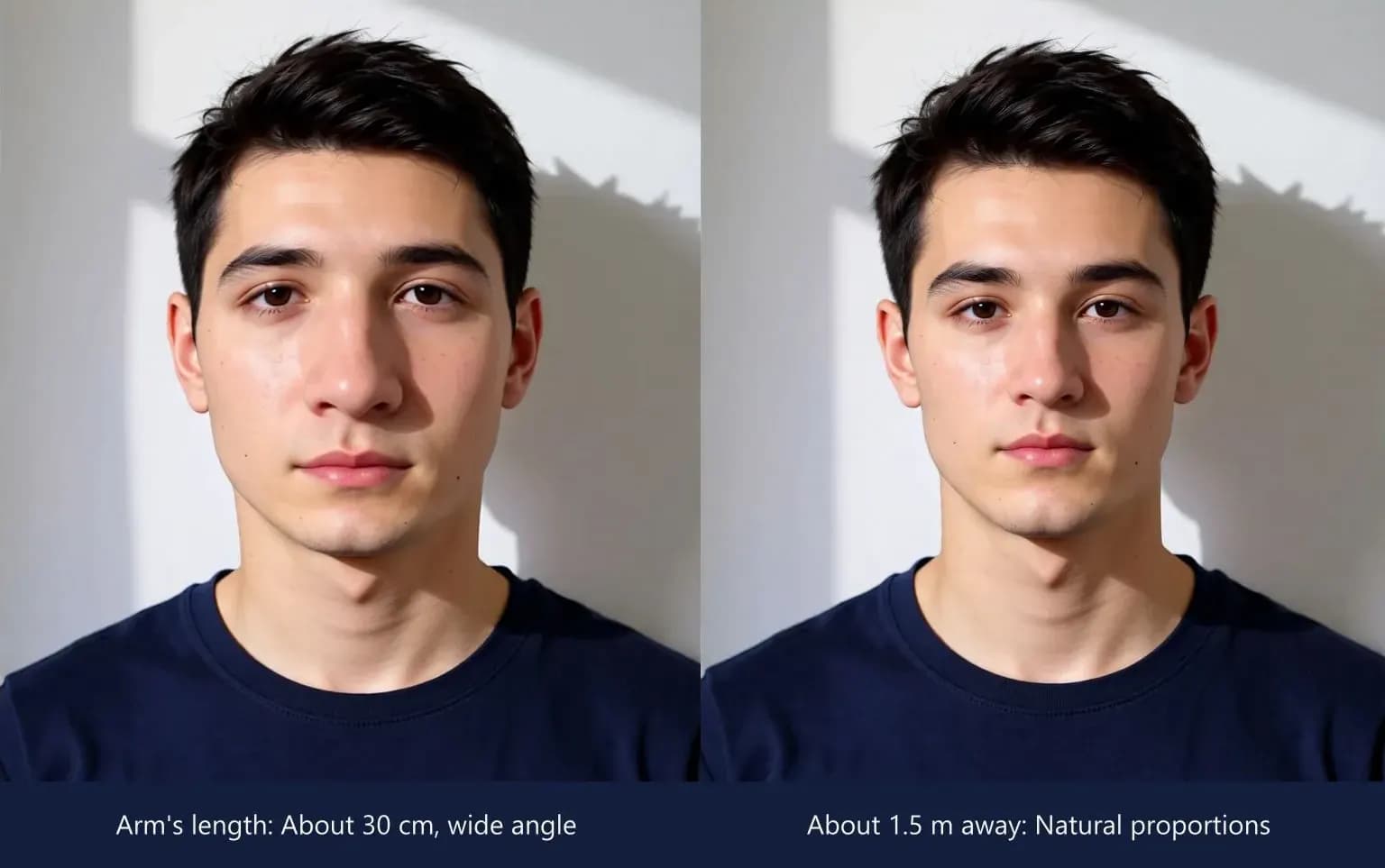
Distance also changes how people judge you. Bryan, Perona and Adolphs photographed the same faces at 45 cm and 135 cm at the same moment. Viewers rated the farther photos as more trustworthy, more competent and more attractive, and almost none of them noticed the distance had changed.3 It's one set of lab experiments, but it explains why close-up selfies often feel "off" without anyone knowing why.
Try this two-minute demonstration:
| Shot A | Shot B | |
|---|---|---|
| Camera | Front camera, arm's length (about 40 cm) | Back camera at 2x zoom, about 1.5 m away |
| Who shoots | You | A friend, or a phone on a shelf with a timer |
| What you usually see | Bigger nose, smaller chin, narrower face, ears almost gone | Normal proportions, wider-looking jaw, visible ears |
Crop both to the same head size and compare. Same face, same light, same minute. Many men who think they're "not photogenic" are simply looking at Shot A.
The practical rule for headshots: stand back and zoom to 2x or 3x on the back camera. If you can only use the front camera, hold it as far away as you can or use a selfie stick, and crop afterward.
Light: window light, angle, and time of day
There's little controlled research on lighting and attractiveness, so this section comes from photography practice, not studies. It's consistent advice and easy to test.
Use a window. Daylight from a large window is soft: it wraps around your face and fills in shadows. Face the window, or turn about 30 to 45 degrees away so one side of your face is slightly darker. That gentle shadow gives your jaw and cheekbones shape.
Avoid overhead light. Ceiling lights and midday sun put dark shadows in your eye sockets and under your nose and chin, which reads as tired and older. Move to a window or into open shade.
Direct flash and harsh sun are just as bad. Flash flattens your face and makes skin shiny. Direct sun makes you squint.
Time of day matters outdoors. The hour after sunrise and before sunset gives low, warm, soft light. Overcast days work all day, because clouds act like a giant softbox. At midday, use open shade facing the open sky. Keep the background plain or far behind you, and not much brighter than your face, or the phone will darken you.
Angles: chin forward and down, camera height, your better side
Push your chin forward, then slightly down. This is the most common tip for men, and it works for a mechanical reason: pushing your head forward a little stretches the skin under your jaw and separates jaw from neck. Then tip your chin down a few degrees. It feels odd, but from the front it reads as a sharper jawline. Forward head posture does the opposite in daily life, as the posture guide explains.
The head-tilt research supports "slightly down," with a caveat. In a study of computer-generated faces (94 participants), male faces were rated most attractive when tilted slightly downward, while tilting them upward made them look more masculine and dominant but less attractive.4 Separately, five studies (1,517 participants) found a downward tilt makes a neutral face look more dominant, because it creates an illusion of lowered, V-shaped brows.5 So a little down reads as confident. A lot down, with a hard stare, reads as hostile.
Keep the lens at eye level or a little above. A low camera enlarges your jaw, neck and nostrils. A camera far overhead shrinks your chin and looks dated. For full-body shots, chest height keeps your legs in proportion.
Turn your body, not just your face. Square-on makes your torso look wide and flat. Angle your body 30 to 45 degrees away, then turn your face back toward the lens.
Then find your better side. No face is perfectly symmetrical. Portrait research found a long-standing tendency for sitters to show the left cheek, linked to wanting to look emotionally expressive; portraits of scientists showed no such bias, and people asked to look unemotional turned the right cheek.6 That's a population trend, not a rule for you. Take ten shots turned each way in the same light and compare. If your face is noticeably asymmetrical, a three-quarter angle showing your better side usually looks more balanced than straight-on.
Expression: smiling with the eyes vs neutral
A real smile helps. A meta-analysis comparing "Duchenne" smiles (which lift the cheeks and crinkle the eye corners) with mouth-only smiles found Duchenne smiles were rated more authentic, attractive and trustworthy. The gap was smaller for photos than video, and smaller for posed smiles than natural ones.7 So a forced "cheese" smile does less than you'd hope. Have someone talk to you or make you laugh between shots, and use burst mode to catch it.
A neutral face can look just as strong if it's relaxed:
- Soften your eyes. Raise your lower eyelids slightly, as if focusing on something far away. Wide eyes look startled; this looks calm and alert.
- Relax your mouth: lips together but not pressed, tongue resting on the roof of your mouth, teeth lightly apart so your jaw isn't clenched.
- Think of something. A blank face reads as empty. Thinking of something mildly amusing adds a hint of warmth.
It's worth having both. Different photos of the same person create very different first impressions, and the "best" photo depends on the goal: in one study, the preferred image of the same face changed depending on whether it was for a dating site or a political campaign.8 For dating, include at least one genuine smile. For a work headshot, a closed-mouth smile is a safe middle ground. If your smile bothers you, see the teeth and smile guide.
Grooming before a shoot (24-hour checklist)
Photos freeze small things you'd never notice in person.
A few days before, get a haircut 3 to 7 days ahead so it looks settled, not freshly cut.
The day before:
- Trim and line up your beard or stubble and clean up your neckline. The beard grooming guide covers shaping for your jaw.
- Tidy stray brow hairs, but don't reshape your brows right before a shoot.
- Go easy on alcohol and salty food, and get a full night of sleep. Both drive next-day puffiness; see why your face gets puffy and the sleep guide.
On the day:
- Moisturize, then blot your forehead and nose with a tissue just before shooting. Shine reads as sweat.
- Lip balm if your lips are dry.
- Well-fitted clothes in solid, mid-to-dark colors; busy patterns and logos pull attention from your face. The style guide covers fit and color.
- Check lint, collar and stray hairs before each set.
Selfie vs someone else shooting
Someone else taking the photo usually wins. They can stand back and zoom in, see angles you can't, and get a real expression out of you.
Let someone else choose, too. In two studies with 610 participants, photos picked by strangers made better first impressions than photos people picked of themselves.9 You're attached to your mirror image and notice "flaws" no one else sees. Shoot 30 to 50 frames, shortlist ten, and let a friend pick.
If you're going solo, put the phone on a tripod or shelf at eye level, use the back camera with a 3 to 10 second timer or burst mode, and trigger it with your earbuds or watch so your arm isn't in the frame. With the front camera, hold it slightly high and as far away as possible. Never shoot from below.
Editing: what's fair and what backfires
Fair edits: cropping and straightening; adjusting brightness, contrast and warmth to match the real scene; removing a temporary blemish or stray hair; choosing the best frame out of 50.
Edits that backfire:
- Face reshaping (slimming the jaw, enlarging eyes, narrowing the nose). Warped backgrounds give it away, and on a dating app the mismatch shows the moment you meet.
- Heavy skin smoothing and beauty filters. Plastic skin reads as edited and costs more trust than a few pores.
The test: would someone meeting you tomorrow say "yes, that's him"? If yes, the edit is fair. If you need edits to like your own face, go back to distance and light, which do far more than any app.
The 10-point checklist
- Back camera, zoomed to 2x or more, from about 1.5 m.
- Soft light: face a window, open shade, or golden hour. No overhead light.
- Lens at eye level or a little above.
- Body angled 30 to 45 degrees, face turned back to the camera.
- Chin forward, then slightly down.
- Your better side, tested rather than guessed.
- A real smile (get someone to make you laugh) or a relaxed neutral face with soft eyes.
- Groomed the day before: haircut settled, beard lined up, skin blotted, clothes fitted.
- Burst mode or 30 to 50 frames, so you catch the good moment.
- A friend picks the final photo, and edits stay at light and color.
Frequently Asked Questions
How do I look good in pictures as a guy if I'm not photogenic? "Not photogenic" usually means you've been shot too close, under overhead light, from below, with a forced smile. Fix distance and light first. The same person's photos can vary in attractiveness more than different people do, so you probably just haven't had the right conditions.1
What's the best angle for a photo of a male face? For most men: camera at eye level or slightly above, body turned 30 to 45 degrees, face back toward the lens, chin forward and slightly down. One study found male faces were rated most attractive tilted slightly downward.4 Test both sides to find your better one.
How do I take a good selfie as a guy? Hold the phone as far away as you can (or use the back camera on a timer), at eye level or slightly above, facing a window. Take several shots and crop afterward instead of moving closer.
How do I look good in photos without smiling? Lips lightly together, tongue on the roof of your mouth so your jaw isn't clenched, lower eyelids slightly raised for soft, focused eyes, chin a touch down. Avoid a hard stare with your head well down, which can look hostile.
How do I look good in photos with an asymmetrical face? Use a three-quarter angle that shows your better side, and soft, even light that doesn't exaggerate shadows on one side. Remember the photo is unflipped, so it can feel "wrong" to you even when others see nothing odd.
How should men pose for pictures? Weight on one leg, body angled, shoulders relaxed and down, hands doing something (in a pocket, holding a drink) rather than hanging. Candid moments, like walking or mid-conversation, usually beat a stiff stance.
The bottom line
How you look in photos depends mostly on settings, not your face. Stand back and zoom in, use soft light, keep the camera at eye level or slightly above, push your chin forward and a little down, and get a real expression instead of a forced one. Then let someone else pick. A single photo is a weak sample of what you look like, so take more of them under better conditions and stop treating the bad ones as the truth.
References
Footnotes
-
Jenkins R, White D, Van Montfort X, Burton AM. Variability in photos of the same face. Cognition (2011);121(3):313-323. https://research.bond.edu.au/en/publications/variability-in-photos-of-the-same-face/: different photos of the same person varied more in attractiveness than different people did. ↩ ↩2
-
Ward B, Ward M, Fried O, Paskhover B. Nasal Distortion in Short-Distance Photographs: The Selfie Effect. JAMA Facial Plastic Surgery (2018);20(4):333-335. https://pmc.ncbi.nlm.nih.gov/articles/PMC5876805/: at 12 inches, the nose appeared about 30% larger relative to face width in men; at 5 feet there was essentially no difference. ↩
-
Bryan R, Perona P, Adolphs R. Perspective Distortion from Interpersonal Distance Is an Implicit Visual Cue for Social Judgments of Faces. PLoS ONE (2012);7(9):e45301. https://journals.plos.org/plosone/article?id=10.1371/journal.pone.0045301: faces photographed from 135 cm were rated more trustworthy, competent and attractive than the same faces from 45 cm, and viewers didn't notice the change. ↩
-
Marshall P, Bartolacci A, Burke D. Human Face Tilt Is a Dynamic Social Signal That Affects Perceptions of Dimorphism, Attractiveness, and Dominance. Evolutionary Psychology (2020);18(1):1474704920910403. https://pmc.ncbi.nlm.nih.gov/articles/PMC10303576/: tilting computer-generated faces upward raised masculinity and dominance ratings; male faces were rated most attractive tilted slightly downward. ↩ ↩2
-
Witkower Z, Tracy JL. A Facial-Action Imposter: How Head Tilt Influences Perceptions of Dominance From a Neutral Face. Psychological Science (2019);30(6):893-906. https://www.psychologicalscience.org/journals/psychological-science/0956797619838762/: across five studies (n = 1,517), a downward head tilt made neutral faces look more dominant by creating an illusion of lowered, V-shaped brows. ↩
-
Nicholls MER, Clode D, Wood SJ, Wood AG. Laterality of expression in portraiture: putting your best cheek forward. Proceedings of the Royal Society B (1999);266(1428):1517-1522. https://pmc.ncbi.nlm.nih.gov/articles/PMC1690171: portraits tend to show the sitter's left cheek, a bias absent in portraits of scientists and linked to showing emotion. ↩
-
Gunnery SD, Ruben MA. Perceptions of Duchenne and non-Duchenne smiles: A meta-analysis. Cognition and Emotion (2016);30(3):501-515. https://pubmed.ncbi.nlm.nih.gov/25787714/: Duchenne smiles were rated more authentic, attractive and trustworthy, with smaller gaps for photos and posed smiles. ↩
-
Todorov A, Porter JM. Misleading First Impressions: Different for Different Facial Images of the Same Person. Psychological Science (2014);25(7):1404-1417. https://pubmed.ncbi.nlm.nih.gov/24866921/: variation in impressions across photos of the same person rivaled variation between people, and preferred photos changed with the goal (dating vs political campaign). ↩
-
White D, Sutherland CAM, Burton AL. Choosing face: The curse of self in profile image selection. Cognitive Research: Principles and Implications (2017);2:23. https://abdn.elsevierpure.com/en/publications/choosing-face-the-curse-of-self-in-profile-image-selection/: across two studies (n = 610), photos chosen by strangers made better impressions than self-chosen ones. ↩