Double Chin When Skinny: Why It Happens and What Actually Helps
If you have a double chin when skinny, the cause usually isn't the fat you'd lose on a diet. In lean men the usual culprits are a chin that sits a little far back, a low hyoid bone, forward head posture, the angle the photo was taken from, or a small fat pocket under the chin that's partly genetic. As you get older, loose skin plays a part too.
That's why "just lose weight" doesn't help a lot of people asking this question. They're already lean. This guide gives you a quick self-check to find your cause, then covers what each fix can and can't do.
Short answer: Nearly everyone gets a fold under the chin when they look down. That's soft tissue bunching up as your chin gets closer to your chest, not proof that you're carrying fat. If the fold disappears when you hold your head level, your problem is angle or posture, not fat.
Is it fat, structure, or angle? A 60-second self-check
None of these steps is a validated clinical test, but together they'll point you in the right direction.
1. The pinch test. With your head level, pinch the soft tissue under your chin. If you can only grab a thin layer of skin, fat probably isn't the main problem. If you get a thick, soft roll, a small fat pocket is part of the picture.
2. The eye-level profile photo. Have someone take a side photo with the camera at face height, at least an arm's length away, with your head level (top of the ear canal roughly in line with the bottom of the eye socket). Check how far your chin sits behind your lips, and whether the underside of your jaw meets your neck at a clear angle or slopes into it.
3. Looking down vs. looking straight ahead. Repeat the photo with your chin dropped, as if you were looking at your phone. If the fold only shows up when you look down, that's normal. If it's still there with your head level, the cause is fat, chin structure, hyoid position or skin.
4. The posture check. In the side photo, does your earlobe sit roughly above the middle of your shoulder, or in front of it? If it's well forward, posture is part of the problem. The posture guide shows how to measure this properly.
5. The skin check (mostly over 35). Pinch the skin on your neck and let go. If it's slow to snap back, loss of skin elasticity is part of what you're seeing.
| What you notice | Most likely cause | What can help |
|---|---|---|
| Fold only when looking down | Normal head-angle effect | Nothing to fix; camera at eye level |
| Ear forward of shoulder, jaw blurs into neck | Forward head posture | Chin tucks, upper-back training, screen height |
| Chin well behind the lips in profile | Chin projection (retrogenia) | Beard and photo angles; chin implant or genioplasty |
| Neck slopes from the chin, thin pinch | Low or forward hyoid | Posture and photo angles; surgery has limits |
| Thick soft roll in the pinch test | Small, partly genetic fat pocket | Moderate fat loss if you have room; injections or liposuction |
| Loose, crepey skin | Skin laxity with age | Sunscreen, retinoids; surgery for significant laxity |
Most people have more than one. A slightly recessed chin plus forward head posture is a very common combination.
Chin projection and jaw shape
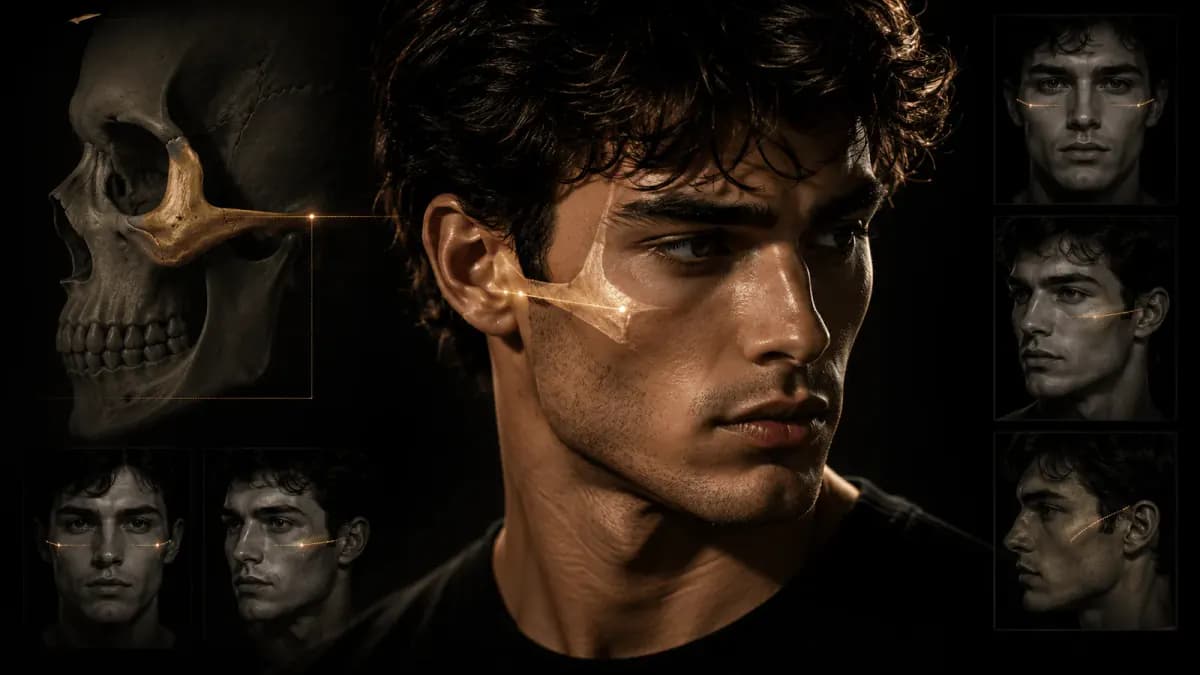
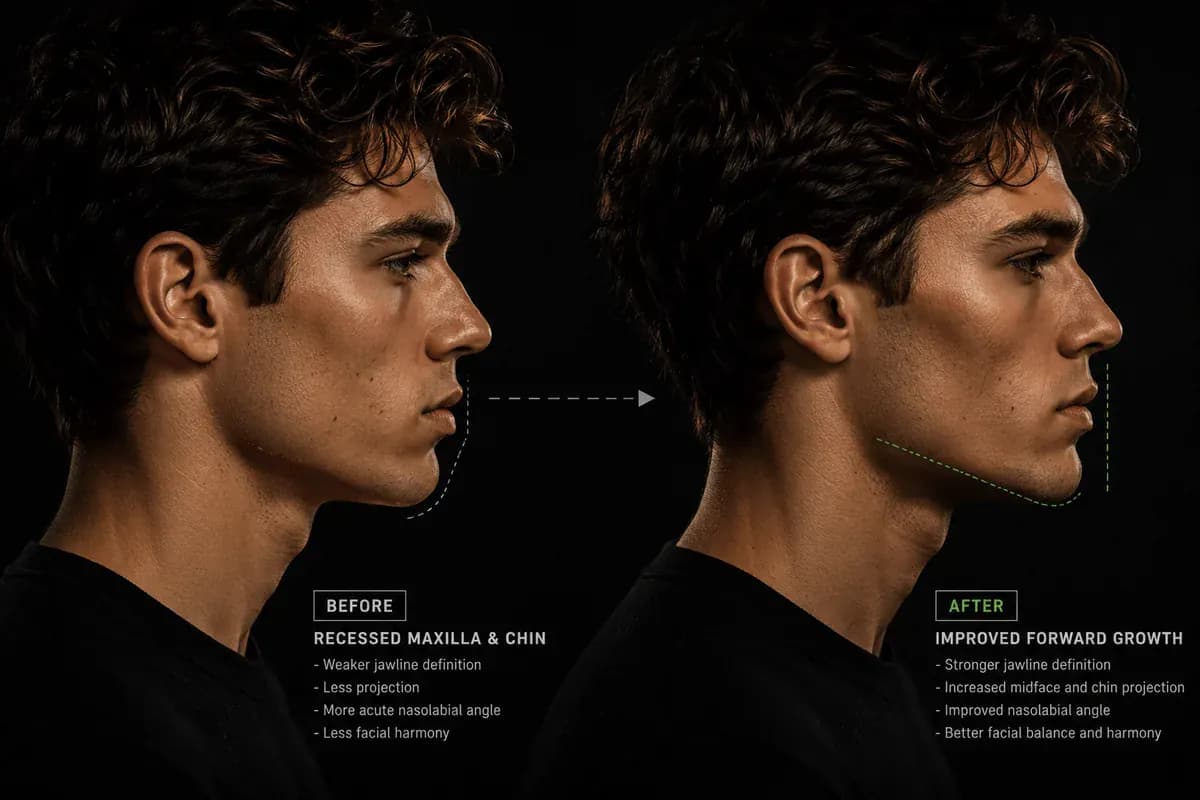
Your chin is the front edge of your profile. If it sits well behind the lips (retrogenia or microgenia), there's less bone holding the tissue under your jaw taut. The area between chin and neck is shorter, so the same tissue looks fuller even with very little fat in it. A short or steep jaw does the same thing. The facial structure guide explains how the chin, jaw angle and ramus fit together.
The goal isn't a huge chin. It's a clean cervicomental angle: the angle between the underside of your jaw and the front of your neck. In a study where raters judged profile silhouettes with that angle changed in 5-degree steps, 90 to 105 degrees was rated acceptable and 125 to 130 degrees very unattractive. Patients wanted surgery at a lower threshold (110 degrees) than laypeople (115) or clinicians (125).1 In other words, people who already worry about their profile judge themselves harder than anyone else does.
The honest part: adult chin bone doesn't change with exercise, mewing, chin straps or "bonesmashing." The mewing guide covers why the adult-bone claims fail, and hitting your face to remodel bone is just a way to injure it.
Hyoid position and the neck angle
The hyoid is a small U-shaped bone at the top of your neck, above the Adam's apple. Muscles from the floor of your mouth attach to it, so its height sets where your jaw turns into your neck. A high hyoid gives a sharp corner under the jaw. A low or forward hyoid makes the neck slope down from the chin, which looks like a double chin even in very lean people.
Hyoid position is mostly anatomy, but it shifts over time. A CT study of 282 adults found the hyoid sits lower with age in both sexes, and higher BMI went with a more forward hyoid (about 2 mm per 5 BMI points).2 That's one well-run imaging study, and the scans were taken lying down, so upright position still needs study.
Surgeons have long recognized this. Ellenbogen and Karlin's 1980 paper on visual criteria for a youthful neck specifically discussed patients with a "low-lying hyoid," arguing a good neck-lift result is still possible in most of them.3 Later papers summarize their criteria as a distinct lower jaw border, a visible hollow below the hyoid, a visible thyroid cartilage, a visible front edge of the sternocleidomastoid, and a cervicomental angle of roughly 105 to 120 degrees. Those criteria were written for facelift patients, mostly women, so don't treat them as a scorecard for a 25-year-old man.
What you can do: you can't move the hyoid without surgery, and even surgery has limits there. You can avoid making it look worse: posture and photo angles matter more for you than for someone with a high hyoid.
Posture and phone neck
When your head drifts forward of your shoulders, the space between jaw and collarbone shrinks and the tissue under the chin bunches up. This is the "double chin at low body fat" the posture guide describes, and it also makes the neck look shorter and thicker.
No study has directly measured how forward head posture changes the area under the chin, so this rests on simple mechanics, not trials. But it's the easiest cause to test: stand side-on to a mirror, draw your head straight back (not down) until your ear lines up over your shoulder, and look again.
What helps:
- Chin tucks a few times a day: slide your head straight back with your eyes level, hold 2 to 3 seconds.
- Upper-back training (rows, rear-delt flyes, face pulls) so you can hold that position without effort.
- Screen height: raise your phone to your eyes instead of dropping your head to it; put the top of your monitor near eye level.
Once you're lean, a stronger neck also helps tighten the jaw-to-neck line; the neck training guide has a safe starter routine.
Why it shows when you look down (and why that's normal)
When you tilt your head down, your chin gets closer to your chest. The skin, the thin platysma muscle and whatever fat sits under your chin have to go somewhere, so they fold. That happens to almost everyone, lean athletes and models included.
Cameras make it worse. A phone held below your face, a laptop on your lap or a phone propped on a desk puts you in exactly the looking-down position, with the lens closest to your neck. If you mostly notice your double chin on selfies and video calls, the mirror vs camera guide explains how camera distance and angle change your face.
Double chin when smiling. A big smile lifts the cheeks and tenses the muscles around the mouth and neck, and many people pull their chin back as they laugh. That squeezes the tissue under the jaw. Nobody has studied this specifically. If it only shows mid-laugh, it's normal.
Photo fix: camera at eye level or slightly above, head slightly forward with the chin a touch down (lead with your forehead), shoulders back. Photographers use this because it stretches the jaw-to-neck line instead of folding it.
How to get rid of a double chin without surgery
Match the fix to the cause:
Posture: fix it first. It's free, reversible, and the visual change is immediate.
A small fat pocket: some people store fat under the chin even at a healthy weight, partly for genetic reasons. If you have room to get leaner, moderate fat loss can shrink it, but chin exercises can't spot-reduce it. Don't chase very low body fat for this; past a point the face looks gaunt and older (see body fat and facial definition). If you're already properly lean and it stays, that's when injections or liposuction make sense.
Structure (chin or hyoid): non-surgical options only change presentation. A short, well-shaped beard can add visual chin length and blur the jaw-to-neck line. Posture and photo angles help too.
Skin laxity: daily sunscreen on the neck and a retinoid improve skin quality over months, but they won't tighten clearly loose skin.
What doesn't work: chin straps, "double chin" jaw exercisers, face yoga for under-chin fat, slimming creams and bonesmashing. There's no good evidence any of them reduce fat or change bone, and jaw devices can strain the jaw joint.
Medical options, briefly
Each of these targets one cause, so do the self-check before you book anything.
Deoxycholic acid injections (ATX-101, sold as Kybella). A prescription injection that destroys fat cells under the chin, tested in two large placebo-controlled phase 3 trials. In REFINE-1 (about 500 adults with moderate or severe submental fat), 70% improved by at least one grade on combined clinician and patient scales versus 18.6% on placebo, but only 13.4% improved by two grades. More sessions helped: 55% had a one-grade improvement after two treatments, 75% after four.4 REFINE-2 (258 people per group) was similar: 66.5% versus 22.2% for one grade, 18.6% versus 3.0% for two.5 Both trials were funded by the drug's maker.
Expect several sessions about a month apart, with swelling, bruising, numbness and soreness at the injection site. The key serious risk is injury to the nerve that controls the lower lip, which causes an uneven smile: 4.3% of treated people in REFINE-1, usually mild and temporary.4 Trouble swallowing and skin sores are rarer serious side effects that need a doctor promptly.6 It only treats fat, so if you're lean with a recessed chin or low hyoid, there may be little for it to fix.
Submental liposuction. A surgeon removes fat through a small incision under the chin. One procedure, more downtime than injections. It works best on a real fat pocket with skin elastic enough to tighten afterward, which is more often true in younger men. It doesn't fix structure.
Chin implant or sliding genioplasty. If your chin sits well back, moving it forward lengthens the area under the jaw and can sharpen the neck angle. An implant sits on the bone; a sliding genioplasty cuts the chin bone and moves it forward. In a 1990 comparison of 76 patients, both had high satisfaction, but the bone procedure improved the cervicomental angle more and gave more predictable soft-tissue results.7 That's one old retrospective study, so treat it as a rough guide. If your chin sits back because of your bite, a surgeon or orthodontist may suggest jaw surgery instead. For significant loose skin in older men, a neck lift is the bigger option.
See a board-certified dermatologist, plastic surgeon or facial plastic surgeon who identifies your cause before recommending a treatment. If someone offers injections without looking at your chin position and skin, ask why.
When to see a doctor
Most double chins in lean men are cosmetic. See a doctor if you have:
- A new lump under the chin or in the neck that's firm, growing, or still there after a few weeks
- Swelling with pain, fever or redness, which can mean an infected gland or lymph node
- Trouble swallowing or breathing, or a lump that moves when you swallow (possibly thyroid)
- Fast facial or neck swelling alongside weight gain, fatigue or other body changes
- Loud snoring with pauses in breathing. A recessed jaw and low hyoid are linked to sleep apnea, which is worth checking for its own sake
Frequently Asked Questions
Why do I have a double chin even when I'm skinny? Usually structure or angle rather than fat: a chin that sits back, a low hyoid, forward head posture, or photos taken from below. Some lean people also keep a small, partly genetic fat pocket under the chin.
Is a double chin when looking down normal? Yes. Looking down shortens the distance between chin and chest, so the tissue folds. Almost everyone gets this. It only tells you something if it's still there with your head level.
Why does my jawline disappear when I look down? Same reason: the underside of your jaw folds against your neck, so the clean angle is gone. A low camera makes it worse; keep it at eye level.
Why do I get a double chin when smiling? Smiling tenses the muscles around the mouth and neck, and many people pull their chin back when they laugh. It's normal and hasn't been specifically studied.
How do I get rid of a double chin when I'm skinny? Start with posture and photo angles. If a real fat pocket remains once you're lean, deoxycholic acid injections or liposuction are the evidence-based options. For a recessed chin, only an implant or genioplasty changes the structure.
Can I get rid of a double chin without surgery? Often, at least visually: better posture, better camera angles and moderate fat loss if you have some to lose. Deoxycholic acid injections are the main non-surgical medical option, but they only target fat.
The bottom line
A double chin on a lean man is usually about structure and angle, not fat. If the fold only appears when you look down, that's normal anatomy; keep the camera at eye level. If posture is involved, chin tucks and back training are the quickest win. If a stubborn fat pocket remains once you're lean, injections or liposuction work on fat and nothing else. If your chin sits well back, only surgery changes the bone, and that decision deserves time and a qualified surgeon. Chin straps and bonesmashing don't work.
References
Footnotes
-
Naini FB, Cobourne MT, McDonald F, Wertheim D. Submental-Cervical Angle: Perceived Attractiveness and Threshold Values of Desire for Surgery. Journal of Maxillofacial and Oral Surgery (2016);15(4):469-477. https://pubmed.ncbi.nlm.nih.gov/27833339/: angles of 90 to 105 degrees were rated acceptable; patients wanted surgery from 110 degrees, laypeople from 115, clinicians from 125. ↩
-
Pazelli AM, Shehab AA, Rames JD, Hussein SM, Bustos SS, Sears VA, Wentworth AJ, Morris JM, Sharaf BA. Hyoid Position and Aging: A Comprehensive Analysis Using AI-assisted Segmentation of 282 Computed Tomography Scans. Plastic and Reconstructive Surgery Global Open (2024);12(9):e6119. https://pubmed.ncbi.nlm.nih.gov/39247578/: the hyoid descends with age in both sexes, and every 5 BMI points goes with about 2 mm of forward movement. ↩
-
Ellenbogen R, Karlin JV. Visual criteria for success in restoring the youthful neck. Plastic and Reconstructive Surgery (1980);66(6):826-837. https://pubmed.ncbi.nlm.nih.gov/7443846/: proposed visual criteria for a youthful neck and argued they can be met in most neck-lift patients, even those with a low-lying hyoid. ↩
-
Jones DH, Carruthers J, Joseph JH, Callender VD, Walker P, Lee DR, Subramanian M, Lizzul PF, Gross TM, Beddingfield FC. REFINE-1, a Multicenter, Randomized, Double-Blind, Placebo-Controlled, Phase 3 Trial With ATX-101, an Injectable Drug for Submental Fat Reduction. Dermatologic Surgery (2016);42(1):38-49. https://pubmed.ncbi.nlm.nih.gov/26673433/: 70.0% vs 18.6% achieved a one-grade composite improvement; marginal mandibular nerve paresis occurred in 4.3% of treated subjects and resolved. ↩ ↩2
-
Humphrey S, Sykes J, Kantor J, Bertucci V, Walker P, Lee DR, Lizzul PF, Gross TM, Beddingfield FC. ATX-101 for reduction of submental fat: A phase III randomized controlled trial. Journal of the American Academy of Dermatology (2016);75(4):788-797.e7. https://pubmed.ncbi.nlm.nih.gov/27430612/: 66.5% vs 22.2% achieved a one-grade improvement and 18.6% vs 3.0% a two-grade improvement. ↩
-
MedlinePlus (US National Library of Medicine). Deoxycholic Acid Injection. https://medlineplus.gov/druginfo/meds/a615026.html: used for moderate to severe fat under the chin; serious side effects include trouble swallowing, an uneven smile and skin sores. ↩
-
Guyuron B, Raszewski RL. A critical comparison of osteoplastic and alloplastic augmentation genioplasty. Aesthetic Plastic Surgery (1990);14(3):199-206. https://pubmed.ncbi.nlm.nih.gov/2399851/: in 76 patients both approaches had high satisfaction, but bony genioplasty improved the cervicomental angle more. ↩