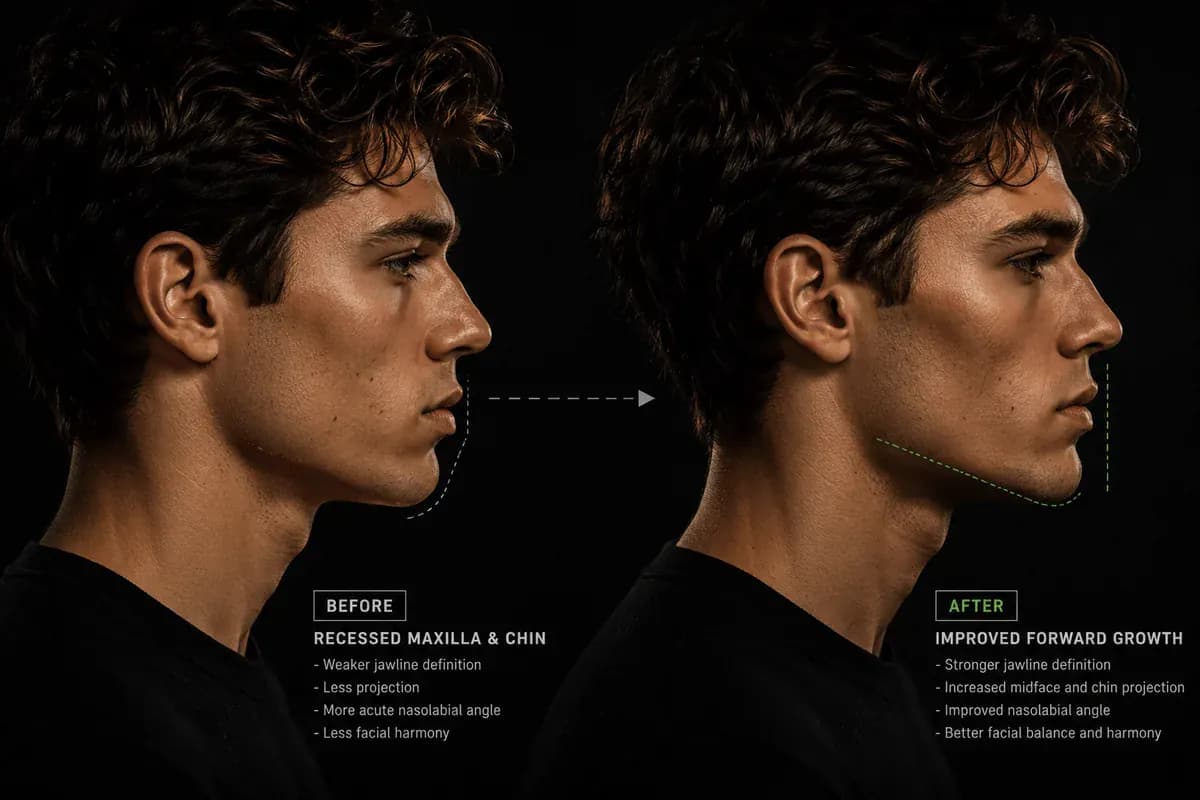
Jawline Gum and Mastic Gum: Does Mastic Gum Help Your Jawline?
Does mastic gum help your jawline? Based on the research that exists, no. The only randomized trial that measured it found that six months of regular gum chewing made people bite harder but did not thicken their jaw muscles or change the shape of their jaw.1 No study has tested mastic gum or branded "jawline gum" for appearance at all.
That hasn't stopped the marketing. Science News looked at five major mastic gum brands advertising on TikTok and found three of them promoting jaw sharpening, with no research behind the claim.2 Meanwhile, the risks of chewing very hard gum for long sessions (jaw pain, flare-ups of jaw joint problems, cracked teeth and broken fillings) are real, if usually manageable.
This guide covers what hard gum actually does to the masseter, why the before-and-after photos are so convincing, who should skip it entirely, and what actually changes a jawline. For tongue posture and chewing in general, see the mewing and chewing guide; this page is about the gum products.
The short answer
Short answer: Gum chewing trains bite force, not visible jaw size. One six-month randomized trial found no change in masseter thickness or jaw shape.1 Mastic has some evidence for oral health (less plaque), but nothing for appearance.32 If your jawline looks better after a few months of "jawline gum," fat loss, posture or the camera is the likely reason.
Here's how the main claims stack up:
| Claim | What the evidence says | Strength |
|---|---|---|
| Hard gum makes the masseter bigger | One RCT: no change in masseter thickness after 6 months | One small trial (58 people) |
| Gum reshapes the jawbone | Same RCT: no change in mandible shape | One small trial, plus adult bone is largely set |
| Gum makes your bite stronger | Same RCT: maximum bite force went up | One small trial |
| Mastic is better for teeth than regular gum | Review: antibacterial, less plaque buildup | Small, early studies |
| Mastic sharpens the jaw | No research at all | None |
What hard gum can and can't do to the masseter
The masseter is the thick chewing muscle at the back corner of your jaw. It's a skeletal muscle, so the logic behind jawline gum sounds reasonable: load it hard and often, and it should grow, like a bicep.
The problem is that this has been tested, and it didn't pan out. In a randomized controlled trial at Yonsei University, 58 healthy adults were split into a gum-chewing group (gum three times a day for six months) and a control group. Researchers measured masseter thickness and jaw shape at the start and end. Maximum bite force went up significantly by three months. Masseter thickness and jaw shape did not change.1 The authors put the bite-force gain down to a larger contact area between the teeth, not bigger muscle.
A few honest caveats:
- It's one trial. It used regular gum, not mastic or extra-hard "jawline gum," and 58 people is small. A harder gum chewed for longer could plausibly do more. But "plausibly" is all anyone selling these products can say, because nobody has published a study showing it.
- Muscle can grow from heavy use. In the review literature, very frequent, long-duration gum chewing has been linked with masseter enlargement, alongside jaw pain.4 That's the catch: the doses that might add bulk are the same doses linked to symptoms.
- A bigger masseter isn't the same as a sharper jaw. The masseter sits on the side of the jaw. More of it adds width at the lower face, not a crisp jaw-to-neck line. That line comes from leanness and posture, covered below.
Bottom line for this section: gum is a decent bite-strength trainer and a poor jaw-sculpting tool, based on the limited evidence we have.
Does mastic gum help your jawline more than regular gum?
Mastic is a resin from the mastic tree (Pistacia lentiscus), traditionally chewed in the Mediterranean. It's much firmer than regular gum, which is why it became the jawline product of choice. But no study has compared it with regular gum for jaw muscle or jaw shape, so there's no evidence it works better.2
Its real evidence is about the mouth, not the face. A 2023 review of 14 studies found mastic gum had antibacterial effects and reduced plaque buildup, making it a possible add-on for cavity prevention, with no notable side effects reported in the trials reviewed. The authors still called for more research before recommending it.3 Science News also notes that most of the gut and metabolic claims come from studies using mastic oil or powder, not chewed gum.2
So mastic is a reasonable choice if you like chewing gum and want a possible plaque benefit. It isn't a better jaw trainer in any way that's been measured; it's just harder, which matters for the risks below.
Why "before and after" photos mislead
Jawline gum before-and-after photos are the main selling point, and almost all of the visible change in them can be explained without any muscle growth:
- Fat loss. Facial definition depends heavily on body fat. Someone who starts chewing gum while also dieting (or just gets a few pounds leaner over three months) will see a sharper jaw regardless of the gum. The full picture is in body fat and facial definition.
- Camera distance and lens. Close-up phone photos distort facial proportions. One modeling study found a photo taken at about 12 inches made the nose look roughly 30% wider than an undistorted view, with almost no distortion at 5 feet.5 A close "before" and a more distant "after" changes the whole face.
- Angle and head position. Chin slightly down and forward, a flatter jaw-to-neck angle. Chin slightly up with the neck long, a sharper one.
- Clenching. Biting down for the photo makes the masseter bulge temporarily. Anyone can do this in the "after" shot.
- Lighting. Overhead or side light carves shadows under the jaw; flat front light erases them.
- Posture. Forward head posture softens the jawline. Standing straighter for the second photo is an instant "result." See the posture guide.
If a before-and-after doesn't control for weight, distance, angle, lighting and expression, it tells you nothing about the gum. None of the ones in gum ads do.
Risks: jaw pain, TMJ and dental work
For most healthy people, a bit of gum is harmless. The risks rise with harder gum, longer sessions and existing problems.
Jaw muscle pain and fatigue. In a small lab study, women without jaw problems chewed hard gum, soft gum or nothing for 40 minutes. Pain and fatigue rose only with the hard gum, and they settled back close to baseline within about 10 minutes of stopping.6 So hard gum does tire and hurt the muscles in the short term, but in healthy jaws it usually passes quickly.
Temporomandibular disorders (TMD). This is where the evidence is genuinely mixed. A 2025 systematic review of eight small studies found everything from no meaningful effect to a possible dose-response pattern, where more frequent and longer chewing went with more joint pain, muscle pain and masseter enlargement. In several studies, symptoms eased once people stopped chewing. The reviewers rated the certainty of the evidence as low.4 A 2025 cross-sectional study of 66 young adults found no significant link between gum-chewing frequency or duration and TMD, though the authors noted the small sample and design limit what it can show.7 The fair reading: gum probably doesn't cause TMD on its own, but heavy chewing can aggravate jaw symptoms, and TMD is multifactorial, involving genes, stress and pain sensitivity.8
Clenching and grinding. An orofacial medicine specialist quoted by Science News said she has seen patients develop jaw pain or clench so hard they grind through night guards, and she doesn't recommend chewing any gum.2 That's clinical experience, not trial data, but it fits the review findings.
Fillings, crowns and cracked teeth. A Cleveland Clinic periodontist advises that people with a lot of dental work may want to avoid gum, because it can raise the risk of fillings or crowns breaking and can cause natural teeth to crack or split. She also says the main group who should avoid gum is people with a known TMD.9 Common sense says this risk is higher with mastic and extra-firm gums, which take more force to chew. If you care about your smile, a cracked molar is a much worse outcome than a soft jawline; see teeth and your smile.
Who should skip it entirely:
- Anyone with diagnosed TMD or current jaw joint pain
- People with many fillings, crowns, veneers or cracked teeth
- Anyone who already clenches or grinds (especially at night)
- People with braces or other orthodontic appliances
If you still want to try it
If you enjoy chewing and want to experiment, do it in a way that limits the downside:
- Start with regular sugar-free gum, not mastic. You can always go firmer later. Sugar-free gum also has a real benefit: it boosts saliva, which helps rinse food away and neutralize acids. Cleveland Clinic describes about 10 to 15 minutes after a meal as generally safe, and suggests avoiding sour or acidic flavors that can wear enamel.9
- Keep sessions short. The hard-gum pain in the lab study came from 40-minute sessions.6 There's no need to chew for an hour.
- Alternate sides. Don't do all your chewing on one side.
- Know the stop signs. Muscle tiredness that fades within minutes is normal. Stop if you get jaw or joint pain that lingers, painful clicking, locking, or a change in how your teeth fit together.8
- Set expectations. Track your weight and take photos in the same light, at the same distance, with a relaxed jaw. If nothing changes at a stable weight after three months, you have your answer.
Which gum is best for jawline? There's no evidence that any gum is best for appearance, because none has been shown to work. If you chew anyway, the "best" gum is a sugar-free one firm enough to be satisfying and soft enough not to hurt.
What actually changes a jawline
The levers that work are the boring ones, in rough order of impact:
- Lower body fat. The biggest changeable factor in jaw definition by a wide margin. A masseter you can't see under fat doesn't matter. Start with body fat and facial definition.
- Posture. Forward head posture blurs the jaw-to-neck line; correcting it is one of the fastest visible changes available. See the posture guide.
- Photo technique. Distance, light and angle can make the same jaw look strong or weak in seconds.
- Grooming. A beard shaped along the jawline can add visual structure; a messy one hides it.
- Procedures, if it truly bothers you. Chin and jaw implants, fillers and jaw surgery do change structure, with real cost, risk and recovery. That's a conversation with a board-certified facial plastic surgeon or oral and maxillofacial surgeon, not something gum can substitute for.
For an honest look at what's worth your effort and what isn't, see cope or not: what you can actually change.
When to see a dentist or doctor
See a dentist if you notice a tooth that hurts when you bite, a chipped or loose filling, or a crown that feels different. See a dentist or doctor if you have jaw pain that doesn't settle after a few days of rest, a jaw that locks or won't open fully, painful clicking, or a bite that suddenly feels off. Most TMDs are temporary and respond to simple care such as soft foods, heat or cold, and cutting back on gum chewing and clenching, so try conservative options first and be wary of anyone pushing irreversible treatments early.8
Frequently Asked Questions
Does jawline gum actually work? Not for appearance, as far as the evidence shows. The one randomized trial found six months of gum chewing increased bite force but didn't change masseter thickness or jaw shape.1 Branded jawline gums haven't been tested in published studies.
Does mastic gum actually work? For your jaw, there's no research supporting it.2 For your mouth, early studies suggest it may reduce plaque and have antibacterial effects, though more research is needed.3
What are realistic chewing gum jawline results? Stronger bite force within a few months is the only measured result.1 Any visible change is more likely to come from fat loss, posture or photo differences than from the gum.
Are jawline gum before and after photos real? Some are genuine photos, but they rarely control for weight, camera distance, angle, lighting or clenching, which can change how a jaw looks on their own.5
What gum should I chew for my jawline? No gum has been shown to improve your jawline. If you chew for other reasons, a sugar-free gum in short sessions is the lowest-risk option.9 Skip very hard gums if you have dental work or jaw pain.
Can chewing gum cause TMJ problems? The evidence is mixed and low-certainty. Heavy, frequent chewing has been linked to jaw muscle and joint symptoms that often ease when you stop, but gum probably isn't a cause on its own.47
The bottom line
Mastic gum and jawline gum are untested products built on a reasonable-sounding idea that the one relevant trial didn't support. Gum makes your bite stronger, not your jaw bigger or sharper, and the hardest gums carry the most risk to your jaw joint and dental work. If you like chewing, sugar-free gum in short sessions is fine. If you want a better jawline, get leaner, fix your posture and learn how photos distort faces. That's where the real, visible change is.
References
Footnotes
-
Jung HJ, Hwangbo NK, Park Y, Ahn HJ. Effects of gum chewing training on occlusal force, masseter muscle thickness and mandibular shape: A randomised controlled clinical trial. Journal of Oral Rehabilitation (2024);51(12):2529-2536. https://pubmed.ncbi.nlm.nih.gov/39215439/: In 58 adults, six months of gum chewing raised maximum bite force but did not change masseter thickness or mandible shape. ↩ ↩2 ↩3 ↩4 ↩5
-
Santora T. No, mastic gum won't reshape your jaw. Science News (2026). https://www.sciencenews.org/article/mastic-gum-benefits-jaw-antibacterial: No research supports mastic's jaw-shaping claims; three of five major brands on TikTok promote them; mastic's evidence is mainly for oral health. ↩ ↩2 ↩3 ↩4 ↩5 ↩6
-
Alwadi MAM, Sidhu A, Khaled MB, Aboul-Enein BH. Mastic (Pistacia lentiscus) gum and oral health: a state-of-the-art review of the literature. Journal of Natural Medicines (2023);77(3):430-445. https://pubmed.ncbi.nlm.nih.gov/37147480/: Across 14 studies, mastic showed antibacterial effects and reduced plaque buildup; more research needed. ↩ ↩2 ↩3
-
Alam MK, Al Shayeb M, Natarajan PM, et al. Association of temporomandibular disorders and other jaw anomalies in chewing gum users: a systematic review. Journal of Oral & Facial Pain and Headache (2025);39(2):35-47. https://pmc.ncbi.nlm.nih.gov/articles/PMC12520423/: Eight small studies showed effects ranging from negligible to a possible dose-response link with TMD symptoms and masseter hypertrophy; low-certainty evidence. ↩ ↩2 ↩3
-
Ward B, Ward M, Fried O, Paskhover B. Nasal Distortion in Short-Distance Photographs: The Selfie Effect. JAMA Facial Plastic Surgery (2018);20(4):333-335. https://pmc.ncbi.nlm.nih.gov/articles/PMC5876805/: At about 12 inches, photos made the nose look roughly 30% wider than an undistorted view; at 5 feet distortion was negligible. ↩ ↩2
-
Farella M, Bakke M, Michelotti A, Martina R. Effects of prolonged gum chewing on pain and fatigue in human jaw muscles. European Journal of Oral Sciences (2001);109(2):81-85. https://pubmed.ncbi.nlm.nih.gov/11347660/: In 15 women without TMD, 40 minutes of hard (not soft) gum chewing increased jaw pain and fatigue, which returned near baseline after 10 minutes. ↩ ↩2
-
Yushchenko Y, Zemowski M, Yefimchuk D, Wieczorek A. Association Between Gum Chewing and Temporomandibular Disorders. Journal of Clinical Medicine (2025);14(15):5253. https://pmc.ncbi.nlm.nih.gov/articles/PMC12347383/: In 66 young adults, gum-chewing frequency, duration and chronicity were not significantly associated with TMD. ↩ ↩2
-
National Institute of Dental and Craniofacial Research. TMD (Temporomandibular Disorders). NIDCR (n.d.). https://www.nidcr.nih.gov/health-info/tmd: Lists TMD symptoms, notes causes are multifactorial, and recommends conservative care first, including cutting back on gum chewing. ↩ ↩2 ↩3
-
Cleveland Clinic. Is Chewing Gum Bad for Your Teeth? Cleveland Clinic Newsroom (2026). https://newsroom.clevelandclinic.org/2026/09/29/is-chewing-gum-bad-for-your-teeth: A periodontist advises people with TMD or extensive dental work to avoid gum; 10 to 15 minutes of sugar-free gum after meals is generally safe. ↩ ↩2 ↩3