Cope or Not? What Actually Works in Looksmaxxing
Looksmaxxing sits somewhere between legitimate self-improvement, basic grooming, useful health advice, and claims that go far beyond what the underlying biology supports.
That can make it difficult to tell what is actually worth doing.
Some strategies can produce noticeable changes in appearance. Others primarily improve health or function without substantially changing how you look. Some create temporary visual effects that are mistaken for permanent structural changes. And some popular claims simply have little evidence behind them.
This guide separates these categories.
The goal is not to dismiss every unconventional strategy or promise a transformation. It is to look at what the intervention can realistically change, what it cannot change, and how meaningful the result is likely to be.
Tongue-to-Palate Posture (Mewing)
Verdict: Limited effect in adults; frequently overstated.
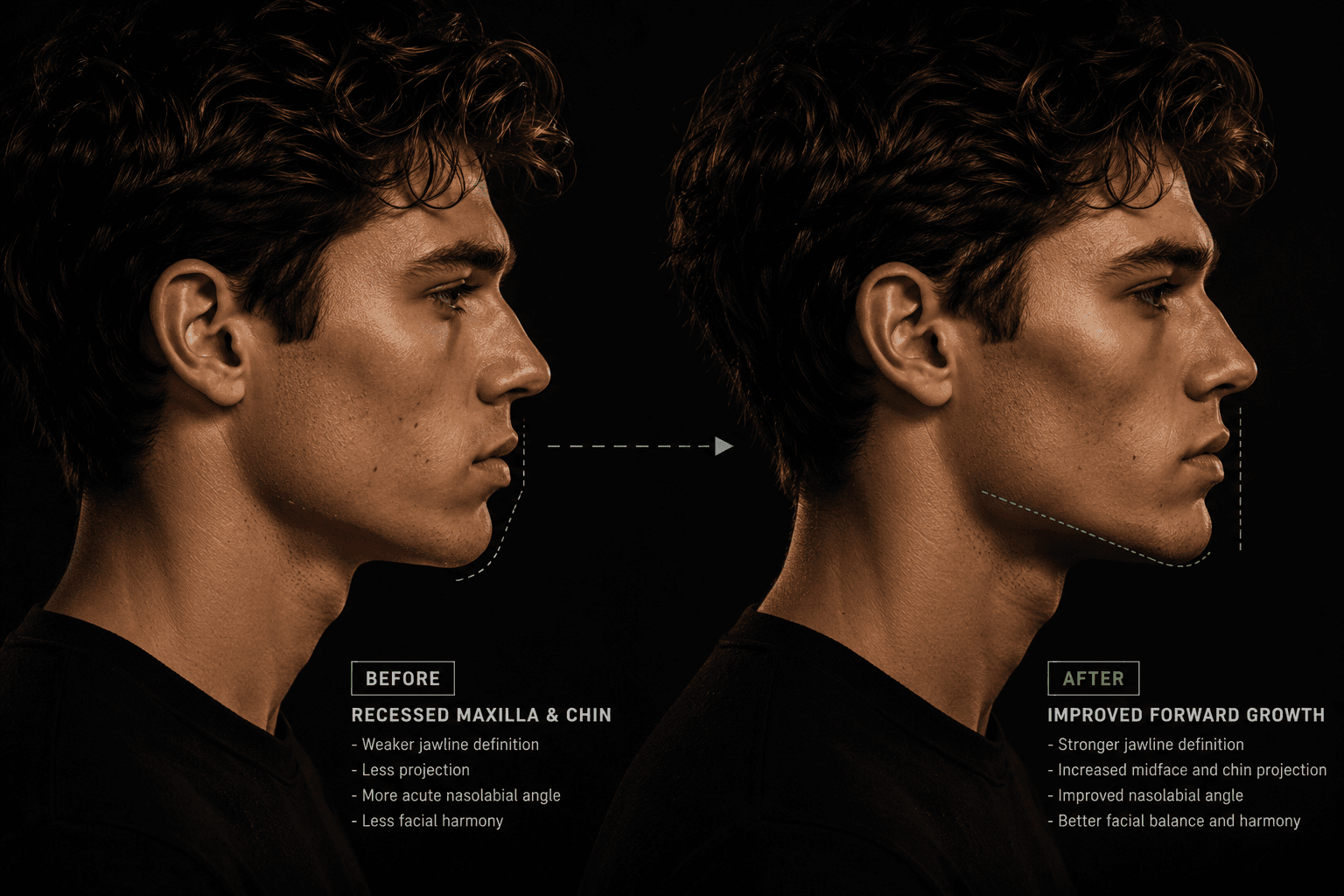
Tongue posture is relevant to swallowing, oral function, breathing patterns, and resting posture. During childhood and adolescence, the forces acting on the teeth and developing craniofacial structures can influence growth.
That does not mean the same process can be used to substantially reshape an already mature adult face.
What it may help with
- More consistent nasal breathing when poor tongue posture is contributing to an inefficient breathing pattern
- Resting oral posture
- Swallowing mechanics
- General awareness of head and neck posture
What it is unlikely to do
- Meaningfully advance the adult maxilla
- Lengthen the mandible
- Permanently project the chin
- Dramatically change facial proportions
There is not good evidence that simply pressing the tongue against the palate produces major skeletal changes in healthy adults. Reviews of conservative facial-rejuvenation techniques have also found limited evidence for many popular mechanical facial techniques, including mewing-related approaches. 1
Excessive force is also not a better version of mewing. Aggressive tongue pressure can contribute to jaw tension or aggravate existing temporomandibular problems.
Bottom line: Mewing can be relevant to oral and postural function, but treating it as a reliable method for remodeling adult facial bones is mostly cope.
Masseter Loading: Chewing gum and Jaw Devices
Verdict: Real muscular effect, but commonly exaggerated.
The masseter is a muscle. Like other muscles, it can respond to repeated loading.
Chewing activity can increase masticatory muscle activity and may influence muscle function over time. However, these effects should not be confused with the dramatic facial changes sometimes attributed to chewing-based looksmaxxing strategies. 2
Simply chewing gum should not be expected to produce significant jaw enlargement, mandibular growth, or major changes in facial structure.
More chewing is also not automatically better. Excessive loading can contribute to jaw pain, muscle tension, tooth wear, or aggravation of existing TMJ problems.
Bottom line: Chewing can have genuine effects on masticatory function, but the evidence does not support treating ordinary gum chewing as a reliable method for dramatically increasing masseter size or changing the underlying jaw structure.
What it can potentially change
- Masseter muscle development
- Lower-face fullness
- The visual width of the jaw area
What it does not reliably do
- Lengthen the mandible
- Move the chin forward
- Increase mandibular projection
- Reshape the entire facial skeleton
More chewing is also not automatically better. Excessive loading can contribute to jaw pain, muscle tension, tooth wear, or aggravation of existing TMJ problems.
Bottom line: Masseter training can have a real effect on soft tissue, but it should not be confused with skeletal jaw development.
Posture Correction
Verdict: Not cope. One of the more useful indirect changes.
Head and neck posture can substantially change how the face and neck are presented.
Forward head posture can alter the apparent relationship between the jaw, chin, and neck. Improving overall posture can therefore make the jawline and cervicomental area look cleaner without changing the underlying bones.
Useful areas to work on
- Cervical posture
- Thoracic extension
- Upper-back strength
- Scapular control
- General standing and sitting posture
The important distinction is that posture changes position and presentation, not the underlying facial skeleton.
You are not growing a new jaw by fixing forward head posture. You are presenting the existing one more effectively.
Bottom line: Posture is a legitimate aesthetic modifier and often has a better return on effort than chasing questionable facial hacks.
Facial Fat Reduction
Verdict: Not cope. Potentially a major visual change.
Facial fat can obscure the contours created by the underlying facial skeleton.
Research has found a consistent relationship between facial adiposity and perceptions of attractiveness and health, although the relationship is influenced by individual differences and is not reducible to a single ideal body-fat percentage. 3
As overall body fat decreases, some people experience:
- More visible cheekbones
- A sharper jawline
- Greater separation between facial structures
- Less fullness around the lower face
- More visible orbital contours
The amount of change varies considerably between individuals because fat distribution is strongly influenced by genetics.
There is also no reliable way to selectively burn facial fat. Overall fat loss is what changes facial adiposity.
Going excessively lean is not automatically better, either. Very low body fat can negatively affect health and, depending on the individual, can make the face look more gaunt rather than more attractive.
Bottom line: Reducing excess body fat is one of the most reliable natural ways to change facial appearance, but the optimal level is individual rather than a single magic percentage.
Sodium and Fluid Manipulation
Verdict: Temporary visual effect, not structural change.
Changes in sodium intake, carbohydrate intake, hydration, sleep, and other factors can affect fluid balance and extracellular fluid volume.
This can sometimes make the face appear temporarily:
- Less puffy
- More defined
- Less swollen
That can be useful for photography or a specific event, but it should not be confused with losing facial fat or changing facial structure.
Aggressively restricting sodium or dehydrating yourself is not a sustainable aesthetic strategy and can be harmful.
Bottom line: Debloating can change appearance temporarily. It does not change your underlying facial structure.
Testosterone Optimization
Claim: Increasing testosterone will improve masculinity and appearance.
Effect: Important when deficient; commonly exaggerated when already normal.
Testosterone influences muscle mass, body-fat distribution, skin, sexual function, and other aspects of male physiology.
Restoring normal testosterone levels in someone with clinically low testosterone can improve health and potentially some aspects of physical appearance. Testosterone treatment is generally considered in men with confirmed hypogonadism rather than simply as an aesthetic optimization strategy. 4
This is a physiological explanation, not a recommendation to manipulate hormone levels without medical supervision.
That does not mean that increasing testosterone beyond normal levels will continue producing proportional aesthetic benefits.
Key distinction:
- Correcting a genuine deficiency can be beneficial
- Increasing already-normal testosterone is not automatically beneficial
- Supraphysiologic testosterone can carry significant health risks
- A change in a hormone does not automatically translate into a noticeable change in attractiveness
Conclusion:
Normal hormone function matters. Chasing increasingly high testosterone is not the same thing as optimizing appearance.
Estrogen Suppression
Claim: Lowering estrogen can increase height or make a male more masculine.
Effect: The biology is real, but the internet interpretation is oversimplified.
Estrogen has important physiological roles in men, including effects on bone health and growth-plate maturation. 5
Because estrogen signaling is involved in growth-plate maturation, hormonal manipulation has been studied in specific medical contexts involving growth. This does not mean that lowering estrogen in a healthy person is a reliable or safe method of increasing height. 5
The common online idea of:
lower estrogen = more height
reduces a complex relationship between hormones and skeletal development to a simple formula that does not apply universally.
Excessive estrogen suppression can also produce unwanted effects.
Conclusion:
Estrogen is not simply a hormone that should be minimized. Hormonal manipulation should not be treated as a DIY height or masculinity hack.
Supplements
Verdict: Supportive, not transformative.
Effect: Some have legitimate physiological effects, but the aesthetic conclusions are often exaggerated.
Supplements are frequently presented as if they can dramatically alter facial appearance. Most cannot.
Creatine
Improves training output and can support increases in muscle mass and strength. 6
There is no good evidence that creatine directly changes facial structure.
Conclusion: Useful for training; not a facial transformation supplement.
Ashwagandha
Ashwagandha has been studied for stress, sleep, and several physiological outcomes. Some studies have reported changes in testosterone or other hormonal markers under specific circumstances. 7
That does not mean that taking ashwagandha will produce a large testosterone increase in every healthy man.
The size and consistency of the effect varies between studies and populations, and a change in a hormone measurement does not automatically produce a noticeable aesthetic change.
Conclusion: Potentially useful for specific purposes, but the claim that ashwagandha is a reliable testosterone-boosting shortcut is overstated.
Tongkat Ali
Tongkat Ali has been studied for stress and hormonal outcomes, but evidence for a large and consistent testosterone increase in healthy men is limited. 8
Even if a physiological effect occurs, that does not automatically mean a meaningful improvement in appearance.
Conclusion: Possible physiological effects, but commonly exaggerated as a testosterone or looksmaxxing shortcut.
Collagen
Collagen supplementation may provide modest benefits for skin hydration and elasticity in some people. 9 These effects are much more subtle than the claims commonly made online.
Bottom line: Supplements can support specific health or training goals, but they are rarely the difference between an average-looking face and a dramatically different one.
Skincare
Verdict: Not cope. High-value for many people and generally well supported.
Skin is one of the most visible components of facial appearance.
Even without changing facial structure, improving skin quality can substantially change how healthy, even, and refined a face appears.
A basic evidence-based routine generally focuses on:
- Daily sunscreen
- Appropriate acne treatment when needed
- Retinoids when appropriate
- Moisturization
- Gentle cleansing
- Avoiding unnecessary irritation
Depending on the problem, dermatological treatments can also address acne scars, pigmentation, vascular redness, and other concerns. 10
Unlike many facial “hacks,” skincare works on something that actually contributes directly to appearance: the skin itself.
Bottom line: Good skin does not replace strong facial structure, but poor skin can undermine it. This is one of the more consistently worthwhile areas to improve.
Hair and Beard
Verdict: Not cope. High-impact perceptual modifiers.
Hair is one of the first things people notice about the face.
Hair density, hairstyle, hairline, length, texture, and framing can all change facial proportions and perception without changing the face underneath.
For people experiencing androgenetic hair loss, evidence-based treatments such as minoxidil and finasteride can help slow progression and, in some cases, improve density. These treatments have potential side effects and should be approached appropriately rather than treated as casual cosmetic supplements. 11
Hair transplantation is another option for selected cases.
Beards can also alter facial perception by:
- Increasing the apparent lower-face density
- Making the chin appear more prominent
- Softening or disguising certain proportions
- Adding visual structure around the jaw
The effect depends heavily on beard density, growth pattern, and styling.
Bottom line: Hair and facial hair do not change your bone structure, but they can have a surprisingly large effect on how that structure is perceived.
The Eye Area
Verdict: Limited naturally; many online claims are exaggerated.
The eye area is one of the most difficult parts of the face to substantially change without professional intervention.
Sleep, allergies, hydration, skin quality, and general health can affect the appearance of the area around the eyes. Grooming can also make a noticeable difference.
However, these factors do not normally change the underlying orbital structure.
Perceptual modifiers
- Eyebrow shape
- Eyebrow density
- Eyelash appearance
- Skin quality
- Hairstyle and facial framing
- Colored contact lenses
These can alter perception without changing the anatomy of the eye itself.
For people with specific structural concerns, professional treatments or surgery may exist, but these are fundamentally different from exercises or internet techniques.
Bottom line: Lifestyle and grooming can improve the presentation of the eye area, but exercises cannot reliably remodel orbital anatomy.
Facial Exercises
Verdict: Low yield for most aesthetic goals.
The face contains muscles that can be trained, but this does not mean facial exercises can reshape the entire facial skeleton.
Some exercises may alter muscle activity or tone. However, the expected aesthetic effect is generally subtle compared with changes in body composition, skin, hair, or grooming. 12
Claims that facial exercises can permanently reshape the bones of a mature face should be treated skeptically.
Bottom line: Facial exercises are unlikely to produce the dramatic structural changes often promised online.
Breathing Pattern Correction
Verdict: Valuable for health and function; limited as an adult facial transformation method.
Chronic mouth breathing can be associated with poor sleep, dry mouth, and other problems. Addressing the underlying cause of dysfunctional breathing can therefore be worthwhile.
But improving breathing in an adult should not be confused with reversing years of craniofacial development.
If nasal obstruction is making nasal breathing difficult, the useful question is not which looksmaxxing hack to try. It is why the obstruction exists.
Bottom line: Fix breathing problems because breathing matters. Do not expect breathing exercises alone to rebuild adult facial structure.
Skull Expansion Devices
Verdict: Unsupported as a general adult facial transformation method.
Online communities sometimes promote devices that claim to expand the adult skull or dramatically widen the face.
The biology is considerably more complicated than simply applying pressure and expecting the entire facial skeleton to expand in a controlled aesthetic direction.
Unsupervised mechanical forces can also affect teeth, the bite, and surrounding tissues.
Orthodontic and medical devices do have legitimate applications under professional supervision, but that is very different from using an internet device as a DIY facial remodeling tool.
Bottom line: Do not confuse legitimate orthodontic treatment with unsupported DIY skull-expansion claims.
Eye Tilt Manipulation
Verdict: Mostly cope without structural intervention.
Eye shape and apparent eye tilt are influenced by the anatomy of the orbit, eyelids, surrounding soft tissues, and facial structure.
Exercises, facial massages, and similar techniques may temporarily alter muscle tension or swelling, but there is no good evidence that they can permanently reposition the underlying structures responsible for eye tilt.
Grooming can change perception. Structural changes are a different matter and may require professional intervention.
Bottom line: You can influence how the eye area is presented, but permanent structural changes should not be expected from exercises.
Height Modification
Verdict: Mostly unchangeable after growth, with limited presentation-based options.
Adult height is largely determined by skeletal growth and genetics.
Once growth is complete, lifestyle interventions cannot meaningfully lengthen the long bones.
There are, however, ways to change perceived height:
- Better posture
- Appropriate clothing proportions
- Footwear/Height insoles
- Body composition and muscular proportions
These can affect how tall someone appears without changing their actual height.
Surgical limb lengthening exists, but it is a major medical procedure with substantial costs, recovery, and risks. It should not be treated as a routine looksmaxxing technique. 13
Bottom line: Optimize presentation if height is a concern, but accept that adult skeletal height has a very high biological ceiling.
A Better Framework for Evaluating Looksmaxxing Claims
You do not need to believe everything in the looksmaxxing community, but you also do not need to dismiss everything either.
A useful way to evaluate a strategy is to ask four questions.
1. What is actually being changed?
Is the intervention affecting:
- Bone
- Muscle
- Fat
- Skin
- Hair
- Posture
- Temporary fluid retention
- Or simply perception?
This immediately eliminates a lot of exaggerated claims.
2. Is the proposed mechanism plausible in an adult?
An intervention that can influence development during childhood does not automatically retain the same ability to change mature anatomy.
3. Is there evidence of a meaningful visible effect?
A biological effect does not automatically mean the aesthetic claim is true.
Something can change a measurement in a laboratory without producing a meaningful difference in someone's appearance.
4. What is the risk-to-reward ratio?
An intervention that produces a tiny aesthetic improvement while carrying significant health or financial risks is rarely a good optimization strategy.
What Actually Has the Best Return?
If the goal is to improve appearance naturally, the highest-value changes are generally the ones that affect several visible variables at once.
High-value
- Improving excessive body fat
- Building an appropriate amount of muscle
- Improving posture
- Treating acne and maintaining skin quality
- Improving hair and facial-hair presentation
- Finding a flattering hairstyle
- Improving grooming
- Wearing clothing that fits well
- Getting adequate sleep and maintaining good general health
Real, but often overstated
- Mewing
- Chewing for facial aesthetics
- Facial exercises
- Supplements marketed for facial transformation
- Debloating strategies
- “Hormonal optimization” beyond correcting an actual deficiency
Primarily temporary or perceptual
- Fluid manipulation
- Certain grooming techniques
- Colored contacts
- Styling tricks
- Photography-specific preparation
Structural changes
Meaningful changes to mature facial anatomy are a different category. Orthodontic treatment, cosmetic procedures, and surgery can alter specific structures, but they come with costs, limitations, risks, and the need for professional assessment.
They should not be presented as equivalent to lifestyle changes.
Final Takeaways
Looksmaxxing works best when you understand what kind of change you are actually pursuing.
- Body composition can significantly change how the face and body look.
- Posture can change presentation without changing bone structure.
- Skin, hair, facial hair, and grooming are highly relevant to attractiveness.
- Muscle can be developed, but muscle growth is not the same as skeletal remodeling.
- Mewing and chewing are commonly given much larger claims than the evidence supports.
- Temporary changes in water retention should not be mistaken for permanent improvements.
- Normal hormone function matters; pushing hormones beyond normal levels is not a reliable aesthetic shortcut.
- Supplements can support health or training but rarely transform facial appearance.
- Adult facial structure has real biological limits.
- Professional procedures can produce structural changes, but they are fundamentally different from natural optimization.
The useful question is not whether every looksmaxxing claim is “real” or “cope.”
The better question is:
What does this actually change, how much does it change, and is the result worth the effort and risk?
That distinction makes it much easier to spend your time on interventions that produce real results instead of chasing increasingly extreme solutions.
References
Footnotes
-
Efficacy of Conservative Techniques for Mechanical Facial Rejuvenation: A Systematic Review. Aesthetic Surgery Journal, 2025. ↩
-
Effects of gum chewing training on occlusal force, masseter muscle thickness and mandibular shape: A randomised controlled clinical trial. Journal of Oral Rehabilitation, 2024. ↩
-
Facial Adiposity, Attractiveness, and Health: A Review. Frontiers in Psychology, 2018. ↩
-
Testosterone Therapy in Men With Hypogonadism: An Endocrine Society Clinical Practice Guideline. Journal of Clinical Endocrinology & Metabolism, 2018. ↩
-
GH, GnRHa, and Aromatase Inhibitors: A Clinical Review. Hormone Research in Paediatrics, 2022. ↩ ↩2
-
Effects of Creatine Supplementation and Resistance Training on Muscle Strength Gains in Adults Under 50 Years of Age: A Systematic Review and Meta-Analysis, 2024. ↩
-
Hormonal Modulation with Withania somnifera: Systematic Review and Meta-Analysis of Randomized-controlled Trials. ↩
-
Eurycoma longifolia (Jack) Improves Serum Total Testosterone in Men: A Systematic Review and Meta-Analysis of Clinical Trials. Phytotherapy Research, 2022. ↩
-
Effects of Oral Collagen for Skin Anti-Aging: A Systematic Review and Meta-Analysis. Nutrients, 2023. ↩
-
American Academy of Dermatology guidance on acne, photoprotection, and skin care. ↩
-
The Efficacy and Safety of Finasteride Combined with Topical Minoxidil for Androgenetic Alopecia: A Systematic Review and Meta-analysis. Aesthetic Plastic Surgery, 2020. ↩
-
The Effectiveness of Facial Exercises for Facial Rejuvenation: A Systematic Review. Aesthetic Surgery Journal, 2014. ↩
-
Cosmetic Stature Lengthening: Systematic Review of Outcomes and Complications. Bone & Joint Journal, 2020. ↩