The Best Haircut for Your Face Shape (Men): Cuts by Shape and by Feature
The best haircut for your face shape, as a man, is the one that nudges your proportions toward balance: height on top if your face is short and wide, less height and a bit more side fullness if it's long and narrow, and tight sides wherever your face is already wide. That one rule explains every face shape chart you've seen. The rest is applying it to your shape, your specific features and, most of all, the hair you actually have.
Two honest notes before the picks. First, face-shape haircut rules are barbering convention built on visual proportion, not something that has been tested in controlled studies. The research that does exist shows hair strongly shapes how strangers read a face, but a haircut frames your face rather than transforming it. Second, most real faces are mixtures, so this guide gives picks by feature (forehead, midface, jaw) as well as by shape.
Short answer: Round or square face: height on top, short sides. Long face: moderate height, some fullness at the sides, a fringe is fine. Oval: almost anything. Big forehead: bring hair forward. Weak jaw: avoid a tall top with skin-tight sides and consider a beard. Then adjust everything for your hair type.
Not sure what shape you are? Work it out first with the face shape guide, which uses three measurements instead of guessing from celebrity photos.
How to pick the best haircut for your face shape: balance length and width
Hair adds visual size wherever it has volume. Three levers do almost all the work:
| Lever | What it does visually | Helps | Works against |
|---|---|---|---|
| Height on top (quiff, pompadour, textured lift) | Makes the face look longer | Round, square | Oblong, long midface |
| Fullness at the sides | Makes the face look wider | Oblong, diamond, narrow forehead | Round, wide faces |
| Tight sides (fades, short back and sides) | Makes the head look narrower | Round, square, wide cheeks | Very long, narrow faces |
| Fringe or forward texture | Makes the face look shorter, hides forehead | Oblong, heart, big forehead | Round (can add width) |
The target is a face that reads somewhat longer than it is wide, with no single region dominating. That's the same "relative balance" idea behind the facial thirds: the forehead, midface and lower face roughly in proportion. Keep it loose, though. When researchers measured 168 young adults selected as good-looking, the three thirds were not equal, and the upper and middle thirds matched within a millimeter in only about 1 in 10 people.1 A pilot study of 250 Kerala adults found the same: none of the vertical face heights were equal on average.2 Balanced thirds are a rough guide, not a target to hit, and hair is one of the few tools that changes how the upper third reads.
What the research does show about hair and faces:
- Hair changes how strangers see you. A well-known demonstration put Bill Clinton's inner features inside Al Gore's hair and outer face, and the composite read as Gore. In a controlled study, changing the hair between first and second viewing disrupted recognition of unfamiliar faces.3 A new cut genuinely changes a stranger's first read.
- The face matters more than the hair. In experiments rating faces and hairstyles together, attractive faces made the hairstyle look better, but the hairstyle had only a marginal, conditional effect on how attractive the face looked. That study used young women's faces and a small stimulus set, so treat it as a hint for men.4
So: expect a better frame, not a new face.
Best haircut for a round face
What you're working with: length and width about equal, full cheeks, soft jaw corners.
Go for: height and tight sides. A textured quiff, short pompadour, faux hawk, or a textured crop with some lift, paired with a mid or high fade. A side part or a slightly angular part adds lines to a soft face.
Avoid: a blunt, heavy fringe straight across the forehead (it shortens a face that's already short), bulk over the ears, and a bowl-like crop with no height.
Worth knowing: a round face is often partly a body-fat effect. Losing fat can move it toward oval or square, as the body fat and facial definition guide explains. A short beard that's squared off and slightly longer at the chin also adds length (see the beard grooming guide).
Best haircut for an oval face
What you're working with: face clearly longer than wide, cheekbones slightly widest, jaw tapering gently.
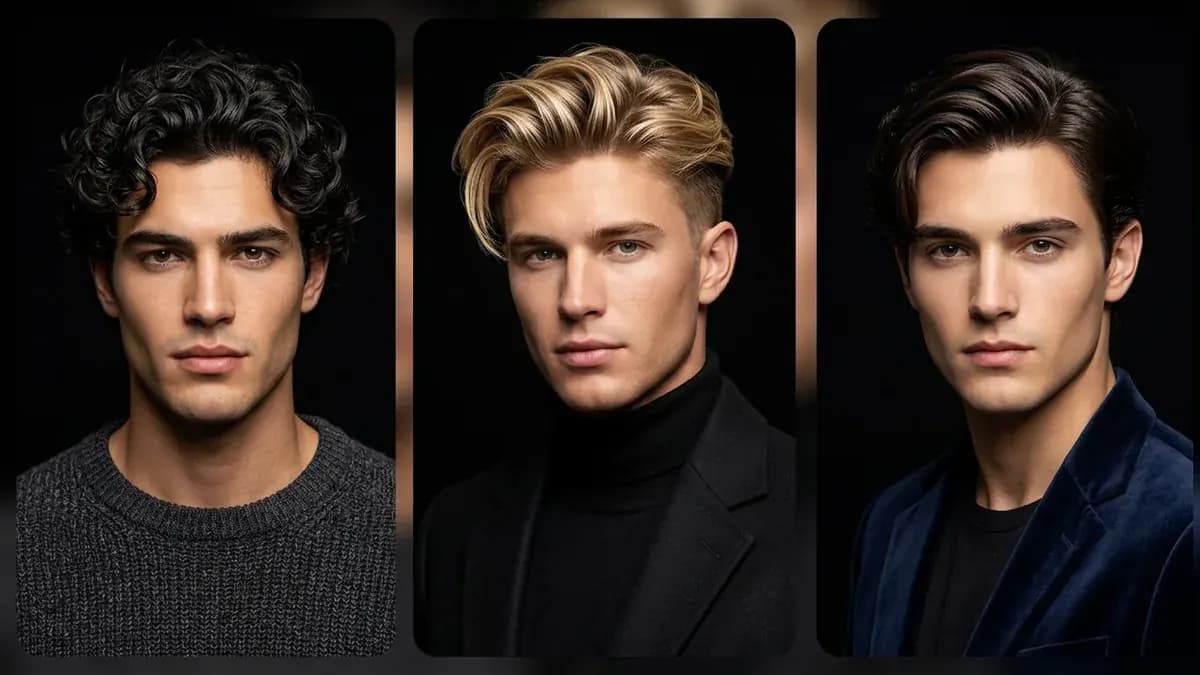
Go for: almost anything. Pick based on hair type, lifestyle and hairline rather than shape: a classic side part, a textured crop, a medium-length swept-back cut, or a buzz if your head shape suits it.
Avoid: a heavy fringe that covers the whole forehead, and extreme height on top if your oval is already on the long side. Both throw off proportions that are already working.
Oval gets called "ideal" only because it has nothing for a haircut to correct. It isn't the one correct face.
Best haircut for a square face
What you're working with: length and width similar, a wide, angular jaw about as wide as the forehead.
Go for: short, classic cuts that show the jaw off: crew cut, buzz cut, short side part, Ivy League, or a short textured crop. Your structure is doing the work, so don't fight it.
Avoid: very boxy, flat-top shapes if your face already reads blocky, and heavy bulk at the sides, which widens the head at the same level as the jaw.
If you want to soften it: add texture and movement on top rather than a rigid, sharp-edged shape.
Best haircut for an oblong or rectangular face
What you're working with: a clearly long face, with forehead, cheekbones and jaw all similar in width.
Go for: cuts that add width and cut length. A textured crop with forward fringe, a side part with moderate volume, a low fade or scissor cut that keeps some fullness at the sides, or medium-length hair with natural movement.
Avoid: tall pompadours and quiffs, and skin fades high up the sides with a lot of length on top. That combination is the fastest way to make a long face look longer.
Beard note: keep beard length at the chin short and let it be a little fuller at the sides, so it doesn't add more length.
Heart, triangle and diamond faces
Heart (wide forehead, narrow chin). Medium length with a side-swept or textured fringe narrows the forehead visually. Avoid a tall, voluminous top over very tight sides, which exaggerates the width up top. A beard that adds some fullness along the jaw balances a narrow chin.
Triangle (narrower forehead, wide jaw). The reverse fix: more volume and width at the top and temples, a textured or swept-back top with medium sides. Avoid hair or a beard that adds bulk at the jaw line.
Diamond (cheekbones clearly widest, narrow forehead and chin). Add fullness at the forehead and keep some weight above the ears: a textured fringe, a messy crop, or medium-length swept-back hair. Very tight sides with a tall top can make the cheekbones look sharper and the forehead narrower than they are.
Fixes by feature: big forehead, long midface, weak jaw
Most faces don't fit a chart cleanly, so it's often more useful to fix the one feature that bothers you.
Big or high forehead. This is the most searched version of the question, and the answer is simple: bring hair forward. A textured crop with a forward fringe, a French crop, or a messy fringe swept slightly to the side all lower the visual hairline. Keep the top textured rather than slicked back, since slicked-back styles expose the full forehead. Avoid very tall quiffs, which add even more height above an already long upper third. If the "big forehead" is really a receding hairline, read the next point.
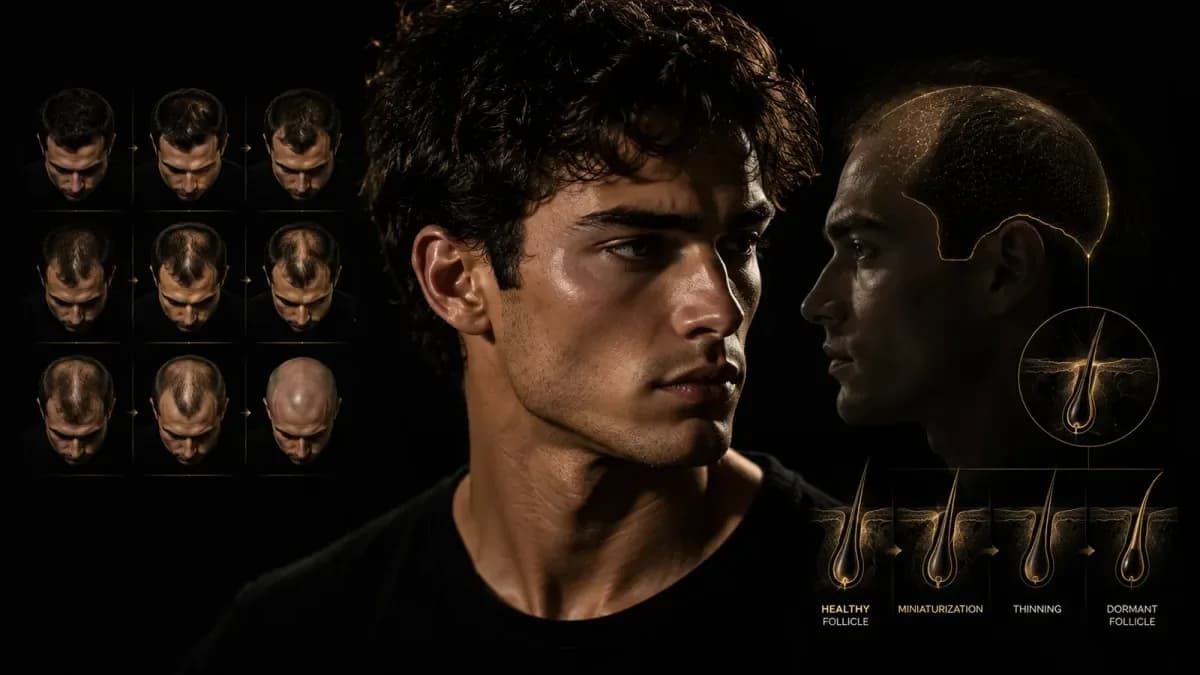
Receding or thinning hairline. Go shorter as it thins: short textured crops, buzz cuts and close fades reduce contrast between thinning areas and the scalp, while length on top separates and shows through. Don't comb over. And a deliberate shave is a legitimate option: in three experiments, men with shaved heads were rated more dominant, about an inch taller and around 13% stronger, but also less attractive and older, while men with visibly thinning hair were rated lower on dominance than shaved men.5 It's a trade, not a free upgrade. The treatments with real evidence are in the hair loss and regrowth guide.
Long midface. A haircut can't change the distance from your eyes to your mouth, but it can stop the whole face from reading long. Keep height on top moderate, keep a little fullness at the sides rather than skin-tight fades, and consider some texture or fringe. A beard adds visual weight to the lower third, which can balance a long middle. There's no direct research on haircuts and midface length; this is proportion logic only.
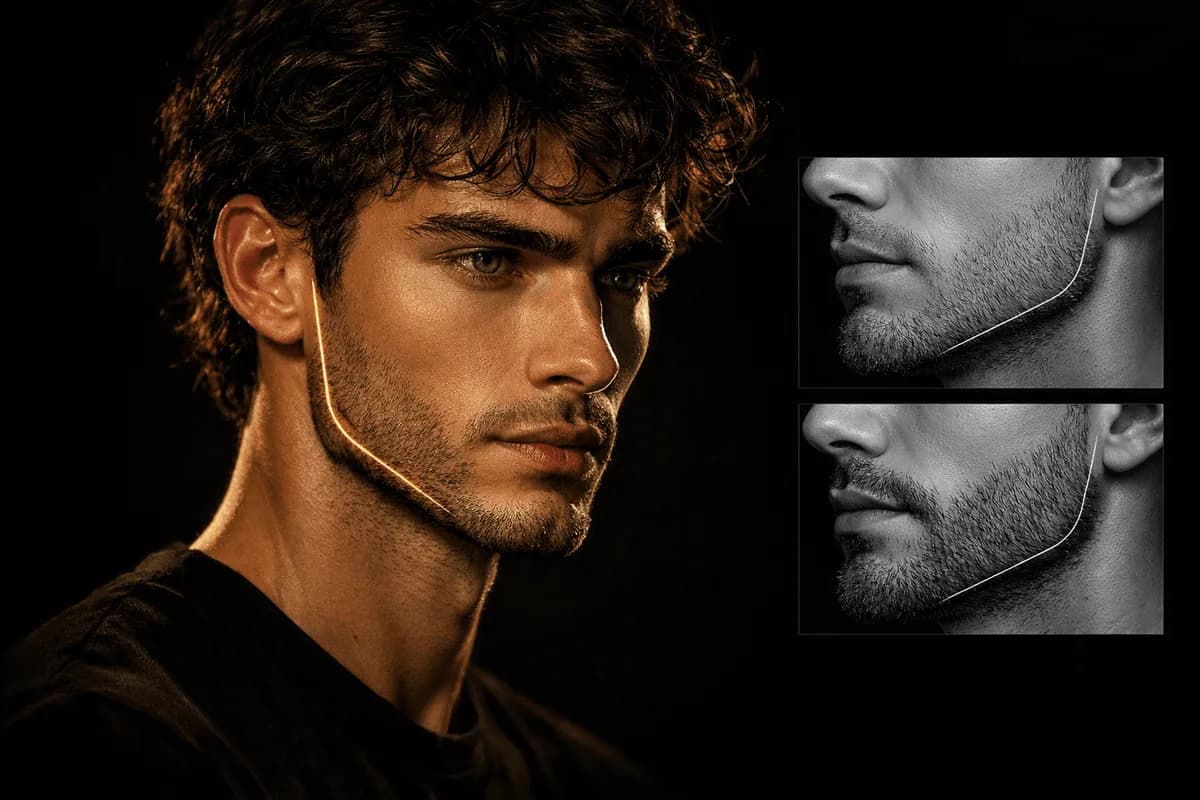
Weak or soft jaw. Two moves. First, avoid the combination of a tall top and skin-tight sides, which makes the lower face look small by comparison. A medium top with some weight at the sides keeps the head in proportion with the jaw. Second, consider a beard. In one study that digitally shrank and enlarged men's jaws, clean-shaven faces with small jaws got the lowest attractiveness ratings, while bearded faces with small jaws got the highest; beards also raised ratings of masculinity and dominance overall.6 That's one study with photo ratings, but it fits what barbers already do. How the bone structure itself works is covered in facial structure and harmony.
Strong, wide jaw. Don't hide it, just avoid adding width at the same level. Short sides, some height on top.
| Feature | Do | Avoid |
|---|---|---|
| Big forehead | Forward fringe, textured crop | Slick-back, tall quiff |
| Thinning hairline | Short crop, buzz, or a clean shave | Comb-over, length on top |
| Long midface | Moderate height, some side fullness, beard | Tall top with skin fade |
| Weak jaw | Medium top with side weight, beard | Tall top with skin-tight sides |
| Wide jaw | Short sides, some height | Bulk at the sides |
Hair type changes everything (straight, wavy, curly, fine)
A chart can tell you to wear a pompadour. Your hair decides whether that's realistic.
Straight hair. Lies flat and shows every line of the cut. Great for side parts, crops and clean fades. Height needs product and a blow-dry, and flat, straight hair can look limp on a round face, so ask for texture to be cut in on top.
Wavy hair. The easiest type to style. Holds height and texture naturally, works for quiffs, crops and medium-length swept-back styles. Leave a bit more length than you think so the wave has room.
Curly or coily hair. Adds width at the sides almost no matter what, so for round or wide faces keep the sides short (a taper or fade) and let the volume sit on top. For long or narrow faces, that natural width is an advantage. Curls shrink when dry, so get a barber who cuts curly hair and is careful with length. If you wear locs, braids or a bun, keep them loose: the American Academy of Dermatology notes tight styles can cause traction alopecia, which often shows first at the hairline, and recommends looser styles and less heat and product.7
Fine or thin hair. Won't hold a tall pompadour without heavy product, and heavy product clumps it and shows the scalp. Shorter, textured cuts with matte, lightweight product look fuller. On fine hair, "add height" usually means a few centimeters of texture, not a quiff.
Thick, coarse hair. Builds width fast, so it needs regular trims and thinning-out at the sides, especially on round and square faces.
How to brief your barber: bring the goal, not just a photo. "My face is round and I want it to look longer, my hair is fine and I don't want to blow-dry every morning" gets a better result than a picture of someone with different hair. A cut that holds its shape for 3 to 4 weeks is the realistic standard. For how hair fits into the rest of your presentation, see the style and visual optimization guide.
Frequently Asked Questions
What haircut should I get for my face shape? Work out whether your face is short and wide or long and narrow, and which part is widest. Short and wide: add height and keep the sides tight. Long and narrow: moderate height, some side fullness, a fringe is fine. Then adjust for your hair type and hairline.
What is the best haircut for a round face (men)? A textured quiff, short pompadour or crop with lift, paired with a mid to high fade. Avoid a heavy straight fringe and bulk over the ears.
What is the best haircut for an oval face? Nearly anything works. Choose based on hair type and lifestyle, and avoid a heavy fringe that hides your forehead or extreme height if your face is already long.
What haircut suits men with a big forehead? Anything that brings hair forward: a textured crop with a fringe, a French crop, or a messy side-swept fringe. Skip slicked-back styles and tall quiffs.
How do I style my hair if I have a big forehead? Push the front forward or slightly to the side with a matte, light product, and keep the top textured rather than flat. If the forehead is growing because the hairline is receding, go shorter overall rather than trying to cover it.
What hairstyle suits my face shape if I'm a mix of two shapes? Most men are. Use the advice for both; neighboring shapes point in the same direction. If they conflict, prioritize the one feature that bothers you most, using the feature table above.
The bottom line
Every face shape chart reduces to one rule: height to lengthen, fringe to shorten, side fullness to widen, tight sides to narrow. Round and square faces want height with short sides, long faces want less height and more width, oval faces can wear almost anything, and a big forehead, long midface or weak jaw each have a simple fix. Your hair type and hairline often matter more than your shape, so let a good barber adapt the plan. The evidence here is limited: the rules are proportion logic, not tested science, and research suggests your face drives how your hair is judged more than the reverse. But hair clearly shapes a stranger's first impression, and for the price of a visit every few weeks, that's one of the cheapest upgrades you have.
References
Footnotes
-
Al-Sebaei MO. The validity of three neo-classical facial canons in young adults originating from the Arabian Peninsula. Head & Face Medicine (2015);11:4. https://pmc.ncbi.nlm.nih.gov/articles/PMC4369102/: in 168 esthetically pleasing Saudi students, the facial thirds were not equal, and upper and middle thirds matched within 1 mm in only about 10% of men and women. ↩
-
Chitta M, Malathi L. Facial Anthropometric Analysis of a Representative Subset in an Average Kerala Population: A Pilot Study. Indian Journal of Plastic Surgery (2023);56(3):238-244. https://pmc.ncbi.nlm.nih.gov/articles/PMC10332907: in 250 adults, none of the vertical face heights were equal, and the average face did not conform to the neoclassical canons. ↩
-
Toseeb U, Keeble DRT, Bryant EJ. The Significance of Hair for Face Recognition. PLoS ONE (2012);7(3):e34144. https://pmc.ncbi.nlm.nih.gov/articles/PMC3312903: adding or removing hair between viewings disrupted recognition of unfamiliar faces; reviews the Clinton/Gore external-feature demonstration. ↩
-
Saegusa C, Intoy J, Shimojo S. Visual attractiveness is leaky: the asymmetrical relationship between face and hair. Frontiers in Psychology (2015);6:377. https://pmc.ncbi.nlm.nih.gov/articles/PMC4390982/: face attractiveness consistently influenced hair ratings, while hair had only a marginal, conditional effect on face ratings (young female faces). ↩
-
Mannes AE. Shorn Scalps and Perceptions of Male Dominance. Social Psychological and Personality Science (2012), as summarized by Knowledge at Wharton. https://knowledge.wharton.upenn.edu/?p=12459: shaved men were rated more dominant, about an inch taller and roughly 13% stronger, but less attractive and older; men with thinning hair were rated lower on dominance. ↩
-
Dixson BJW, Lee AJ, Sherlock JM, Talamas SN. Beneath the beard: do facial morphometrics influence the strength of judgments of men's beardedness? Evolution and Human Behavior (2017);38(2):164-174. https://eprints.gla.ac.uk/147936: beards raised masculinity and dominance ratings; attractiveness was highest for bearded faces with smaller jaws and lowest for clean-shaven faces with small jaws. ↩
-
American Academy of Dermatology. Hairstyles that can lead to hair loss. AAD (accessed 2026). https://www.aad.org/public/diseases/hair-loss/causes/hairstyles: tight buns, ponytails, braids and locs, and constant hat friction, can cause traction alopecia, often first visible at the hairline. ↩