What's My Face Shape? How Men Can Tell (Without an App)
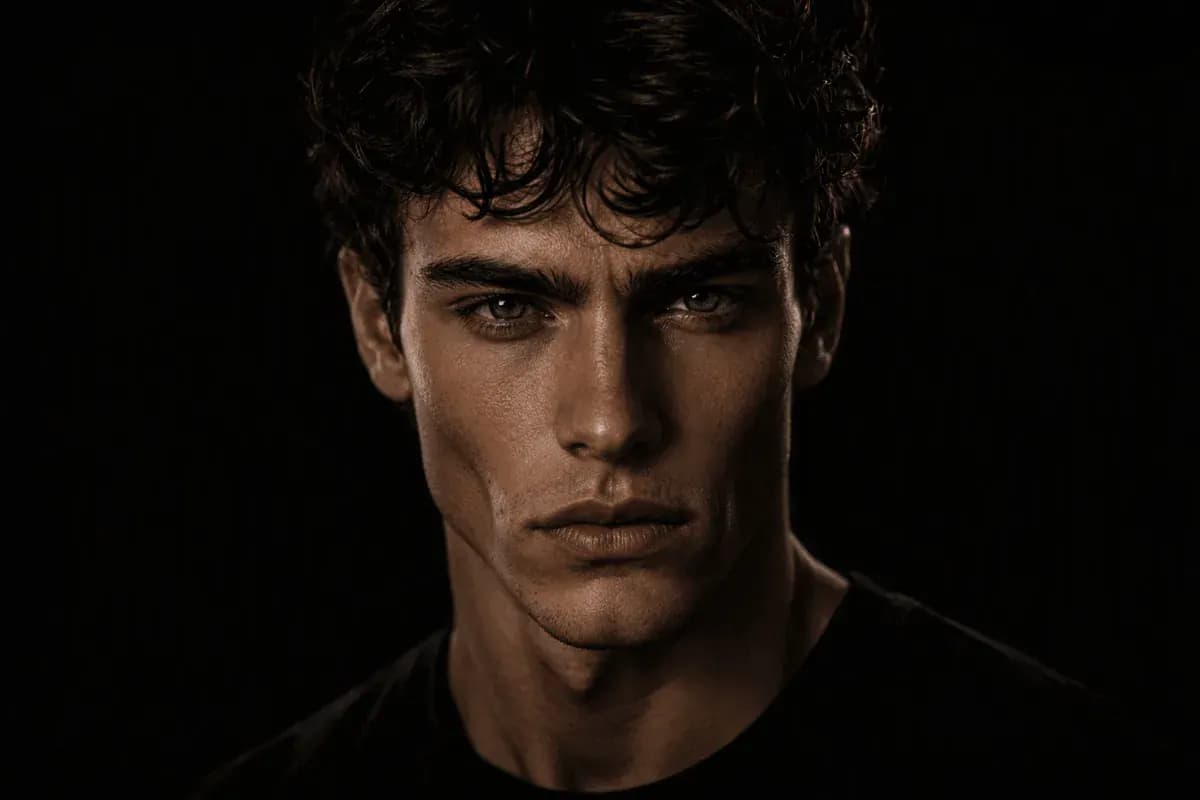
If you want to know your face shape as a man, you don't need an app. You need three things: how long your face is compared with how wide it is, which part is widest (forehead, cheekbones or jaw), and whether your jaw corners are sharp or rounded. Get those three right and you can place yourself on any face shape chart in about five minutes.
The honest part most charts leave out: face shapes are a styling convention, not a scientific category. When researchers test how consistently people sort faces into named shapes, agreement is poor for most of them.1 Your face will often sit between two shapes, and that's normal. The measurements are what matter, because they're what a barber, a beard trim or a pair of frames actually works with.
Short answer: Measure face length (hairline to chin) and your three widths (forehead, cheekbones, jaw). Compare length to the widest width, note which width wins, and check whether your jaw corners are angular or soft. The decision table below turns that into a shape. If you land between two, use the advice for both.
The three measurements that decide your face shape
Every face shape chart for men is really answering three questions. Ignore the silhouettes and focus on these.
1. Length versus width. Measure from your hairline to the bottom of your chin, then compare it with the widest width of your face. Is your face about as long as it is wide, a bit longer, or clearly longer? This single comparison separates round and square faces from oval and oblong ones.
2. Which width is biggest. Compare forehead width, cheekbone width and jaw width. Cheekbones widest points toward oval, round or diamond. Forehead widest points toward heart. Jaw widest (or level with the forehead) points toward square or triangle.
3. Jaw corners: angular or soft. Look at where your jaw turns up toward your ear. A defined corner with a fairly straight jawline reads square or rectangular. A gentle curve reads round or oval. This is the one judgment call that needs your eyes rather than a tape.
Where to measure each one:
| Measurement | Where |
|---|---|
| Face length | From the center of your hairline straight down to the bottom of your chin |
| Forehead width | Across the widest part of the forehead, roughly halfway between brows and hairline |
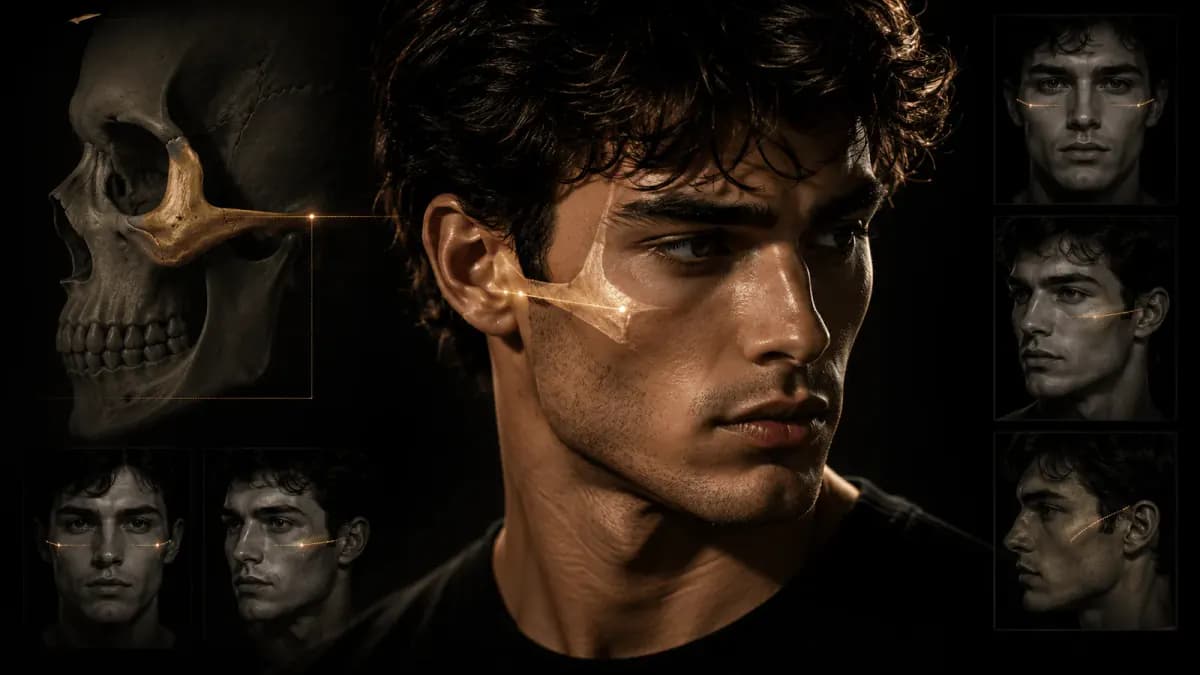
| Cheekbone width | Across the widest point of the cheekbones, just below the outer corners of the eyes |
| Jaw width | From one jaw corner (just below the ear) to the other |
Receding hairline? Use where your hairline was, or the top of the crease that forms when you raise your eyebrows. Measuring from a receded hairline makes almost any face read "long."
One reason charts disagree with each other: different systems measure length differently. Anthropologists use the facial index, which measures from the bridge of the nose (not the hairline) to the chin and divides by cheekbone width. In one sample of 140 medical students, the average man's face was about 111 mm long on that measure and 131 mm wide at the cheekbones, which put most of them in the "medium" category.2 Style charts measure from the hairline, which makes the same face look longer. Neither is wrong; they're just different conventions, so don't compare your numbers across systems.
Step-by-step: how to know your face shape at the mirror or from a photo
You have three ways to do this. Pick whichever is easiest; they should land in the same place.
Method 1: Tape and mirror (most accurate).
- Pull your hair fully back off your forehead and stand square to the mirror in even light.
- Use a soft tailor's tape (or a string you lay against a ruler) for the four measurements in the table above.
- Write them down. Keep your face relaxed, not clenched, since clenching flexes the masseter and widens the jaw.
Method 2: Trace it on the mirror (how to know your face shape without measuring).
- Stand about an arm's length from the mirror, close one eye, and keep your head still.
- With a dry-erase marker or a bar of soap, trace the outline of your face from hairline to chin.
- Step back and look at the outline. Is it longer than wide? Where's the widest part? Are the lower corners square or curved? This is rougher but surprisingly useful, because it shows you the whole silhouette at once.
Method 3: From a photo.
- Have someone take a straight-on photo at eye level from at least 1.5 meters (about 5 feet) away, using zoom if needed. Hair back, neutral face.
- Don't use an arm's-length selfie. A modeling study of camera distance found that at about 12 inches, the nose appears roughly 30% wider relative to the face than at 5 feet, because close lenses exaggerate whatever is nearest the camera.3 That same distortion changes how wide your cheeks and jaw look compared with the center of your face.
- Open the photo in any editor and draw lines for length and the three widths. You don't need real units; you only need the comparisons.
If you want the bigger picture on why your face looks different in the mirror and in photos, see the mirror vs camera guide.
The decision table
Use your three measurements here. The ratios are rules of thumb used in styling, not validated thresholds, so read them as "roughly."
| Length vs widest width | Widest part | Jaw corners | Most likely shape |
|---|---|---|---|
| About equal (length up to ~1.25x width) | Cheekbones | Soft, rounded | Round |
| About equal | Forehead and jaw similar | Angular, straight jawline | Square |
| Clearly longer (~1.3x to 1.5x) | Cheekbones, jaw a bit narrower | Soft taper to a rounded chin | Oval |
| Very long (~1.5x or more) | All three widths similar | Angular or slightly soft | Oblong (rectangle) |
| Longer than wide | Cheekbones, clearly; forehead and jaw both narrow | Narrow, often pointed chin | Diamond |
| Longer than wide | Forehead | Narrow jaw, pointed chin | Heart |
| Any | Jaw | Angular | Triangle (pear) |
If two rows fit, you're both. Round-square and oval-oblong are the most common blends. The styling advice for neighboring shapes points in the same direction, so a blend isn't a problem.
The common face shapes for men, and what they look like
Here's what each shape tends to look like on a man, described by features rather than by celebrity. We deliberately don't list "famous men with a square face": style sites routinely assign the same person different shapes, which is part of the problem this guide is about.
Oval. Face clearly longer than wide, cheekbones slightly the widest, jaw tapering gently to a rounded chin. Often called the "ideal," but only because it has no strong feature that styling needs to balance.
Round. Length and width close, full cheeks, soft jaw angles and a rounded chin. Very often a body-fat effect as much as a bone effect (more on that below).
Square. Length and width close, a broad jaw roughly as wide as the forehead, and defined jaw corners. The shape most people picture when they think "masculine jaw."
Oblong (rectangle). A long face with forehead, cheekbones and jaw all similar in width. Basically a stretched square or oval.
Diamond. Cheekbones clearly the widest point, with a narrower forehead and a narrower, often pointed chin. Less common.
Heart. Wide forehead and temples tapering to a narrow jaw and chin.
Triangle. The reverse of heart: a narrower forehead and a wide, strong jaw.
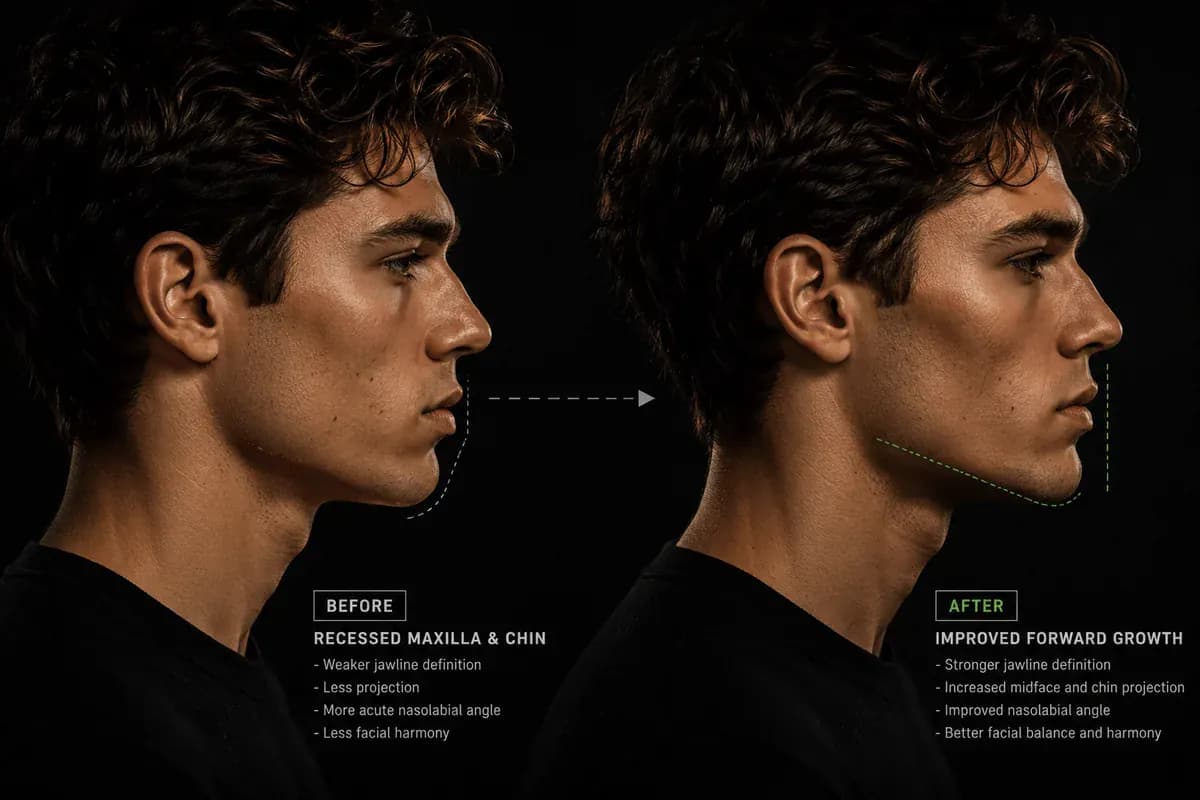
Your shape isn't fixed for life. In a study of facial cues to weight, the ratio of cheek width to jaw width and the face's overall width-to-height ratio both tracked body mass index in men, and observers used those same cues to judge how heavy someone was.4 In plain terms: gaining or losing fat shifts the exact proportions that decide your face shape. A face that reads round at higher body fat often reads oval or square when leaner. The body fat and facial definition guide covers how much leanness changes, and facial structure and harmony covers the bone underneath.
Why face shape apps and detectors disagree with each other
If you've tried a face shape detector or calculator and got "oval" from one and "square" from another, that's not a glitch. There are three reasons.
The categories themselves are fuzzy. A 2025 study tested Pöch's face shape system, a classic system with around ten categories, on 973 faces. Shape analysis showed most categories overlapped heavily, and when 16 observers sorted the faces, agreement was poor for everything except round and oval. The authors proposed cutting the system to four categories.1 If trained observers can't agree on a shape from the same face, an app can't be more "correct" than the definition it's built on.
AI detectors learn from labels that are themselves guesses. One of the first neural-network face shape classifiers was trained on 500 celebrity photos with face shapes "known" from the internet, and reached about 84% accuracy against those labels. Simpler methods using measured landmark ratios managed only about 36% to 65%.5 That accuracy means "agrees with the website labels," not "found your true shape." The study used female faces only, and it's a preprint, so treat it as an illustration, not a benchmark. Still, it shows the problem: there's no ground truth to train against.
Your photo changes the answer. Lens distance, head tilt, a slight smile, hair over the forehead and lighting all move the outline an app sees. Take two selfies at different distances and many detectors will give you two shapes.
What to do with that: use an app as a rough second opinion if you like, but trust your own measurements. And if your result changes between "oval" and "oblong," you have a face between those two, which is useful information in itself.
What your face shape actually means for hair, beard and glasses
This is the only reason face shape matters. Every recommendation follows one principle: add visual volume where your face is narrow, and keep things tight where it's already wide. Height lengthens, width widens, and anything that crosses the forehead or chin shortens.
| Shape | Haircut direction | Beard direction | Glasses direction |
|---|---|---|---|
| Oval | Almost anything works | Most styles work | Most frames work |
| Round | Height on top, tight sides | A little length at the chin, tight cheeks | Angular, rectangular frames |
| Square | Short classic cuts, or soft texture on top | Shorter, rounder at the chin if you want to soften | Rounder or oval frames |
| Oblong | Less height, some fullness at sides, fringe OK | Keep it short at the chin, fuller at sides | Deeper frames that break up length |
| Diamond | Fullness at the forehead and above the ears | Fuller beard to add width at the jaw | Frames with a strong top line |
| Heart | Medium length, side-swept or textured fringe | Fuller beard to widen a narrow chin | Bottom-heavy or rimless frames |
| Triangle | Volume at the top and temples | Keep the jaw trim, avoid bulk at the sides | Frames with a strong top line |
Hair. Face shape is a reasonable starting point, but hair type and hairline often matter more. Fine hair won't hold a tall quiff, and thinning hair changes everything. The full logic, cut by cut, is in the haircut for your face shape guide.
Beard. A beard is the one tool that changes the lower outline of your face directly: length at the chin lengthens, fullness at the sides widens, and a clean neckline sharpens the jaw. How to shape and maintain it is in the beard grooming guide.
Glasses. The usual advice is to contrast your face (angular frames on round faces, rounder frames on angular ones) and to pick frames about as wide as the widest part of your face. That's sensible proportion logic, but no direct research tests face shape rules for frames, so fit and comfort come first: the frame shouldn't pinch at the temples, and your eyes should sit near the center of each lens.
Frequently Asked Questions
How do I know my face shape for a haircut? Measure face length and your forehead, cheekbone and jaw widths, then use the decision table. For a haircut, the key question is simply whether your face is short and wide (add height, tighten the sides) or long and narrow (less height, a bit more width or a fringe).
How can I know my face shape without measuring? Trace your outline on a mirror with a dry-erase marker or soap, from about an arm's length with one eye closed. Then judge length versus width, which part is widest, and whether the jaw corners are angular or curved.
Are face shape detectors and calculators accurate? Only roughly. They're trained on labels people disagree about, and they're sensitive to photo distance, angle and expression. Use one as a second opinion, not a verdict.
What is the most common face shape for men? There's no reliable answer, because studies use different systems and populations. In the one anthropometric sample cited here, most men fell into the "medium" (mesoprosopic) band of the facial index, which doesn't map neatly onto oval or square.2
Can your face shape change? Your bones are largely set in adulthood, but body fat changes the proportions that decide your shape. Leaning out often moves a round face toward oval or square. A beard and haircut change how the outline reads without changing the face at all.
Is there a face shape men chart I can trust? Any chart is fine as long as it describes shapes by length, widest point and jaw corners, which is what the decision table above does. Charts that rely only on silhouettes or celebrity examples are harder to apply to your own face.
The bottom line
Knowing your face shape comes down to three measurements: length versus width, which width is biggest, and how angular your jaw corners are. Take them at a mirror or from a photo shot from at least 1.5 meters, run them through the decision table, and accept that you may land between two shapes. The categories are styling shorthand, which is why apps and charts disagree; the research that exists shows people only reliably agree on round and oval. Use the result for what it's good for: picking a haircut, a beard shape and frames that balance your proportions. Don't treat it as a verdict on your face.
References
Footnotes
-
Valladares J, Lopez-Valdes DA, Farrera A. Technical Note: Reliability of Pöch's facial shape classification system: A morphometric approach. Forensic Science International (2025);369:112435. https://pubmed.ncbi.nlm.nih.gov/40043498/: in 973 Mexican faces, most face shape categories overlapped; 16 observers agreed poorly except on round and oval, and the authors proposed a four-category system. ↩ ↩2
-
Pandey N, Gogoi P, Budathoki D, KC G. Anthropometric study of facial index of medical students. Journal of Kathmandu Medical College (2015);4(4):131-134. https://nepjol.info/index.php/JKMC/article/view/18256: in 140 students, men averaged 110.7 mm morphological face length and 130.8 mm cheekbone width, and mesoprosopic (medium) was the most common type. ↩ ↩2
-
Ward B, Ward M, Fried O, Paskhover B. Nasal Distortion in Short-Distance Photographs: The Selfie Effect. JAMA Facial Plastic Surgery (2018);20(4):333-335, as summarized by Rutgers University. https://www.rutgers.edu/news/selfies-drive-self-image-and-may-lead-many-seek-plastic-surgery: a mathematical model showed photos taken at about 12 inches make the nasal base appear about 30% wider than at 5 feet. ↩
-
Coetzee V, Chen J, Perrett DI, Stephen ID. Deciphering faces: quantifiable visual cues to weight. Perception (2010);39(1):51-61. https://pubmed.ncbi.nlm.nih.gov/20301846/: in men, face width-to-height, perimeter-to-area and cheek-to-jaw-width ratios all related to BMI, and observers used them to judge weight. ↩
-
Tio AE. Face shape classification using Inception v3. arXiv preprint (2019). https://arxiv.org/abs/1911.07916: trained on 500 female celebrity images with internet-sourced face shape labels, a neural network reached about 84% accuracy, while landmark-ratio classifiers reached 36% to 65%. ↩