Receding Hairline Haircuts for Men: What Works at Each Stage
The best receding hairline haircut for men depends on how far the recession has gone. Early on, a short textured cut with the front pushed forward hides the temples well. As the hairline moves back and the crown thins, shorter is better. Past a certain point, a buzz cut or a clean shave looks stronger than any attempt to cover what's missing.
Most haircut galleries skip the step that matters: working out your stage. They show the same cuts to a guy with a slightly mature hairline and a guy with a bald crown. This guide goes stage by stage using the Norwood scale, and is honest about the evidence: research on how hair loss is perceived is real but limited, and most haircut advice is barbering experience, not tested science.
Short answer: Norwood 2 to 3: textured crop, French crop or messy fringe with matte product. Norwood 3 vertex to 4: go shorter all over. Norwood 5 and beyond: buzz or shave. At any stage a beard can rebalance the face, and treatment is the only thing that changes the hair itself.
First, check your stage (Norwood quick check)
The Hamilton-Norwood scale is the standard way doctors stage male-pattern hair loss. O'Tar Norwood published his version in 1975, using it to measure baldness by age in 1,000 adult men.1 To place yourself roughly, take two photos in good overhead light, one of your hairline pulled back and one of your crown, and compare:
| Stage | What you see | Haircut goal |
|---|---|---|
| Norwood 1 | No real recession | Anything goes |
| Norwood 2 | Slight, even recession at the temples (a "mature hairline") | Almost anything |
| Norwood 3 | A clear "M" with deeper temple corners | Hide the temples with forward texture |
| Norwood 3 vertex | Norwood 3 plus thinning at the crown | Shorter so the crown doesn't show |
| Norwood 4 | Deeper recession plus a crown spot, with a band of hair between | Short crop or buzz |
| Norwood 5 to 7 | The band thins and disappears; a horseshoe remains | Buzz or shave |
The full chart and the biology are in the hair loss and regrowth guide. Two points matter for haircuts. A Norwood 2 hairline is normal for adult men and doesn't always progress. And watch the trend, not one photo: if your temples are moving back over 6 to 12 months, plan for the next stage.
If the recession is patchy, sudden, or follows how you wear your hair (tight braids, locs, ponytails), it may not be male-pattern loss at all. See the section on Black men below.
Norwood 2 to 3: receding hairline haircuts that hide recession
This is where haircuts do the most work. You still have density on top, so the goal is to blur the hairline and pull attention away from the temple corners.
What works:
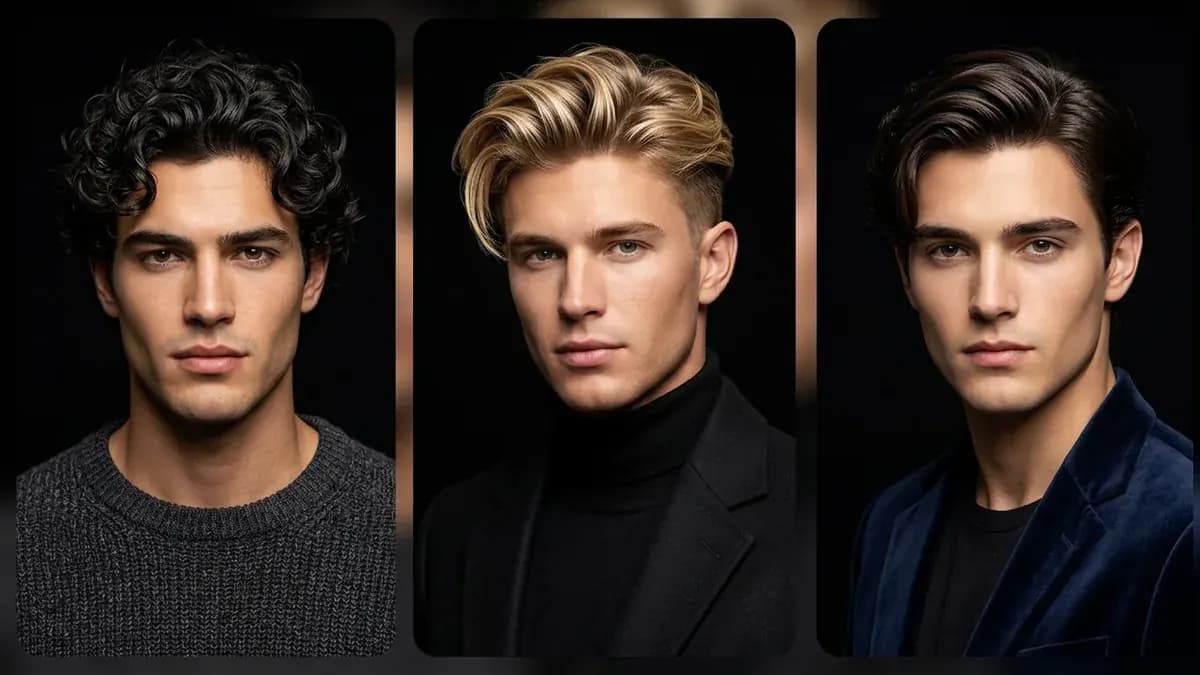
- Textured crop or French crop. Short sides, an inch or two on top, cut with texture and pushed forward so the fringe sits over the "M" corners. The most reliable choice at this stage.
- Messy fringe or forward quiff. A bit more length, styled forward and slightly to one side. Good if your hair has some wave.
- Short side part with texture. Works at Norwood 2 and early 3. Part on the side where recession is shallower, and keep the part soft rather than shaved in.
- Fade or taper on the sides. Tight sides reduce the contrast between full sides and a thinner front, so the top looks fuller.
What tends to backfire: slick-backs and tall pompadours, which pull hair off the temples and frame the recession; a long, flat fringe that separates into strands; and a hard line-up pushed forward past where hair actually grows.
Long hair at this stage. You can keep longer hair at Norwood 2, and into early Norwood 3 if it's thick and wavy. Swept-back long hair shows the temples more than people expect, so a side or middle part with some length falling forward hides recession better. Once the front looks see-through when wet, length is working against you.
Norwood 3 vertex to 4: when to go shorter
Now you have two problems at once, the front and the crown. Length hurts here, because longer hair separates and lets light through to the scalp, especially at the crown.
Go shorter all over. A short textured crop (number 1 to 2 on the sides, half an inch to an inch on top) or a long buzz (around number 3 to 4 all over) keeps hair at a similar length everywhere, so the difference between thin and full patches mostly disappears. Lower hair-to-scalp contrast reads as more density.
What to tell your barber: "I'm thinning at the front and crown and want it short enough that it doesn't show. Keep texture on top, no hard part, don't push the hairline forward."
Thinning on top without much recession? The same rules apply. Short, textured and matte beats long and flat. Keep the sides only slightly shorter than the top; a high skin fade under a thin top makes the top look thinner by comparison.
For matching a cut to your face shape too, see the haircut for face shape guide. From Norwood 4 on, the hairline matters more than face shape.
Buzz cut and shaved head: when it's the best move
There's a stage where hiding stops working. A comb-over or long hair around a bare top signals "I'm covering this," and that reads worse than the loss itself.
Signs it's time: you can see scalp through the top in normal indoor light, styling takes longer and looks worse each month, or you're at Norwood 5 or beyond.
What the research says. In three experiments by Albert Mannes at Wharton, men with shaved heads were rated more dominant than men with hair, and in two of them were seen as about an inch taller and around 13% stronger. They were also rated less attractive and older. Men with visibly thinning hair were consistently rated lowest on dominance.2 Mannes himself didn't recommend that every balding man shave. The honest reading: a deliberate shave beats visible thinning on how confident you look, but it isn't a free attractiveness upgrade. Researchers also still cite Muscarella and Cunningham's 1996 work for the point that head hair changes how old a man looks.3
| Option | Best for | Trade-offs |
|---|---|---|
| Long buzz (guard 3 to 4) | Norwood 3 vertex to 4 | Some outline of the recession still shows |
| Short buzz (guard 1 to 2) | Norwood 4 to 5 | Pattern visible but low contrast |
| Zero or skin shave | Norwood 5 to 7 | No outline at all; shave every 1 to 3 days |
If your scalp has bumps or flat spots that bother you, a short buzz hides them better than a razor. And protect the scalp: the American Academy of Dermatology advises that if your hair is thinning, you apply sunscreen to your scalp or wear a wide-brimmed hat.4 More in the sun protection guide.
Receding hairline haircuts for Black men
The stage advice applies, with three differences.
Perception may differ. In a 2021 study, a White man was rated more attractive with hair than bald, but there was no such difference for Black men.5 It's one study, so don't over-read it, but low cuts, bald fades and clean shaves are already mainstream, well-regarded looks.
Rule out traction first. The AAD notes that tight styles (cornrows, locs, tight braids, ponytails, weaves) can cause traction alopecia, and that the hairline is one of the first places it shows, with broken hairs around the forehead and a receding edge. It can become permanent if ignored.6 If your recession lines up with how you've worn your hair, loosen styles and see a dermatologist early.
Line-ups and shaving. Ask your barber to follow your natural hairline rather than push the line-up forward; it shows within days. Tightly curled hair cut very short can curl back into the skin. For the beard, the AAD recommends shaving with the grain using a sharp single-blade or electric razor, never dry shaving, avoiding very close shaves, and notes that growing the beard out clears bumps in about three months.7 If a razor-smooth head gives you bumps, a close clipper cut is often easier.
Use your beard as balance
A receding hairline shifts visual weight upward to the forehead. A beard puts weight back on the lower face.
The evidence: in a study photographing 37 men clean-shaven and bearded, beards significantly raised ratings of masculinity and dominance, with a smaller effect on attractiveness. In a second experiment, attractiveness was highest for bearded faces with smaller jaws.8 So a beard reliably adds masculinity and can help a softer jaw, but it's not a guaranteed attractiveness boost.
Practical pairings:
- Buzz or shaved head plus a short boxed beard or heavy stubble. The classic combination from Norwood 4 on: the beard gives the face an edge where the hair used to.
- Shorter on the sides than the chin if your face is round, so the beard adds length, not width.
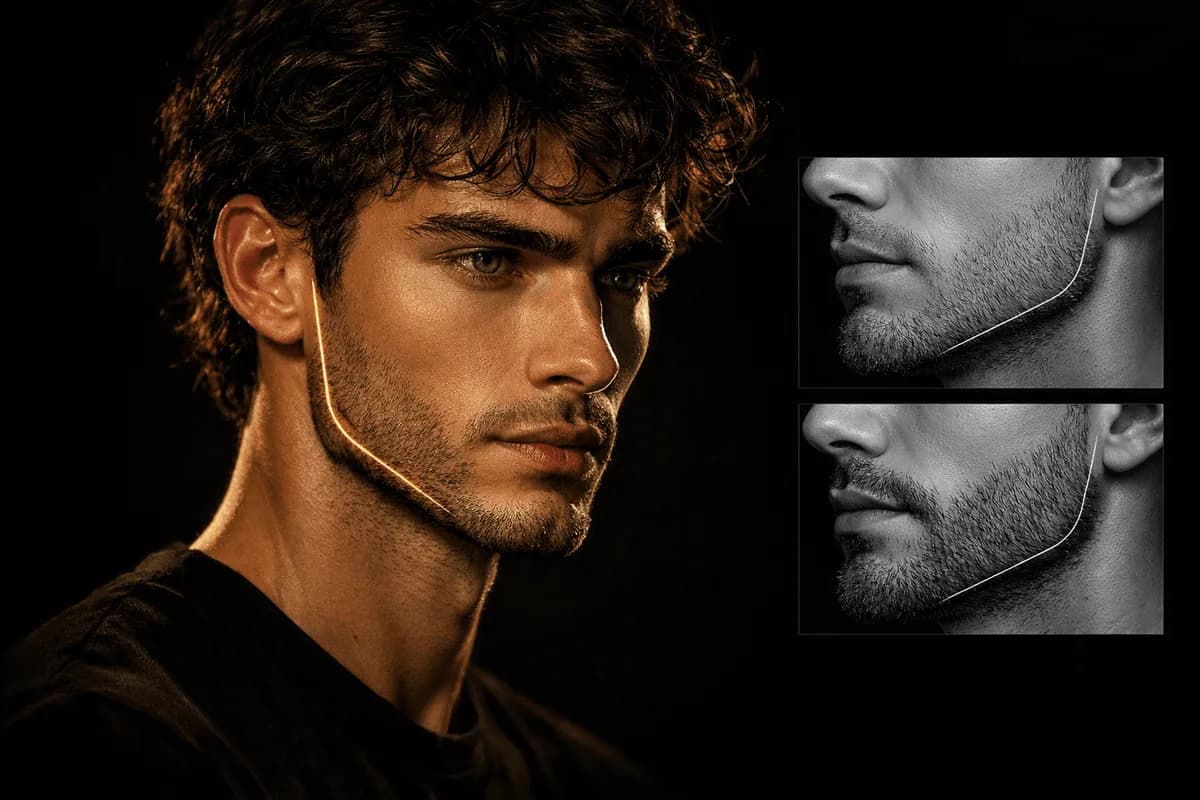
- Keep it neat. A long, wild beard under a skin-shaved head looks top-heavy upside down. The neckline matters more than length; the beard grooming guide covers it.
Products and styling: matte, volume, no wet looks
This section is styling experience, not research.
- Use matte products. Clay, paste, fiber or texture powder hold without shine. Shine reflects light off the scalp.
- Avoid wet looks. Gel and high-shine pomade clump hair into strands and open gaps that show the scalp. This is the most common mistake on a receding hairline.
- Build volume at the root. Blow-dry on medium heat, lifting the front up and forward with your fingers, then work a pea-sized amount of product through dry hair.
- Go light. Too much product weighs fine hair down.
- Mind the contrast. Dark hair over pale skin shows the scalp more. Colored hair fibers can reduce that at Norwood 2 to 3, but look obvious on large bare areas.
- Trim every 2 to 4 weeks. Short cuts on thinning hair lose shape fast.
Pairing styling with treatment
A haircut changes how your hair looks today. It does nothing to the loss, which keeps progressing.
What has evidence: a systematic review and meta-analysis of randomized trials found minoxidil, finasteride and low-level laser therapy all promote hair growth in men with androgenetic alopecia compared with placebo.9 According to the AAD, topical minoxidil can take 6 to 12 months to show results and finasteride about 6 months; both only work while you keep using them, full regrowth is unlikely, and men who start early do best. Finasteride is prescription-only and can cause side effects including reduced sex drive and erection problems, so it's a conversation with a doctor.10
How to combine them:
- Norwood 2 to 3: the best window for treatment and for a hiding cut. Wear a textured crop while treatment gets 6 to 12 months to work.
- Norwood 3 vertex to 4: go shorter now and treat. Short hair also makes topical treatment easier to apply.
- Norwood 5 and up: treatment can still slow loss, but a shave is often the better look. Choosing to stop chasing it is legitimate.
- Hair transplant: surgery that moves hair from the back and sides, best once loss has stabilized, usually alongside medication. See a dermatologist or hair restoration surgeon.
Full details are in the hair loss and regrowth guide.
Frequently Asked Questions
What is the best haircut for a receding hairline? It depends on your stage. Norwood 2 to 3: a textured or French crop pushed forward. Norwood 3 vertex to 4: a short crop or long buzz. Norwood 5 and beyond: a short buzz or clean shave.
Should I go short if my hairline is receding? Usually yes, and shorter as it progresses. Short hair keeps thin and full areas at similar length, so less scalp shows. Norwood 2 with thick hair gives you more freedom.
What receding hairline haircut works with a beard? A buzz or short crop with a short boxed beard or heavy stubble. Beards raise ratings of masculinity and dominance in studies and shift visual weight to the lower face.
Can I keep long hair with a receding hairline? At Norwood 2, and sometimes early Norwood 3 with thick, wavy hair. Part it with some hair falling forward rather than slicking it back.
What haircut is best for men with thinning hair on top? A short, textured crop with matte product and sides only slightly shorter than the top. Avoid long, flat styles and high skin fades.
What receding hairline haircut suits Black men? Low cuts, bald fades and clean shaves all work well. Ask for a line-up that follows your natural hairline, and rule out traction alopecia if you've worn tight styles.
The bottom line
Match the cut to the stage: textured and forward at Norwood 2 to 3, shorter all over at 3 vertex to 4, buzz or shave from 5 on, ideally with a neat beard. Skip the comb-over, the wet look and the forward-pushed line-up at every stage. The research is limited but points one way: visibly thinning hair reads worse than a deliberate short cut or shave. A haircut manages the look; only treatment changes the hair, and it works best early.
References
Footnotes
-
Norwood OT. Male pattern baldness: classification and incidence. Southern Medical Journal (1975);68(11):1359-1365. https://pubmed.ncbi.nlm.nih.gov/1188424/: proposed a reproducible classification of male-pattern baldness and used it to measure its incidence by age in 1,000 adult men. ↩
-
Mannes AE. Shorn Scalps and Perceptions of Male Dominance. Social Psychological and Personality Science (2012), as summarized by Knowledge at Wharton. https://knowledge.wharton.upenn.edu/?p=12459: across three experiments, shaved-head men were rated more dominant, about an inch taller and around 13% stronger, but less attractive and older; men with thinning hair were rated lowest on dominance. ↩
-
Jach Ł, Moroń M, Jonason PK. Men's Facial Hair Preferences Reflect Facial Hair Impression Management Functions Across Contexts and Men Know It. Archives of Sexual Behavior (2023);52(6):2465-2473. https://pmc.ncbi.nlm.nih.gov/articles/PMC10501953/: notes, citing Muscarella and Cunningham (1996), that the presence or absence of hair on men affects how old they are perceived to be. ↩
-
American Academy of Dermatology. How to apply sunscreen. AAD. https://www.aad.org/public/diseases/skin-cancer/prevent/sunscreen-apply: if you have thinning hair, apply sunscreen to your scalp or wear a wide-brimmed hat. ↩
-
Wade TJ, Fisher ML, Burch RL. Toupee or Not Toupee?: Cranial Hair and Perceptions of Men's Attractiveness, Personality, and Other Evolutionary Relevant Traits. Evolutionary Psychological Science (2021). https://digitalcommons.bucknell.edu/fac_journ/1912: a White man with hair was rated more attractive than when bald, while there was no such difference for Black men. ↩
-
American Academy of Dermatology. Hairstyles that can lead to hair loss. AAD. https://www.aad.org/public/diseases/hair-loss/causes/hairstyles: tight braids, locs, cornrows, ponytails and weaves can cause traction alopecia, often first visible at the hairline, and it can become permanent. ↩
-
American Academy of Dermatology. Razor bump remedies for men with darker skin tones. AAD. https://www.aad.org/public/everyday-care/skin-care-basics/hair/razor-bump-remedies: shave with the grain using a sharp single-blade or electric razor, never dry shave, avoid close shaves; growing a beard clears bumps in about three months. ↩
-
Dixson BJW, Lee AJ, Sherlock JM, Talamas SN. Beneath the beard: do facial morphometrics influence the strength of judgments of men's beardedness? Evolution and Human Behavior (2017);38(2):164-174. https://eprints.gla.ac.uk/147936/: beards raised masculinity and dominance ratings with a smaller effect on attractiveness; attractiveness was highest for bearded faces with smaller jaws. ↩
-
Adil A, Godwin M. The effectiveness of treatments for androgenetic alopecia: A systematic review and meta-analysis. Journal of the American Academy of Dermatology (2017);77(1):136-141. https://pubmed.ncbi.nlm.nih.gov/28396101/: minoxidil, finasteride and low-level laser therapy all outperformed placebo for hair growth in men. ↩
-
American Academy of Dermatology. What is male pattern hair loss, and can it be treated? AAD. https://www.aad.org/public/diseases/hair-loss/treatment/male-pattern-hair-loss-treatment: minoxidil can take 6 to 12 months and finasteride about 6 months; both require continued use, and early treatment gives the best results. ↩