Facial Thirds and Fifths: How to Measure Your Proportions (and What the Numbers Mean)
Facial thirds split your face into three horizontal bands: hairline to brow, brow to the base of the nose, and nose base to the bottom of the chin. The classical rule says the three should be equal. You can measure yours from a single well-taken photo in about ten minutes, and the result is genuinely useful for choosing a haircut or a beard shape.
What the tool pages and "facial thirds test" apps don't tell you is that equal thirds are the exception, not the norm, including in faces people rate as attractive. When researchers actually measured real people, the classical canons mostly failed. So this guide does two things: it shows you how to measure properly, and it tells you how little a few millimeters of "imbalance" actually means.
Short answer: Measure from a photo taken at 1.5 m (5 ft) or more, camera at eye level, hair pulled back. Divide each third by total face height. Anything roughly in the 30 to 37% range per third is ordinary human variation. The middle third being the shortest is a common pattern in measured faces, not a flaw.
What facial thirds and fifths are
The thirds and fifths are "neoclassical canons": drawing rules from Renaissance artists such as Leonardo da Vinci and Albrecht Durer that later made their way into surgical planning. They describe proportion, not attractiveness. The bigger picture of how proportions fit into overall harmony is in the facial structure guide; this page is the practical how-to.
Facial thirds (vertical proportions). Clinicians use these soft-tissue landmarks:1
| Third | From | To |
|---|---|---|
| Upper | Trichion (midpoint of the hairline) | Glabella (smooth point between the brows) |
| Middle | Glabella | Subnasale (where the nose meets the upper lip) |
| Lower | Subnasale | Menton (lowest point of the chin) |
Some studies use the nasion (the deepest point of the nose bridge) instead of the glabella, which makes the middle third a little shorter and the upper third a little longer. Pick one and stick with it. The lower third is often split again: upper lip about one third, lower lip and chin about two thirds.
Facial fifths (horizontal proportions). At eye level, the face is divided into five vertical strips, each ideally one eye-width wide: ear edge to outer eye corner, the eye itself, the gap between the eyes, the other eye, outer eye corner to ear edge. Two related rules sit inside this one: the gap between your eyes should equal one eye width, and the width of the nose base should equal the gap between the eyes.1
How to measure your facial thirds from a photo
You need one straight-on photo and any image editor that shows pixel coordinates (or a printout and a ruler). Pixels are fine, because you only care about ratios.
Step 1: Take the photo correctly. Have someone shoot you from at least 1.5 m (5 ft), zooming in rather than moving closer. Camera lens at the height of your eyes, pointed straight at you. Face a window or even light. Neutral expression, lips lightly closed, teeth together. Pull your hair fully off your forehead so the hairline is visible.
Step 2: Get your head level. Look straight ahead as if at the horizon. A quick check: the bottoms of your ear lobes and the bottoms of your eyes should look roughly level from the side. Tilting your chin up or down changes the vertical numbers more than almost anything else.
Step 3: Mark the four vertical landmarks. Hairline midpoint (trichion), the point between your brows (glabella), the junction of nose and upper lip (subnasale), and the bottom of your chin (menton). Note each point's vertical pixel position.
Step 4: Calculate. Subtract to get each third's length, add the three for total face height, then divide each third by the total. Example: upper 180 px, middle 160 px, lower 190 px. Total 530 px. Ratios: 34%, 30%, 36%.
Step 5 (optional): Measure fifths. On the same photo, mark both outer eye corners, both inner eye corners and the outer edge of each ear at eye level. Compare each segment to your average eye width.
Step 6: Repeat it. Take three photos and measure each. If your numbers move by 2 to 3 percentage points between shots, that's your measurement error, and any "imbalance" smaller than that isn't real.
An automated tool like the looksmax calculator places the landmarks for you, but it is only as good as the photo you give it. The same rules about distance, tilt and hairline apply.
What "balanced" means, and why perfect thirds are rare
Here is the part most facial thirds calculators skip. The canons have been tested repeatedly on real people, and they mostly don't hold.
The original test. Farkas and colleagues measured 153 young North American adults against nine classical proportion rules. The best-performing rules held in only about 40% of people, and the vertical profile proportions fit worst of all. The authors concluded the canons "do not represent the average facial proportions."2
The international follow-up. A 2005 study by the same lead author measured 1,470 adults across Europe, Asia, Africa and the Middle East using the measurements classical artists relied on. It found real variation between groups, especially around the eyes and nose, and the authors called it preliminary because some regional samples were small.3 The practical point: there is no single "correct" face template across populations.
Attractive faces don't meet them either. A study of 168 Saudi dental students who had been selected as esthetically pleasing found that only about 5 to 22% had any given pair of thirds equal within a millimeter. The middle third was the shortest on average in both sexes, and over 90% of men had a lower third longer than their middle third.4 In 103 young adults from Hong Kong scanned in 3D, not one person met the equal-thirds canon or the "gap between eyes equals one eye width" rule.5
Where balance does show up. One study comparing 83 female students with 24 celebrity women found the attractive group had more uniform thirds and fifths than the ordinary group.6 That's a small, women-only sample, so treat it as a hint that extreme imbalance may count against a face, not as proof that hitting 33/33/33 makes you better looking.
Takeaway: Use the classical ratio as a rough reference point. If each third sits somewhere around 30 to 37% and nothing is wildly out, you're within normal variation. Chasing millimeters is pointless.
To put it in numbers: in the Saudi men above, the average thirds worked out to roughly 35%, 29% and 35% (measured with the nasion, which shortens the middle third).4 That's the average of a group chosen for good looks, and it's nowhere near equal.
What a long middle third (or a long lower third) actually means
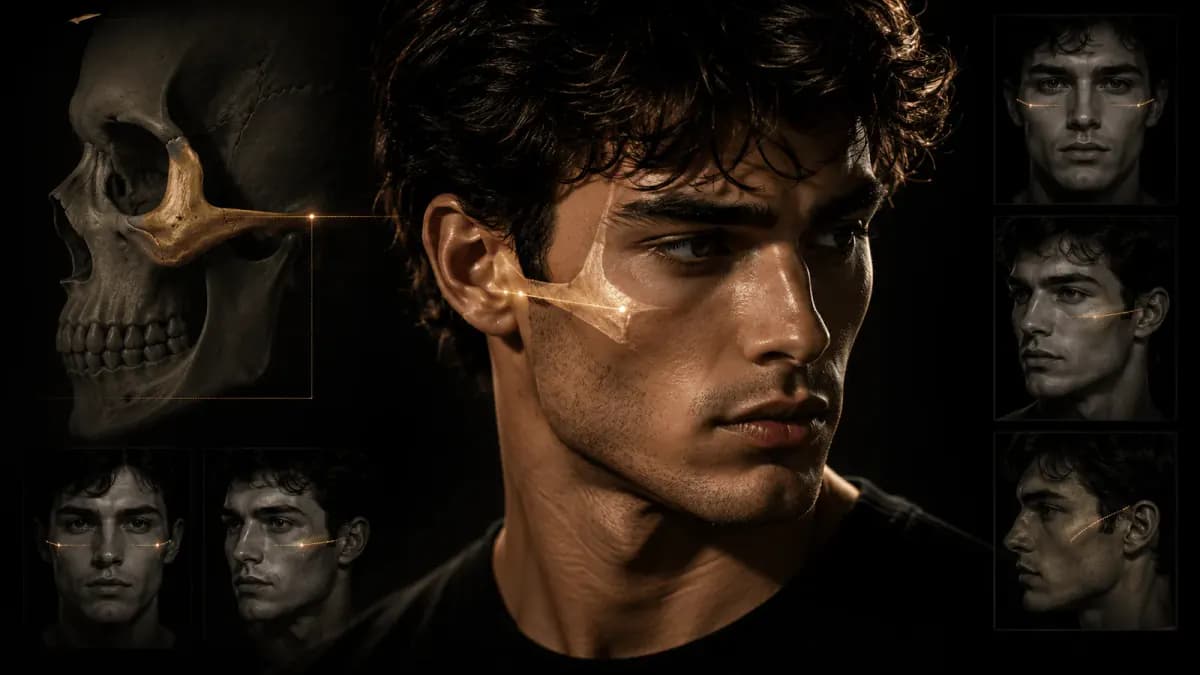
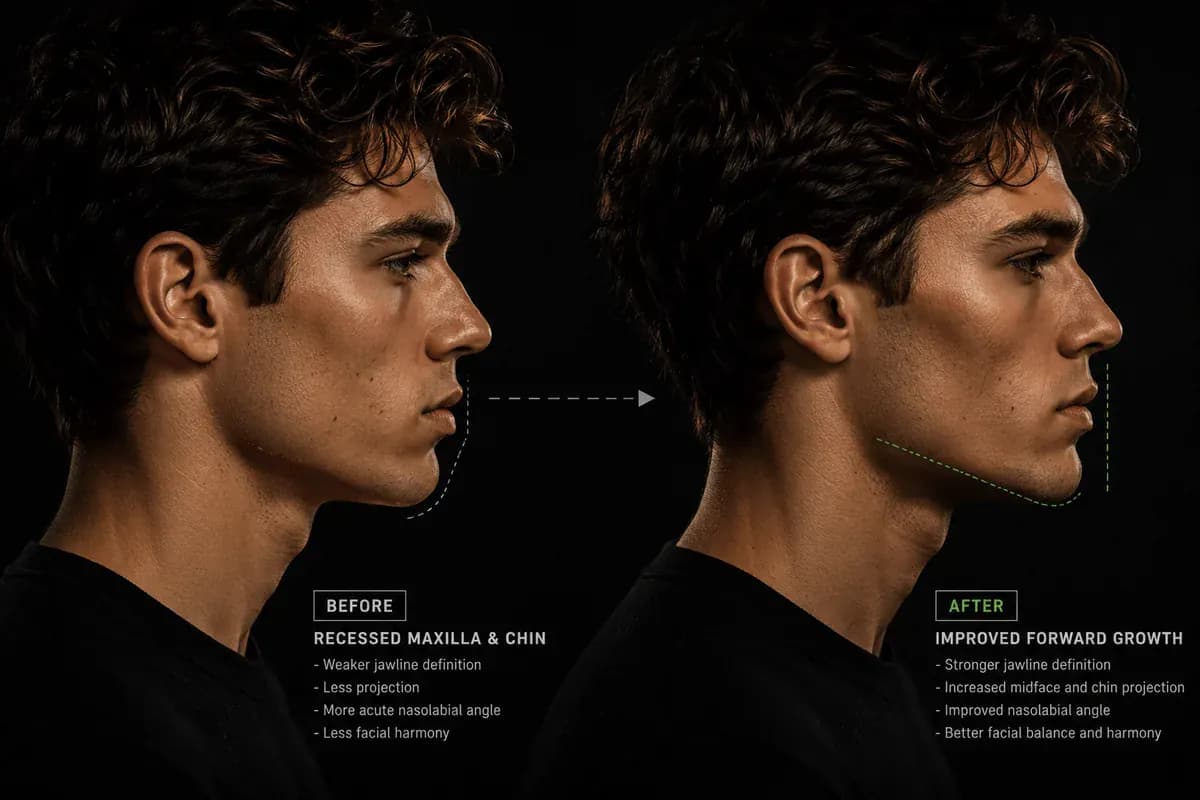
A long middle third face means the distance from brow to nose base is a larger share of your face than the other two. It often comes with a longer nose and can make a face read as long or mature. It's set by the bones of the midface (the maxilla and nasal bones), so no exercise, mewing or posture trick changes it in an adult.
A long lower third is common in men, since men tend to have larger lower faces than women.4 A very long lower third can read as heavy-jawed or long-faced; a short one can make the face look compact or younger.
A tall upper third usually means a high hairline or a receding one. This is the only third whose length regularly changes during adult life.
None of these is a diagnosis. They're descriptions that help you decide what to frame and what to leave alone. If a proportion is tied to a real functional problem (bite issues, breathing, jaw pain), that's a question for an orthodontist or maxillofacial surgeon, not a ratio app.
Which third you can influence
You can't move bone, but you can change what's visible and where the eye lands.
| Third | What changes how it reads | How much |
|---|---|---|
| Upper | Hairline position, fringe or textured hair over the forehead, volume on top | Large |
| Middle | Very little. Brow grooming and eye-area framing slightly | Small |
| Lower | Beard length and shape, body fat under the jaw, posture | Moderate to large |
Hairline. The trichion is the top of the upper third, so a receding hairline literally lengthens it on paper and in person. If your upper third is creeping up because of hair loss, that's a treatable cause; the evidence on minoxidil and finasteride is in the hair loss guide.
Posture. Forward head posture with a dropped chin compresses the look of the lower third and softens the jaw-to-neck line. It doesn't change your measurements in a proper level photo, but it changes how your face reads in daily life. See the posture guide.
Body fat. Fat under the chin blurs where the lower third ends, which makes it look longer and heavier. Getting leaner sharpens the menton landmark you just measured. Details are in body fat and facial definition.
How hairstyle and beard change perceived thirds
This part rests on practical styling experience rather than controlled studies. There's no direct research on haircuts and perceived thirds, so treat it as rules of thumb.
If your upper third is tall: a fringe, a textured crop or a side-swept front covers part of the forehead and shortens the visible upper third. Very high volume on top (a tall quiff) does the opposite and adds length.
If your upper third is short: pushing hair back or up shows more forehead and adds some visual height. A heavy fringe makes it look even shorter.
If your lower third is short or your chin is small: a beard that's slightly longer at the chin than at the sides adds visual length and definition to the lower face.
If your lower third is long: keep the beard shorter at the chin and fuller on the sides, which adds width and makes the lower face read less long. A clean-shaven chin makes a long lower third more obvious.
If your middle third is long: you can't shorten it, but you can stop exaggerating it. Avoid styles that add height on top (which makes the whole face read longer) and consider some fullness at the sides. A mustache breaks up the space between nose and lip, which some men find makes the midface look less dominant.
For cuts matched to overall face shape, see haircuts for your face shape. For shaping a beard you can actually grow, see the beard grooming guide.
Common measuring mistakes
Shooting too close. At selfie distance (about 30 cm, or 12 inches), the parts of your face nearest the lens look bigger. Modeling work found noses appear about 30% wider at 12 inches than in an undistorted projection, with essentially no distortion at 5 feet.7 That same perspective effect warps the other proportions you're trying to measure. Front cameras held at arm's length are the worst offenders. The mirror vs camera guide explains why selfies and mirrors both mislead.
Head tilt. Chin up makes the lower third look longer and the forehead shorter; chin down does the reverse. A few degrees can shift your ratios by more than the "imbalance" you're worried about.
Camera above or below eye level. Same effect as tilting your head. Shooting from above shrinks the lower face; from below enlarges it.
Guessing the hairline. If your hairline is receding, uneven or hidden by hair, the trichion is a guess. Mark where the fine forehead skin meets terminal hair at the midline, and note that a receding hairline will inflate your upper third.
Smiling or tensing. A smile lifts the cheeks and changes lower-third length. Clenching or jutting the jaw changes the menton. Neutral face, lips closed, teeth lightly together.
Treating one photo as the truth. Measure three photos. Average them. Ignore differences smaller than your own measurement scatter.
Frequently Asked Questions
What is the ideal facial thirds ratio? The classical ideal is 1:1:1, so each third about 33% of face height. In practice, measured faces, including attractive ones, rarely hit it, and the middle third is often a bit shorter than the other two.
Is a facial thirds test or calculator accurate? Only as accurate as the photo. A good tool can place landmarks consistently, but a close-up selfie, a tilted head or a hidden hairline will skew the result by more than the differences it's reporting.
What are facial thirds and fifths, in simple terms? Thirds split your face top to bottom into forehead, midface and lower face. Fifths split it left to right at eye level into five strips about one eye-width each. Both are old artistic guides, not medical standards.
Is having a long middle third bad? No. It's a description of proportion, not a defect. It can make a face read longer or more mature. Hairstyle and beard choices can reduce how much it stands out, but the bone itself doesn't change.
Can you fix unbalanced facial thirds? The upper third responds to hairline and hairstyle, and the lower third to beard, body fat and posture. The middle third is skeletal. Surgical changes exist for real structural or functional problems and belong in a conversation with a qualified surgeon, not a ratio app.
The bottom line
Facial thirds are a useful way to describe your face and to pick a haircut or beard shape that suits it. Measure from a distant, level photo with your hairline visible, repeat it, and look at the ratios rather than the raw numbers. Then keep the result in perspective: the equal-thirds face is uncommon even among attractive people, and most of what you can change lives in the upper and lower thirds, through hair, beard, leanness and posture. If your numbers are roughly in range, there's nothing to fix.
References
Footnotes
-
Corduff N, Chao YYY, Lam SCK, et al. A new simplified visual assessment tool describing facial morphotypes observed and desired in Asian populations. Journal of Clinical and Aesthetic Dermatology (2020);13(4):23-34. https://pmc.ncbi.nlm.nih.gov/articles/PMC7605391/ : Describes the clinical landmarks for thirds (trichion, glabella, subnasale, menton) and fifths, and notes attractive faces often fail the equal-fifths rule. ↩ ↩2
-
Farkas LG, Hreczko TA, Kolar JC, Munro IR. Vertical and horizontal proportions of the face in young adult North American Caucasians: revision of neoclassical canons. Plastic and Reconstructive Surgery (1985);75(3):328-338. https://pubmed.ncbi.nlm.nih.gov/3883374/ : In 153 young adults, the best classical rules held in about 40% of people, vertical profile proportions fit worst, and the canons did not represent average faces. ↩
-
Farkas LG, Katic MJ, Forrest CR, et al. International anthropometric study of facial morphology in various ethnic groups/races. Journal of Craniofacial Surgery (2005);16(4):615-646. https://pubmed.ncbi.nlm.nih.gov/16077306/ : Measurements of 1,470 adults across Europe, Asia, Africa and the Middle East showed meaningful variation between groups, especially around the orbits and nose; described as preliminary. ↩
-
Al-Sebaei MO. The validity of three neo-classical facial canons in young adults originating from the Arabian Peninsula. Head & Face Medicine (2015);11:4. https://pmc.ncbi.nlm.nih.gov/articles/PMC4369102/ : In 168 esthetically pleasing young adults, few had equal thirds, the middle third was shortest, and over 90% of men had a lower third longer than the middle third. ↩ ↩2 ↩3
-
Jayaratne YSN, Deutsch CK, McGrath CPJ, Zwahlen RA. Are neoclassical canons valid for Southern Chinese faces? PLoS One (2012);7(12):e52593. https://pmc.ncbi.nlm.nih.gov/articles/PMC3532441/ : None of 103 young adults scanned in 3D met the facial three-section canon or the orbital canon. ↩
-
Milutinovic J, Zelic K, Nedeljkovic N. Evaluation of facial beauty using anthropometric proportions. The Scientific World Journal (2014);2014:428250. https://pmc.ncbi.nlm.nih.gov/articles/PMC3951104 : A small sample of attractive celebrity women showed more uniform thirds and fifths than ordinary students. ↩
-
Ward B, Ward M, Fried O, Paskhover B. Nasal distortion in short-distance photographs: the selfie effect. JAMA Facial Plastic Surgery (2018);20(4):333-335. https://pmc.ncbi.nlm.nih.gov/articles/PMC5876805/ : At 12 inches the nose appears about 30% wider than in an undistorted projection, with essentially no difference at 5 feet. ↩