Looksmaxxing Terms Explained: A Plain-English Glossary
Looksmaxxing terms are a mix of real anatomy (maxilla, gonial angle, canthal tilt), forum rating slang (PSL, HTN, Chad, mogging) and methods that range from sensible to dangerous (softmaxxing, mewing, bonesmashing). This glossary gives you a one-line definition of each, a quick verdict on whether it's real, and a link to the guide that covers it properly.
The vocabulary grew up on small forums in the 2010s and has since gone fully mainstream: Dictionary.com named "maxxing" its 2026 Word of the Year.1 You'll hear these words everywhere, often used with far more confidence than the science behind them deserves. Knowing what each one actually means is the fastest way to filter good advice from noise.
Short answer: the anatomy terms are real, but their "ideal" numbers mostly aren't backed by research. The rating slang (PSL, HTN, Chad) is community convention, not science. And some methods, bonesmashing above all, can genuinely hurt you.
How to use this glossary
Every term has a stable link (for example /looksmaxxing-terms#canthal-tilt), so you can jump straight to it or share it. Each entry gets one of three verdicts:
| Verdict | What it means |
|---|---|
| Real | A genuine anatomical feature or established concept you can measure or observe. |
| Overhyped | Real underneath, but the online claims (ideal values, how much it matters, how to change it) go well past the evidence. |
| Myth | No evidence it works, or evidence it's harmful. |
Evidence for slang is thin by nature: nobody runs studies on what "HTN" means. Where research exists (FWHR, canthal tilt, averageness), it's cited. For anatomy, the deep guides hold the full citations, so this page links out rather than repeating them. New to all this? Read the no-fluff starter guide next.
Face structure terms
Maxilla. The upper jawbone. It holds the upper teeth, forms the floor of the eye sockets and the base of the nose, and supports the cheeks. "Good maxilla" online means a midface that looks well supported and forward-grown. Real. Its growth is largely finished by the end of adolescence. No exercise moves it in adults; only orthognathic surgery does. See the midface section.
Forward growth (FFG). Shorthand for a maxilla and lower jaw that grew forward rather than downward, giving a strong profile and chin. Overhyped. The growth pattern is real; the claim that adults can "grow forward" through tongue posture is not. The mewing guide explains why.
Gonial angle. The angle at the back corner of the jaw, where the horizontal jawbone meets the vertical ramus. A smaller (sharper) angle reads as more angular. Real and measurable. There's no proven "ideal" number, and the bone doesn't change without surgery. Body fat and posture change how visible it is. See the lower third.
Ramus. The vertical part of the lower jaw, running from the jaw angle up toward the ear. A "long ramus" makes the back of the jawline look taller. Real. Fixed in adults, same as the gonial angle.
Jawline / mandible. The mandible is the whole lower jawbone; the jawline is how its edge shows through skin and fat. Real. The bone is set, but visible definition depends heavily on leanness. See body fat and facial definition.
FWHR (facial width-to-height ratio). Cheekbone-to-cheekbone width divided by the height from the brow to the upper lip. Overhyped. The most-studied single face metric. Meta-analyses found wider faces are rated as more dominant and threatening, but also as less attractive, especially by women, and the behavior links were small.2 The forum idea that a high FWHR is something to maximize runs backwards. More in the FWHR section.
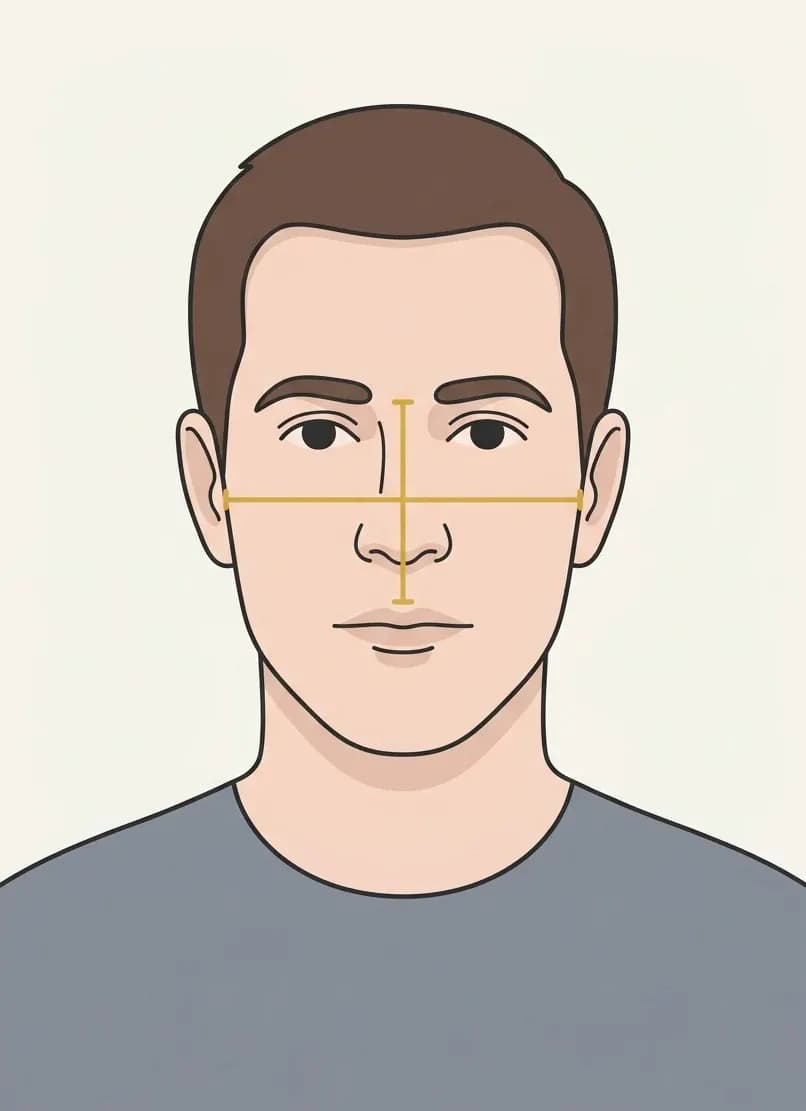
Midface ratio (MFR). A forum measurement comparing the distance between the pupils with the height from the pupils down to the mouth. A "compact midface" is a relatively short one. Overhyped. Midface length is a real proportion, but the "ideal" ranges posted online differ from source to source. No direct research validates MFR as a predictor of attractiveness. The same goes for ESR (eye separation ratio), its sibling measurement.
Facial thirds. Dividing the face into hairline to brow, brow to nose base, and nose base to chin, ideally roughly equal. Overhyped. A useful artist's and surgeon's convention, not a law of attraction. See facial thirds.
Zygos / cheekbones. The zygomatic bones, which set the widest part of many faces. "High zygos" means prominent cheekbones. Real. Mostly fixed, but far more visible when you're lean. Related: the ogee curve, the S-shaped line from cheekbone to cheek hollow, covered in the hollow cheeks guide.
Brow ridge. The bony ridge above the eyes. A strong one sets the brows low and the eyes deeper. Real, mostly genetic and larger in men on average. See strong vs. weak brow ridge.
Recessed chin / chin projection. How far the chin sits forward relative to the lips in profile. Real. The goal is proportion, not maximum projection. Fixing a genuinely recessed chin (genioplasty, implants) is surgery and belongs with a board-certified surgeon.
Dimorphism. The average structural differences between male and female faces. "Dimorphic" on forums means "very masculine." Overhyped. The differences are real, but "more masculine is always better" isn't. A 2025 study of 100 faces rated by 400 people found averageness predicted attractiveness in both sexes, while masculinity in male faces did not.3 The effects were weak, which is the point: no single feature runs the show.
Harmony. How well features fit together as a whole, rather than how strong any one feature is. Real as a concept, and it fits the research better than single-feature scoring. It's hard to put a number on, which is why forums prefer ratios.
Eye area terms
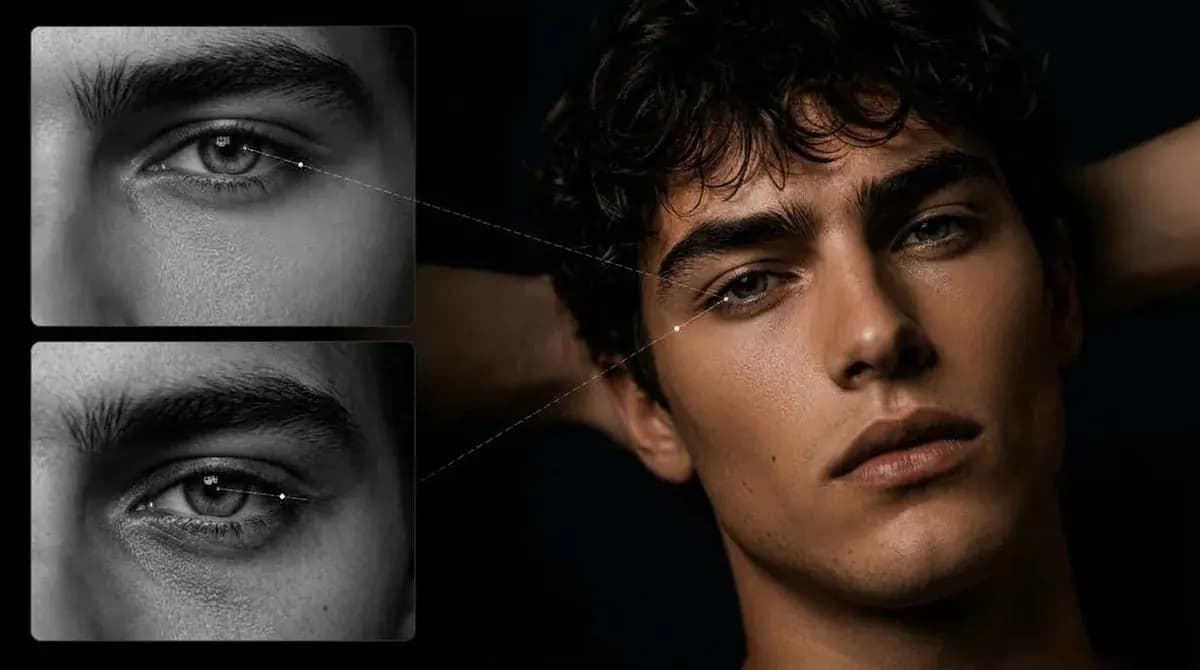
Canthal tilt. The angle of a line from the inner corner of the eye to the outer corner. Positive means the outer corner sits higher, negative lower, neutral level. Overhyped. It's measurable and it affects how eyes read. But the most-cited study only tested female faces (an edited, stronger tilt was preferred 93% of the time), so it says little about men.4 The term spread on 4chan boards around 2013 and became a TikTok filter in 2023.5 See the eye area.
Hunter eyes / prey eyes. "Hunter eyes" means deep-set eyes with a positive tilt, low brows and little visible upper eyelid. "Prey eyes" means rounder, more open eyes with a negative tilt. Overhyped. A description of a look built from bone and soft tissue, not something you can train. What actually helps is in the eyesmaxxing guide.
UEE (upper eyelid exposure). How much upper eyelid shows between the lash line and the brow. Low UEE goes with the "hunter eyes" look. Real, but set by brow ridge, brow position, fat and age. Brow grooming and sleep shift it slightly; only surgery changes the anatomy.
Under-eye support. How well the cheekbone and lower-lid tissues hold up the area under the eye. Poor support shows as hollows, a tired look or scleral show (white visible below the iris). Real. Partly bone, partly fat and skin. The dark circles guide helps you tell structural darkness from the fixable kind.
Rating and status slang
Looksmaxxing. Deliberately improving your appearance. The "-maxxing" suffix comes from the gaming term "min-maxing," and the word traces back to the PUAHate, SlutHate and Lookism forums around 2014.6 Real as a goal. Whether it helps depends on the methods. What you can and can't change is in cope or not.
PSL. A face-rating scale named after those same three forums (PUAhate, Sluthate, Lookism), now often back-explained as "proportion, size, lineation." It runs from below 1 to about 8.7 Not science. No validated method sits behind the numbers, and researchers have called it a pseudoscientific framework.7 A PSL score is one stranger's opinion with decimals attached.
HTN, MTN, LTN (and HTB, LTB). High, mid and low tier normie: the "average" bands of the PSL scale. HTB and LTB (high and low tier Becky) are the female equivalents.7 Not science. Same scale, same problems.
Chad / Chadlite. The top of the PSL ladder: a man considered very attractive, with Chadlite one step below.7 Outside the forums it's used jokingly for any confident, good-looking guy. Slang, not a category. It describes a perception, not a measurable type.
Mog, mogging, mogger. To outshine someone, usually by looking more attractive, taller or fitter next to them. It comes from the pickup-artist acronym AMOG ("alpha male of the group") and shows up on 4chan's fitness board from 2016, with variants like "heightmog" and "framemog."8 Slang. People do judge you partly relative to who's next to you, but it's a poor yardstick to live by.
Ascend / ascension. Moving up the looks or social hierarchy after improving your appearance. Influencers use it to sell the idea of "ascending" through physical changes.9 Overhyped. Looking better can genuinely change how you're treated. The fixed ladder you climb rung by rung is forum framing.
Frame. Your skeletal build, mainly shoulder width relative to waist and height. Real. Bone width is fixed, but the shoulder-to-waist ratio is very trainable. See the aesthetic physique guide and height and perception.
Statusmaxxing. Raising your perceived social value: competence, reputation, how you carry yourself. Real, and often a better return than another face measurement. See statusmaxxing.
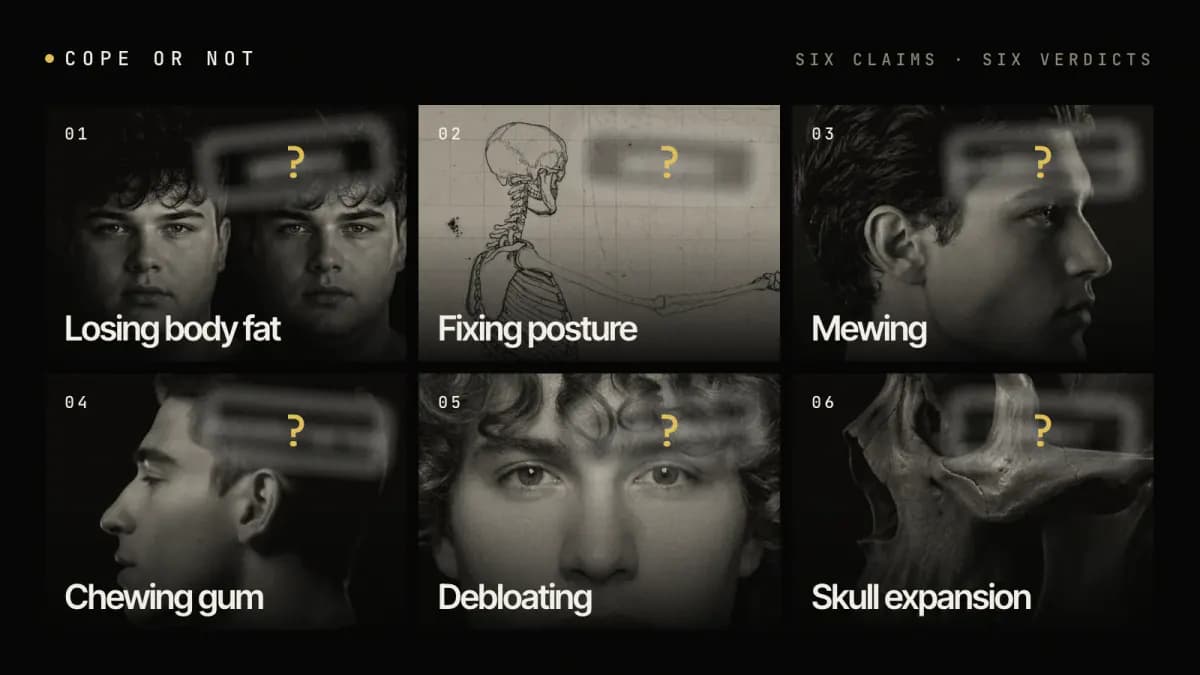
Cope. Forum shorthand for a method someone uses to feel better that supposedly doesn't work. Often thrown at anything that isn't surgery. Overused. Some cope really is cope. Getting lean, fixing posture and treating acne are not. Sorted out in cope or not.
Methods: softmaxxing, hardmaxxing and the dangerous stuff
Softmaxxing. Low-cost, non-invasive improvements: skincare, training, diet, grooming, haircut, style.6 Real, and where most of your results will come from. One caution from a UT Southwestern plastic surgeon: it can still tip into harm when it means severe dieting or piling on supplements.10
Hardmaxxing. Invasive or expensive changes: jaw surgery, implants, rhinoplasty, limb lengthening and, on the forums, steroids.610 Real procedures, real risks. Some are legitimate medicine for the right person; all carry cost, downtime and complications. Big jaw procedures such as LeFort I advancement are usually reserved for congenital problems or injury.10 That decision belongs with a board-certified surgeon, not a forum thread.
Mewing. Resting the whole tongue against the roof of the mouth, lips closed, breathing through the nose, sold as a way to reshape the jaw. Overhyped. As a resting posture it's harmless. As jaw sculpting, the American Association of Orthodontists says the evidence is very weak and no current research shows a jawline benefit.11 Jawmaxxing (hard gum, jaw trainers) adds a little masseter muscle at most, and can cause jaw-joint pain. Details in the mewing guide.
Leanmaxxing / debloating. Losing body fat and cutting water retention to reveal facial structure. Real. Usually the single highest-return change for a sharper face. See debloating.
Bonesmashing. Hitting your cheekbones or jaw with a hammer or other hard object to cause micro-fractures, on the idea that the bone grows back bigger. Dangerous myth. Don't do it. Surgeons warn it can cause fractures needing surgery, nerve damage, scarring, damaged teeth, a changed bite and permanent disfigurement, without improving appearance.1210 Bone doesn't heal into a sculpted shape.
Terms that are mostly myth
These come up constantly, so it helps to know where they stand.
| Term | The claim | Verdict |
|---|---|---|
| Bonesmashing | Trauma makes facial bone grow bigger and sharper | Harmful, no benefit12 |
| Eye mewing / hunter-eye exercises | Training eye muscles creates hunter eyes | No evidence; eye shape is set by bone and soft tissue |
| Adult forward growth | Tongue posture pushes the adult maxilla forward | Not supported11 |
| Height hacks | Stretching or supplements add height after growth plates close | Only limb-lengthening surgery does, with major risks |
| Golden ratio face | Beautiful faces match 1.618 proportions | No good evidence; no single ratio predicts attractiveness |
| "It's over" / blackpill | Looks are fixed and decide everything | Looks matter, but plenty is changeable, and the rest of your life counts too |
It's also worth knowing what the rating culture does to people. A Dalhousie University analysis of more than 8,000 comments on a looksmaxxing forum found the critique threads often left users demoralized and feeling like failures, and some posts encouraged self-harm.13 If a community makes you feel worse every time you open it, that's information.
Frequently Asked Questions
What does mogging mean? To outshine someone, usually by looking more attractive, taller or fitter next to them. It comes from the pickup-artist acronym AMOG, "alpha male of the group."8
What does ascend mean in looksmaxxing? Moving up the perceived looks or social hierarchy after improving your appearance. The improvement can be real; the fixed ladder is forum framing.
What is the difference between softmaxxing and hardmaxxing? Softmaxxing is non-invasive: skin, fitness, grooming, style. Hardmaxxing is invasive: surgery, implants and riskier forum practices. Start soft, and treat anything hard as a medical decision made with a qualified surgeon.
What does LTB mean in looksmaxxing? "Low tier Becky," the female counterpart of LTN (low tier normie) on the PSL scale. Slang, not a measurement.7
Are looksmaxxing terms like canthal tilt and maxilla real? The anatomy is real. What isn't well supported is an "ideal" value for each feature, or the idea that one feature decides how attractive you are.34
What does PSL stand for? Three forum names, PUAhate, Sluthate and Lookism. It's now often explained as "proportion, size, lineation."7
The bottom line
Learn the vocabulary so you can read the advice, not so you can grade yourself with it. The anatomy terms describe real features, but their "ideal numbers" are mostly forum convention. The rating slang is a social language, not a science. Among the methods, the boring ones (getting lean, sleep, skincare, posture, training, a good haircut) are the ones that reliably work, and bonesmashing is the one that can permanently hurt you. When a term comes with a promise of fast bone change, assume it's wrong until a doctor tells you otherwise.
References
Footnotes
-
Frolo C. 'Maxxing' named Dictionary.com's 2026 Word of the Year. The National News Desk / KMPH (2026). https://kmph.com/news/nation-world/maxxing-named-dictionarycom-2026-word-of-the-year-why-internet-slang-maximize-looksmaxxing-tanmaxxing-nonnamaxxing-cozymaxxing-social-media-affordability-data-center-odyssey-unc-definition-viral: Dictionary.com picked "maxxing" as its 2026 Word of the Year, linking it to "min-maxing" and forum origins. ↩
-
Geniole SN, Denson TF, Dixson BJ, Carré JM, McCormick CM. Evidence from Meta-Analyses of the Facial Width-to-Height Ratio as an Evolved Cue of Threat. PLoS One (2015);10(7):e0132726. https://pmc.ncbi.nlm.nih.gov/articles/PMC4504483/: Larger FWHR was judged more threatening and dominant but less attractive, especially by women; behavioral effects were small. ↩
-
Lee P, Li J, Rafiee Y, Jones BC, Shiramizu VKM. Further evidence that averageness and femininity, rather than symmetry and masculinity, predict facial attractiveness judgments. Scientific Reports (2025);15:5498. https://pmc.ncbi.nlm.nih.gov/articles/PMC11828934/: Averageness weakly predicted attractiveness in both sexes; masculinity did not predict male attractiveness and symmetry predicted neither. ↩ ↩2
-
Bashour M, Geist C. Is medial canthal tilt a powerful cue for facial attractiveness? Ophthalmic Plastic and Reconstructive Surgery (2007);23(1). https://hsrc.himmelfarb.gwu.edu/smhs_ophthalm_facpubs/302: Female faces edited to have an accentuated canthal tilt were preferred 93% of the time; male faces were not tested. ↩ ↩2
-
Know Your Meme. Canthal Tilt. Know Your Meme (accessed 2026). https://knowyourmeme.com/memes/canthal-tilt: The term spread on 4chan boards from 2012 to 2013 and became a TikTok trend and filter in 2023. ↩
-
Know Your Meme. -Maxxing. Know Your Meme (accessed 2026). https://knowyourmeme.com/memes/maxxing: Traces "looksmaxxing" to the PUAHate, SlutHate and Lookism forums around 2014 and defines softmaxxing and hardmaxxing. ↩ ↩2 ↩3
-
Know Your Meme. PSL Scale. Know Your Meme (accessed 2026). https://knowyourmeme.com/memes/psl-scale: PSL is named after PUAhate, Sluthate and Lookism; lists the tiers (normie, HTN/HTB, Chadlite, Chad) and cites researchers calling it pseudoscientific. ↩ ↩2 ↩3 ↩4 ↩5 ↩6
-
Know Your Meme. Mogging. Know Your Meme (accessed 2026). https://knowyourmeme.com/memes/mogging: Mogging derives from the pickup-artist acronym AMOG and appears on 4chan /fit/ from 2016 before spreading widely in 2021. ↩ ↩2
-
PsyPost. Study outlines the five-stage pipeline Clavicular used to spread diagnostic masculinity and looksmaxxing. PsyPost (2026). https://www.psypost.org/study-outlines-the-five-stage-pipeline-clavicular-used-to-spread-diagnostic-masculinity-and-looksmaxxing/: Summary of a single-case study by Madsen on how slang like "mogging" and "ascend" reached the mainstream. ↩
-
Stiles C. Broken jaw, shattered confidence: How to help young men avoid risks of looksmaxxing. UT Southwestern Medical Center via Newswise (2026). https://www.newswise.com/articles/broken-jaw-shattered-confidence-how-to-help-young-men-avoid-risks-of-looksmaxxing: Defines softmaxxing and hardmaxxing, warns bone smashing can cause fat necrosis and permanent disfigurement, and advises seeing a board-certified surgeon. ↩ ↩2 ↩3 ↩4
-
American Association of Orthodontists. Does Mewing Actually Reshape Your Jaw? AAO (accessed 2026). https://aaoinfo.org/whats-trending/is-mewing-bad-for-you/: No current research shows mewing benefits the jawline or oral health; tongue position alone can't reshape the jaw. ↩ ↩2
-
Mater Group. Mater doctors warn of dangers of bone smashing trend. Mater News (2026). https://mater.org.au/about-us/news/mater-news/2026/april/mater-doctors-warn-of-dangers-of-bone-smashing-trend: A plastic surgeon warns bone smashing can cause fractures, nerve damage, scarring and bite problems without improving appearance. ↩ ↩2
-
Dalhousie University. Increasingly popular looksmaxxing sites can harm rather than help young men. Dalhousie University media release (2025). https://www.dal.ca/news/media/media-releases/2025/06/02/media_opportunity__increasingly_popular__looksmaxxing__sites_can_harm_rather_than_help_young_men__making_some_feel_like_failures_in_the__manosphere___dalhousie_university_research.html: Halpin's analysis of 8,000+ forum comments found users were often left demoralized, and some were encouraged to self-harm. ↩