How to Look Older With a Baby Face (Men): What Makes a Face Read Young and What Changes It
If you want to know how to look older with a baby face as a man, the short version is this: grow whatever facial hair you can grow well, get lean enough that your jaw shows, and dress and carry yourself like an adult. Facial hair is the single biggest lever, because the research shows beards reliably raise how old and how high-status a man is judged to be. Everything else is smaller but adds up.
What you can't change is the bone and the eye shape you were born with, and you don't need to. A babyface reads young because of a handful of specific cues. Each tip below is matched to the cue it actually changes, so you can see why it works instead of following a random list of "look older" hacks.
Short answer: You can't grow a new face, but you can cover, frame or reveal the features that make it read young. Beard or stubble does the most. Leanness, a structured haircut, well-fitting clothes, posture and a steady voice do the rest.
What makes a face read as young: the babyface cues
The best-known work on this comes from psychologists Leslie Zebrowitz and Joann Montepare, who describe "babyface overgeneralization": because spotting a baby is so important to us, we react to adults whose faces merely resemble a baby's as if they had childlike traits.1 Their review lists the features that make an adult face read babyish:
- Larger eyes
- Higher eyebrows
- A smaller nose bridge
- A rounder, less angular face
- Thicker lips
- Features set lower on the face, which gives a higher forehead and a shorter chin
Babyfaced adults are perceived as more naive, submissive, weak, warm and honest, and as physically and socially weaker than mature-faced people. In real-world settings, babyfaced people get passed over for leadership and mentally demanding roles but are favored for jobs that need warmth.1
That last point matters: a babyface is not purely a handicap. It reads trustworthy and approachable. The goal for most guys isn't to add ten years. It's to stop being read as a kid while keeping the friendly part.
Here is how each cue maps to something you can do:
| Babyface cue | What changes it | How much you can move it |
|---|---|---|
| Round, soft face | Lower body fat, beard along the jaw | Moderate to large |
| Smooth jaw, short chin | Beard or heavy stubble on chin and jaw | Large (if you can grow it) |
| High forehead | Haircut with some texture or fringe | Small to moderate |
| High, thin or arched brows | Keep brows full and straight, don't over-pluck | Small |
| Large eyes | Mostly fixed; framing via brows and beard balance | Small |
| Fuller lips | Mustache or stubble partially frames them | Small |
| Youthful overall read | Clothes, posture, voice, behavior | Moderate |
The structural pieces (eye size, brow bone, nose bridge, where your features sit) are skeletal, and the facial structure guide explains why adults can't change them with exercises. The levers below work around them.
Facial hair: the biggest lever
If you can grow it, facial hair changes more of the babyface cues at once than anything else. It adds visual length to a short chin, puts an edge on a round or smooth jaw, and frames the mouth.
The evidence is fairly consistent on age and status. In a cross-cultural study, raters in New Zealand and Samoa judged the same men as older and higher in social status when bearded than when clean-shaven. Beards did not, however, make the men more attractive to women.2 A separate study using five levels of facial hair found full beards were rated the most masculine, socially mature and oldest, while light stubble was rated the most attractive.3
Beards may help most when the jaw is weaker. In a 2017 study that manipulated jaw size in composite faces, beards strongly raised masculinity and dominance ratings and had a smaller effect on attractiveness. Among clean-shaven faces, bigger jaws looked more masculine, but once a beard was added that effect mostly disappeared, and bearded faces with smaller jaws received the highest attractiveness ratings.4 For a babyfaced man, that's the useful finding: a beard partly substitutes for the jaw you don't have.
So the practical choice is a trade-off:
- Heavy stubble to a short beard is the sweet spot for most babyfaced men. It adds maturity and jaw definition without the attractiveness cost some studies find with a full beard.
- A full beard reads oldest and most mature but is more polarizing.
- Clean-shaven keeps every babyface cue on display.
What if it grows in patchy? A patchy or wispy beard can read younger, not older, because it signals early facial-hair growth. Keep it short and even, let it grow for several weeks before judging it, and shape the neckline and cheek line so it looks deliberate. Beard growth is mostly genetic, and the honest options for patchiness (including off-label minoxidil, which needs a doctor's input) are covered in the facial hair and beard grooming guide.
Body fat and facial definition
A round, soft face is one of the main babyface cues, and facial fat is what rounds it. Getting leaner sharpens the jaw-to-neck line, shows the cheekbones and makes the whole face more angular, which pushes it away from the babyish end of Zebrowitz's list. The body fat and facial definition guide covers realistic ranges and why you can't spot-reduce face fat.
An honest caveat about "looking older." Leanness changes how mature your features look, which is not the same as how many years people guess. In a study of 186 pairs of identical twins, the heavier twin looked older when the twins were under 40, and the pattern reversed over 40, when the heavier twin looked younger.5 So for a man in his twenties, gaining fat is not a route to looking more mature; it mostly adds roundness. Getting lean is the right move because it makes your face read as an adult man's face, not because it adds years.
This is also why "bulking to look older" is a bad plan. Building muscle helps (a broader frame reads more adult, see below), but extra body fat works against the angular look you're after.
Hair: cut and structure
Two babyface cues sit near your hairline: a high forehead and an overall round face shape. Your haircut can soften both.
- Add height and structure on top. A cut with some volume or texture on top and shorter, tidier sides makes a round face look longer and less circular.
- Use some forehead coverage if yours is high. A textured fringe or a side part breaks up a tall forehead. Keep it styled and intentional, though: a heavy, straight, flat fringe tends to read schoolboy.
- Avoid shapeless, grown-out hair. Floppy, unstyled hair is one of the clearest "teenager" signals. A regular cut every four to six weeks reads more adult on its own.
- Groom your brows lightly. High, thin or arched brows are a babyface cue. Tidy strays between and under the brows, but don't thin or arch them. Fuller, straighter brows sit visually lower and read more mature. The lashes and brows guide covers what helps sparse brows.
Which exact cut suits you depends on your face shape; the haircut for face shape guide walks through that.
Clothes and fit: how to look older as a man without changing your face
No study measures exactly how many years a blazer adds, so this section is practical styling rather than research. The logic is simple: if your face reads young, your clothes shouldn't add to it.
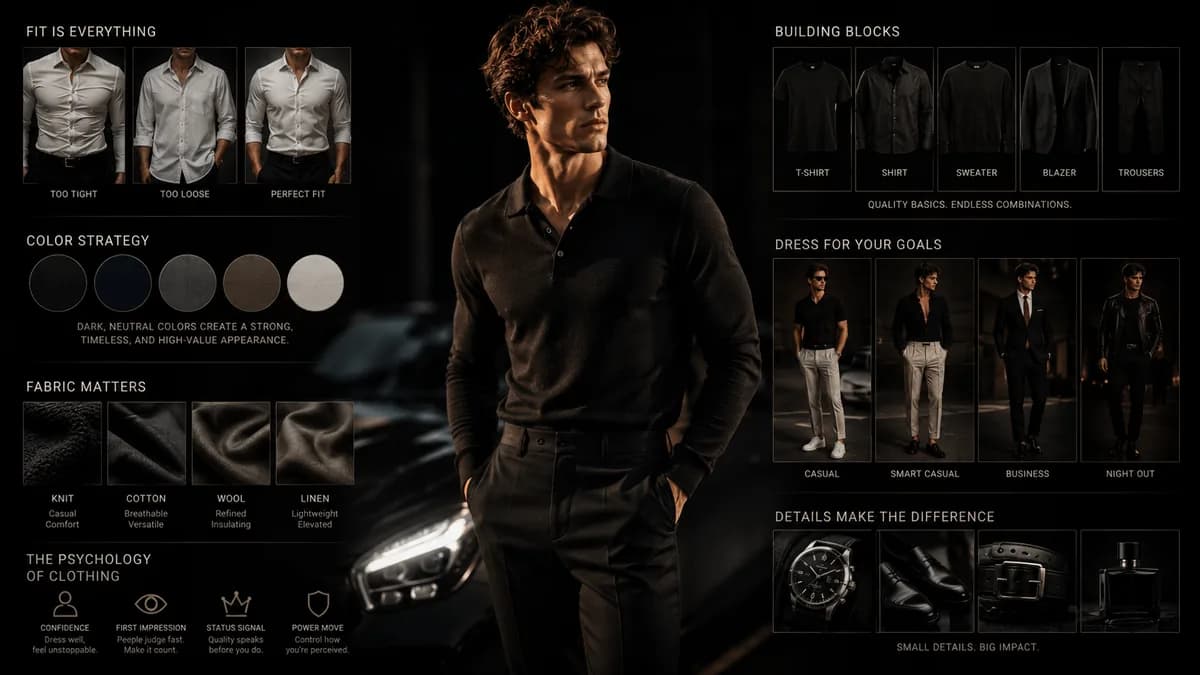
Fit beats everything. Baggy hoodies, oversized graphic tees and loose jeans read teenage on anyone. Clothes that fit your shoulders and taper slightly at the waist read adult. The style guide covers fit in detail.
Move one step up in formality. You don't need a suit. Swap the hoodie for a knit sweater or an overshirt, the graphic tee for a plain one or a polo, the running shoes for clean leather sneakers or boots. One step up is enough to shift the read.
Choose adult materials and colors. Plain, darker or muted colors, leather, wool, denim and cotton with some texture all read more grown-up than bright logos and synthetic athleisure.
Add one or two adult details. A simple watch, a leather belt and decent shoes are low-effort signals that you're not a student.
Don't overcorrect. A full suit at a casual event, or a costume-like "old money" outfit at 19, reads like someone trying to look older, which is the opposite of what you want.
Posture, voice and presence
How you move and speak changes how old you seem as much as your face does in person. There is little direct research on posture and perceived age, so treat this as sensible practice rather than proven effect.
Posture. Slouching and forward head posture make you look smaller and less confident. Standing tall with your head stacked over your shoulders also makes your jaw look sharper. The posture guide has a simple routine to fix it.
Build your frame. Broader shoulders and a more developed upper body read more like a man and less like a boy, which offsets a young face. Strength training is slow but compounds.
Voice. Your pitch is mostly set by anatomy and can't be permanently deepened with exercises, so don't try to force a lower voice. What you can change is pace, volume and steadiness: speaking slower, finishing sentences without trailing off and dropping the upspeak all make you sound more adult. The vocal presence guide covers what is and isn't changeable.
Behavior. Calm eye contact, a firm (not crushing) handshake, fewer nervous fillers and not over-explaining all signal maturity. Much of looking older is acting like someone who doesn't need to prove it. The status guide goes deeper on how people read social value.
How to look older as a teen
If you're still a teenager, the most honest advice is that your face isn't finished yet. The lower face and jaw keep developing through the late teens, and in many men into the early twenties, and facial hair often fills in gradually over the same years. A lot of babyfaces resolve on their own.
In the meantime, the safe levers are the same ones above: a good haircut, well-fitting clothes one step more formal than your peers, decent posture, regular training and getting reasonably lean. Don't use beard-growth drugs or other medications without a doctor, and don't fall for pseudoscience like mewing to "grow" your jaw or bonesmashing (hitting your face to supposedly build bone), which can injure you and has no evidence behind it. The mewing guide explains what tongue posture can and can't do.
What not to do
- Don't grow a patchy, unkempt beard and hope. Thin, uneven facial hair can make you look younger. Keep it short and shaped, or go clean-shaven with good grooming.
- Don't gain fat to "fill out." Extra fat rounds your face, which is itself a babyface cue. The twins study did find heavier men under 40 were guessed a little older, but that is weight adding apparent age, not a more adult-looking face, and the effect reversed after 40.5
- Don't try to age your skin. Smoking and sun exposure were tied to older-looking faces in the same twins study.5 Damaged skin doesn't look mature; it just looks damaged. Wear sunscreen.
- Don't force a deep voice or a tough-guy act. Both read as insecure.
- Don't wear a costume. Dressing two levels above the room looks like a kid in his dad's clothes.
- Don't chase "bone" hacks. No exercise, device or chewing routine changes adult bone structure.
- Don't drop the warmth entirely. Babyfaced men are read as trustworthy and approachable.1 Keep that and add maturity on top.
Frequently Asked Questions
How can I look older with a baby face naturally? Grow heavy stubble or a short beard if it comes in evenly, get lean enough to show your jaw, get a structured haircut, dress one step more formally than your peers, and fix your posture. None of it needs medication or surgery.
Does a beard make a baby face look older? Yes, fairly reliably. Studies find bearded men are rated older, more mature and higher in status than the same men clean-shaven.23 The trade-off is that a full beard doesn't consistently raise attractiveness, while stubble often does.
Why do I have a baby face as a man? Mostly genetics and bone structure: larger eyes, higher brows, a smaller nose bridge, a rounder face and features set lower on the face, giving a high forehead and short chin.1 Body fat and a clean-shaven face make those cues more obvious.
How do I look older as a teen? Mostly wait and work on the safe levers: haircut, fit, posture, training and leanness. Your face and facial hair are likely still developing. Avoid drugs or "bone" hacks without a doctor's advice.
Is having a baby face bad? Not really. Babyfaced adults are seen as warmer and more honest, though also as less dominant and less suited to leadership.1 Adding a few mature cues lets you keep the approachable read without being taken for a kid.
How do I look older with my face specifically? Target the cues: facial hair for the jaw and chin, leanness for roundness, fuller and straighter brows for high brows, and some fringe or texture for a high forehead. Eye size and bone structure stay as they are.
The bottom line
A babyface reads young because of specific cues: a rounder face, a smooth jaw and short chin, high brows, a high forehead and large eyes. You can't change the bone underneath, but you can cover, frame or reveal it. Facial hair is the biggest single lever, with good evidence that it raises perceived age and status. Getting lean, a structured haircut, adult-fitting clothes, upright posture and a calm, steady voice do the rest. Do those consistently and most men stop being mistaken for a teenager, while keeping the approachability that a younger-looking face gives them.
References
Footnotes
-
Zebrowitz LA, Montepare JM. Social psychological face perception: Why appearance matters. Social and Personality Psychology Compass (2008);2(3):1497. https://pmc.ncbi.nlm.nih.gov/articles/PMC2811283: Review describing babyface overgeneralization; babyfaced features (large eyes, high brows, round face, low-set features) lead to adults being judged naive, warm, weak and less suited to leadership. ↩ ↩2 ↩3 ↩4 ↩5
-
Dixson BJ, Vasey PL. Beards augment perceptions of men's age, social status, and aggressiveness, but not attractiveness. Behavioral Ecology (2012);23(3):481-490. https://academic.oup.com/beheco/article/23/3/481/221987: In New Zealand and Samoa, the same men were rated older and higher in status when bearded, but women did not rate them as more attractive. ↩ ↩2
-
Neave N, Shields K. The effects of facial hair manipulation on female perceptions of attractiveness, masculinity, and dominance in male faces. Personality and Individual Differences (2008);45(5):373-377. https://researchportal.northumbria.ac.uk/en/publications/the-effects-of-facial-hair-manipulation-on-female-perceptions-of-/: Full beards were rated most masculine, socially mature and oldest; light stubble was rated most attractive. ↩ ↩2
-
Dixson BJW, Lee AJ, Sherlock JM, Talamas SN. Beneath the beard: do facial morphometrics influence the strength of judgments of men's beardedness? Evolution and Human Behavior (2017);38(2):164-174. https://eprints.gla.ac.uk/147936: Beards strongly raised masculinity and dominance ratings; larger jaws mattered less once a beard was present, and bearded faces with smaller jaws were rated most attractive. ↩
-
Guyuron B, et al. Factors contributing to the facial aging of identical twins. Plastic and Reconstructive Surgery (2009);123(4):1321-1331. https://pubmed.ncbi.nlm.nih.gov/19337100/: In 186 identical twin pairs, a higher BMI was linked to an older appearance under age 40 and a younger appearance over 40; smoking and sun exposure were linked to older-looking faces. ↩ ↩2 ↩3