Canthal Tilt: What It Is, How to Measure Yours, and What Can Change
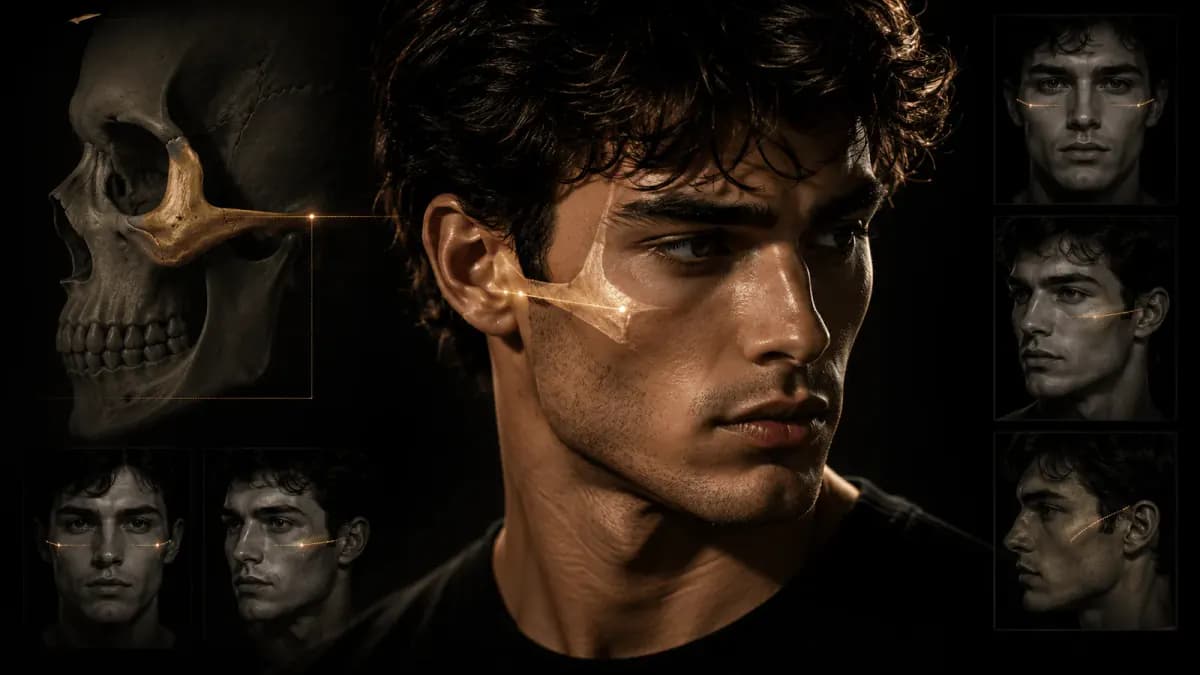
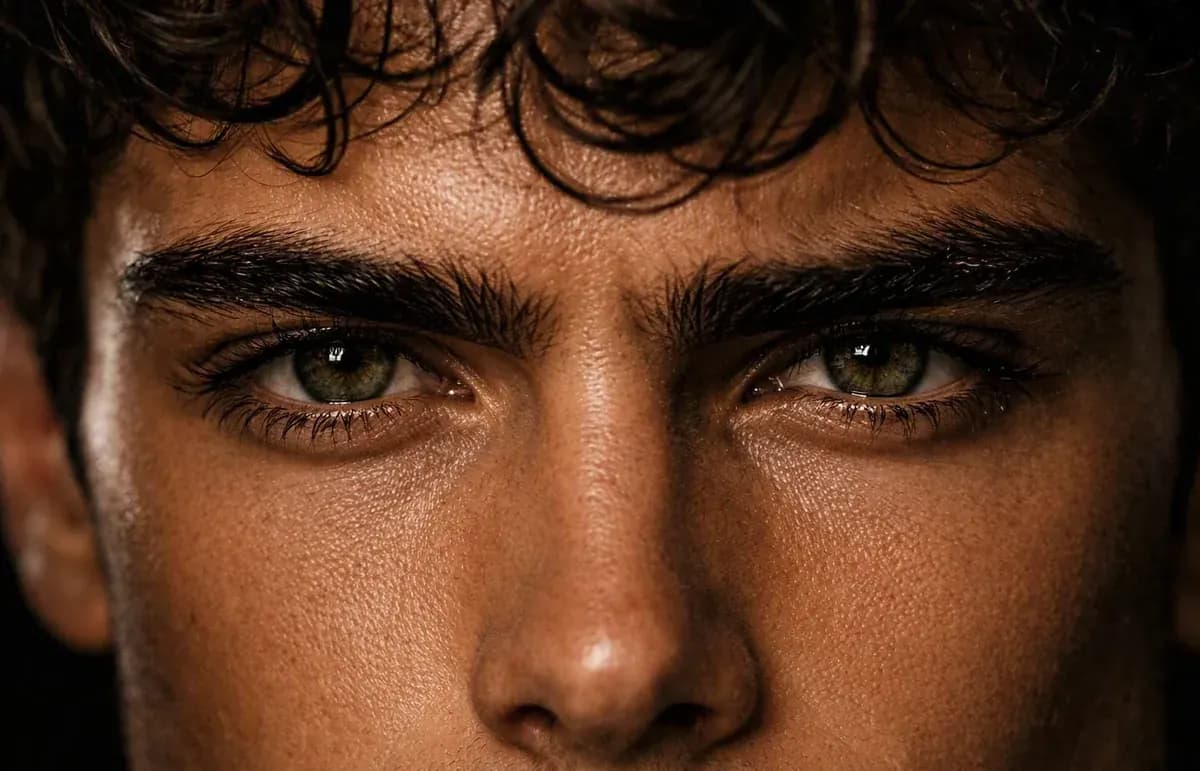
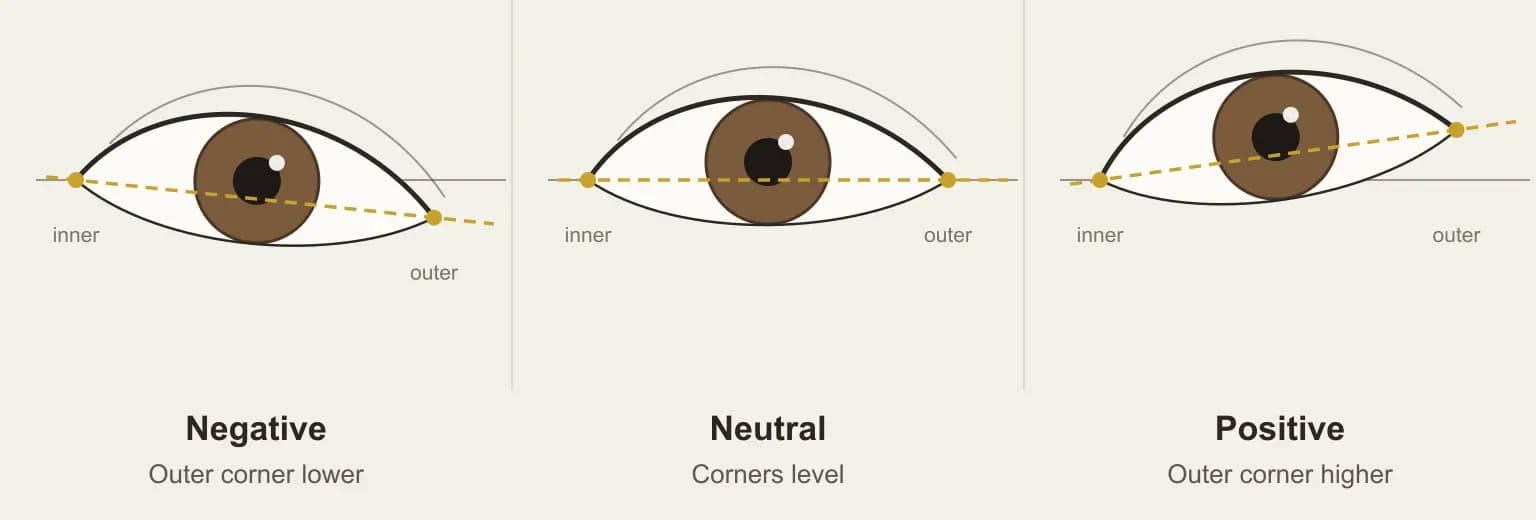
Canthal tilt is the angle of a line from the inner corner of your eye to the outer corner. If the outer corner sits higher, the tilt is positive; if it sits lower, it's negative. Measured properly, most adults land at a slight positive tilt of roughly 4 to 9 degrees, so a "positive canthal tilt" is not a rare trophy feature. It's the norm.
The problem is that almost every canthal tilt test online skips the part that matters most: how you take the photo. Tip your head a few degrees and you can turn a neutral eye into a "hunter eye" or a "negative tilt" without anything about your face changing.
This guide gives you a measuring method that controls for that, the real population numbers, what the attractiveness research actually shows, and a clear list of what can and can't change it.
Short answer: measure from a straight-on, eye-level photo using the line through both inner corners as your baseline. A slight positive tilt is typical. Tilt is mostly set by bone and the tendon that anchors your outer eyelid, so outside surgery, the things you can change affect how the eye area reads, not the angle itself.
What canthal tilt means
Two landmarks define it:
- Medial canthus (endocanthion): the inner corner, where the upper and lower lids meet. Not the pink tissue in the corner (the caruncle), but the point where the lid margins join.
- Lateral canthus (exocanthion): the outer corner, where the lids meet at the side.
Draw a line between them and measure its angle against horizontal. Researchers often call this the palpebral fissure inclination or slant, and the more careful studies measure it against a reference line drawn through both inner corners rather than against "true" horizontal.1 That detail is the key to measuring it yourself, because it cancels out sideways head tilt.
| Tilt | What it looks like | How common |
|---|---|---|
| Negative (below 0°) | Outer corner lower than inner | Less common in young adults |
| Neutral to mild (0° to about 4°) | Corners close to level | Common, especially in some groups and in men |
| Typical positive (about 4° to 9°) | Outer corner a little higher | Where most measured group averages fall |
| Strong positive (about 10°+) | Clearly upslanted | Seen, but at the high end |
These bands are rough guides built from the studies below, not clinical cutoffs. There's no official canthal tilt chart with medical categories.
The facial structure guide covers how the eye area fits with the brow, cheekbones and the rest of the face. This page is about the tilt itself.
Canthal tilt test: how to measure it from a photo, step by step
You need one good photo and a tool that can draw lines and read angles (most free image editors can, or use the looksmax calculator).
- Take the right photo.
- Camera at eye level, straight in front of you. Not from below, not from above.
- Stand back about 1 to 1.5 meters (3 to 5 feet) and zoom in slightly, or have someone else take it. Close-up selfie lenses distort the face.
- Neutral face, eyes open normally, looking straight into the lens. No smiling: a smile pushes the lower lids and cheeks up and changes where the outer corner appears.
- Even, front-facing light so both corners are clearly visible.
- Keep your chin level. Imagine a line from the bottom of your eye socket to the top of your ear hole and keep it roughly horizontal.
- Mark four points: the inner and outer corner of each eye, where the lid margins actually meet. Zoom in until you can see the exact junction.
- Draw the baseline by connecting the two inner corners. This is your zero line.
- Measure each eye. Draw a line from each inner corner to the outer corner of the same eye and measure its angle against the baseline. Outer corner above the baseline is positive; below it is negative.
- Do the quick math if you prefer. Angle = arctan(vertical rise ÷ horizontal distance). If the outer corner sits 2.5 units above the inner corner over a horizontal span of 28 units (pixels work fine), that's arctan(0.089), or about 5 degrees.
- Repeat with three photos and average. Single photos are noisy. If your three results differ by more than a couple of degrees, your photo setup is the problem, not your eyes.
The baseline matters because of head roll. If you measure against the photo's horizontal edge instead of the inner-corner line, a head rolled 3 degrees to one side adds about 3 degrees to one eye and subtracts 3 from the other. That's enough to call one eye "positive" and the other "negative" in the same photo. Using the inner-corner line removes that error.
One error you can't remove is chin up or down. Nodding your head forward or back changes how the eye looks in 2D, and no baseline corrects for it. In a study of 12 women photographed at different head angles, tilting the head down made the outer corner appear higher: the vertical gap between inner and outer corners averaged 2.55 mm with the head level, 3.79 mm at 10 degrees down, and 1.06 mm at 10 degrees up.2 That means the same eye can look roughly half again as upslanted, or barely tilted at all, depending only on posture in the photo. Raters also scored the chin-down versions as more attractive, which is why so many "positive tilt" photos online are taken from slightly above.
Also, don't use strabismus tests. Some "canthal tilt test" pages mix in eye-alignment tests like the Hirschberg or Krimsky test. Those check whether your eyes point in the same direction. They have nothing to do with canthal tilt.
What's normal: canthal tilt ranges by population
Here's what measured studies actually report. Methods differ (photos, 3D scans, composite faces), so compare loosely.
| Group | Men | Women | Source |
|---|---|---|---|
| Malaysian South Indian adults, 18 to 26 (300 people, photos) | 4.7° | 7.0° | Packiriswamy 20121 |
| Korean adults (age-stratified eyelid study) | 7.9° ± 2.4 | 8.8° ± 2.3 | Park 20083 |
| Average Caucasian composite face (reference value) | about 4.1° (sexes combined) | Rhee 2012, as cited by Liu 20234 | |
| Caucasian celebrities and models, 23 to 42 (42 people) | 6.5° ± 2.7 | 8.5° ± 2.1 | Liu 20234 |
Three patterns hold up:
- A slight positive tilt is typical in every group measured. A neutral tilt is not abnormal, it's just at the lower end.
- Women average a few degrees more than men, so a man with 4 to 6 degrees is right in a normal range for his sex.
- East Asian eyes tend to measure higher than the European and South Asian samples.
There's no good evidence on how common a true negative tilt is in the general population, so be skeptical of any page that quotes a percentage.
Does canthal tilt affect attractiveness?
Somewhat, but much less cleanly than looksmaxxing forums claim. The direct evidence is thin, and it doesn't support "the more positive, the better."
Mild positive tilt does show up in attractive faces. In a biometric study of composite faces, attractive Caucasian and African composites had a steeper eye slant than average ones, but attractive Asian composites had a less steep slant than average Asian faces.5 Celebrities and models also measured above the average reference value.4 Both suggest that a bit above your group's average looks good, not that maximum tilt does.
Exaggerating it backfires, though. In a 2025 study of 2,081 raters looking at an edited face, raising the outer eye corner lowered ratings of attractiveness, masculinity and trustworthiness, and raised ratings of dominance, threat and disgust.6 Raising the brows as well made the effect stronger. That's one face and one study, but it's the largest test so far, and it points the opposite way from the "push it as high as possible" idea.
The study most often quoted online is about female faces. A widely shared 2007 study found edited faces with a steeper tilt at the inner corner were picked 93% of the time.7 It used female faces and a different measurement from the standard canthal tilt, so it says little about positive canthal tilt in men.
So what does this mean for you? No study has shown that a man's measured canthal tilt predicts how attractive real people find him. The eye area as a whole (lids, brows, under-eye area, skin, how rested you look) matters more than a single angle, which is the same lesson the facial structure guide draws for every individual feature.
What changes canthal tilt (and what only changes how it looks)
The real angle is set by bone and the lateral canthal tendon, meaning your orbit shape and where the tendon anchoring your outer eyelid attaches. In adults, that doesn't change with exercise, diet or posture.
Age matters less than people think. A large study of 320 people aged 10 to 89 found that aging did not move the position of the outer eye corner. What it did do was make the lower eyelid sag, more in men, and shorten the eye opening by about 2.5 mm from middle to old age.8 So an eye that looks more downturned with age is usually a lower-lid and soft-tissue change, not the corner itself dropping.
Lid laxity is different. When the lower lid loosens a lot, it can turn outward (ectropion), causing dryness, redness, tearing and irritation, and it may need treatment.9 This is a medical issue, not a cosmetic tilt type.
Your brows don't change the angle, but they frame it. Attractive composite faces in every group had a lower brow position than average ones,5 and brow elevation shifted ratings in the 2025 study.6 A low, straight-ish brow makes the eyes look more defined. The lashes and brows guide covers grooming.
Puffiness also plays a part. Swollen lids and under-eyes blur the outer corner and make eyes look tired and downturned. This is temporary and covered in the sleep guide and the debloating guide.
Finally, photo angle and expression. As shown above, chin position alone can swing the apparent tilt a lot. Smiling and squinting change it too.
Negative canthal tilt: how to fix it (what you can and can't change)
| Option | What it actually changes | Lasts | Evidence |
|---|---|---|---|
| Brow grooming (clean up the tail, keep it low and full) | Framing of the eye, not the angle | As long as you maintain it | Indirect; brows clearly affect how the eye area reads |
| Sleep, less sodium and alcohol | Lid and under-eye puffiness | Days | Good for puffiness, none for the angle |
| Photo posture (level camera, chin very slightly down) | Apparent tilt in photos only | That photo | One small study on head tilt |
| Canthal tilt exercises, "eye mewing," taping | Nothing structural | No | No evidence |
| Lateral canthoplasty or canthopexy (surgery) | Repositions the outer corner and lid | Long term, with relapse possible | Surgical case series; complications not rare |
There's no research showing any facial exercise, tongue posture, taping or massage changes where your lateral canthal tendon attaches. Skip them.
Lateral canthoplasty and canthopexy are real oculoplastic procedures, often used to repair lid laxity or ectropion. Cosmetic versions exist, but they're surgery on a structure that controls how your eyelid protects your eye. A review of cosmetic lateral canthoplasty notes that complications and unfavorable results are "not rare," including a rounded or webbed outer corner, recurrence, ectropion and exposed lining causing dry eye, lid turning inward, mechanical droop of the lid, asymmetry and scarring.10 Tellingly, that same procedure is popular in East Asia mostly to reduce eye slant and widen the eye, which shows how cultural the "ideal" tilt is.10
If you're considering it, see a board-certified oculoplastic surgeon (an ophthalmologist who specializes in eyelids), not a med spa, and ask specifically about relapse, dry eye and revision rates. Read what actually helps the eye area first, because most men get more from the non-surgical basics.
When canthal tilt is a medical issue
Most tilt differences are simply anatomy. See an eye doctor or oculoplastic surgeon if you notice:
- A lower lid that sags, pulls away from the eye or turns outward, especially with watering, redness, grittiness or dryness. That suggests lid laxity or ectropion, which can damage the cornea if ignored.9
- A drooping upper lid (ptosis), particularly on one side. Ptosis is a sign with many causes.11
- Urgent signs: a lid that droops suddenly with a headache, a change in pupil size or double vision needs emergency care, because it can signal a nerve problem such as a compressed oculomotor nerve. A droop that gets worse as the day goes on or with fatigue can point to myasthenia gravis.11
- A change after injury or eyelid surgery, or a new difference between your two eyes.
Frequently Asked Questions
What does canthal tilt mean? It's the angle between your inner and outer eye corners. Outer corner higher means positive; lower means negative; level means neutral.
How do I do a canthal tilt test accurately? Use a straight-on, eye-level photo with a neutral face and level chin, measure each eye against the line through both inner corners, and average three photos. Anything else mostly measures your head position.
Positive canthal tilt vs negative: which is better for men? A slight positive tilt is the most common pattern and tends to read as alert. A neutral tilt is normal too. Making it more extreme doesn't help: in the largest rating study, raising the outer corner lowered attractiveness and raised threat ratings.
Can you fix a negative canthal tilt without surgery? Not the bone or tendon. You can make the eye area read better with brow grooming, less puffiness and better photo posture, but the angle itself only changes with surgery.
Is there a canthal tilt chart I can use? No medical one exists. Use the ranges table above: typical group averages fall around 4 to 9 degrees, with women a few degrees higher than men.
How can I improve my canthal tilt as I age? Protect the lower lid and skin: sun protection, not rubbing your eyes, and getting a sagging or outward-turning lid checked early. Age mainly loosens the lower lid rather than moving the corner itself.
The bottom line
Canthal tilt is real, measurable and mostly fixed. Measure it against the line through your inner corners from a level, eye-level photo, or you're measuring your camera angle. A slight positive tilt is the norm, men average a little lower than women, and a neutral tilt is nothing to fix. The research doesn't support chasing a steeper angle; if anything, exaggerating it reads as less attractive and more threatening. Spend your effort on the parts that move: brows, sleep, puffiness, skin and how you're photographed. If a lid is sagging, turning out or drooping, that's a job for an eye doctor, not an exercise.
References
Footnotes
-
Packiriswamy V, Kumar P, Rao KGM. Photogrammetric analysis of palpebral fissure dimensions and its position in Malaysian South Indian ethnic adults by gender. North American Journal of Medical Sciences (2012);4(10):458-462. https://pubmed.ncbi.nlm.nih.gov/23112966/: In 300 adults aged 18 to 26, palpebral fissure inclination averaged 4.72° in men and 7.04° in women. ↩ ↩2
-
Vaca EE, Bricker JT, Mioton LM, Fagien S, Alghoul MS. The Influence of Sagittal Head Tilt on Periorbital Appearance: Implications for Clinical Photography and the Evaluation of Postoperative Results. Aesthetic Surgery Journal Open Forum (2021);4:ojab043. https://pmc.ncbi.nlm.nih.gov/articles/PMC8830303/: Downward head tilt exaggerated positive intercanthal tilt in photos and was rated more attractive. ↩
-
Park DH, Choi WS, Yoon SH, Song CH. Anthropometry of Asian eyelids by age. Plastic and Reconstructive Surgery (2008);121(4):1405-1413. https://pubmed.ncbi.nlm.nih.gov/18349663/: Palpebral fissure slant in Korean adults was 7.9 ± 2.4 degrees in men and 8.8 ± 2.3 in women. ↩
-
Liu AS, Salinas CA, Sharaf BA. Using Artificial Intelligence to Quantify Sexual Dimorphism in Aesthetic Faces: Analysis of 100 Facial Points in 42 Caucasian Celebrities. Aesthetic Surgery Journal Open Forum (2023);5:ojad046. https://pmc.ncbi.nlm.nih.gov/articles/PMC10335162/: Canthal tilt averaged 6.51° in male and 8.50° in female celebrities, versus a 4.12° reference for an average Caucasian face. ↩ ↩2 ↩3
-
Rhee SC, Woo KS, Kwon B. Biometric study of eyelid shape and dimensions of different races with references to beauty. Aesthetic Plastic Surgery (2012);36(5):1236-1245. https://pubmed.ncbi.nlm.nih.gov/22810555/: Attractive Caucasian and African composites had steeper eye slant than average, attractive Asian composites less steep; all had lower brows. ↩ ↩2
-
Kempa J, Kasielska-Trojan A, Gabryszewski M, et al. Understanding the impact of eyebrow and lateral canthal height on the perception of character traits: A rating-based analysis of 2081 participants. Journal of Plastic, Reconstructive & Aesthetic Surgery (2025);104:417-425. https://pubmed.ncbi.nlm.nih.gov/40174260/: Raising the outer eye corner lowered attractiveness and trustworthiness ratings and raised dominance and threat. ↩ ↩2
-
Bashour M, Geist C. Is medial canthal tilt a powerful cue for facial attractiveness? Ophthalmic Plastic and Reconstructive Surgery (2007);23(1). https://hsrc.himmelfarb.gwu.edu/smhs_ophthalm_facpubs/302: Female faces edited to a steeper inner-corner tilt were preferred 93% of the time. ↩
-
van den Bosch WA, Leenders I, Mulder P. Topographic anatomy of the eyelids, and the effects of sex and age. British Journal of Ophthalmology (1999);83(3):347-352. https://bjo.bmj.com/content/83/3/347: In 320 people aged 10 to 89, aging did not move the lateral canthus but made the lower lid sag, especially in men. ↩
-
Ozgur O, Kaufman EJ. Ectropion. StatPearls (2023). https://pubmed.ncbi.nlm.nih.gov/28722958/: An outward-turned lower lid can cause dryness, redness, tearing and corneal damage; care starts with lubrication and often needs surgery. ↩ ↩2
-
Kim YJ, Lee KH, Choi HL, Jeong EC. Cosmetic Lateral Canthoplasty: Preserving the Lateral Canthal Angle. Archives of Plastic Surgery (2016);43(4):316-320. https://pmc.ncbi.nlm.nih.gov/articles/PMC4959973/: Complications after cosmetic lateral canthoplasty are not rare, including commissure deformity, recurrence, ectropion and dry eye. ↩ ↩2
-
Koka K, Zeppieri M, Vadeo A, Patel BC. Blepharoptosis (Ptosis): Classification, Evaluation, and Surgical Management. StatPearls (2026). https://pubmed.ncbi.nlm.nih.gov/30969650/: Ptosis is a sign with many causes; sudden onset with headache, pupil changes or eye-movement problems needs urgent imaging. ↩ ↩2