How to Look Taller (Men): Clothes, Posture, Shoes and Photos
If you want to know how to look taller as a man, the honest answer is that you're working with an inch or two, and most of it comes from three places: standing at your full height, clothes that keep your leg line long and unbroken, and shoes with a little built-in lift. Photos are where you have the most room to play, because camera height alone can shift how tall people judge you.
None of this changes your skeleton, and the internet's favorite tip (vertical stripes) has surprisingly little research behind it. This guide covers what changes perceived height, what each lever is worth, and which "tall hacks" don't hold up.
If you're here because of what height does to attraction and dating, that's a different question, covered in height and attraction. This page is purely practical.
Short answer: Fix your posture first (it's free and you're probably losing some height to it). Wear trousers that fit with little or no break, keep your trousers and shoes in similar colors, and keep the upper body fitted rather than baggy. Choose shoes with a modest heel, and treat big lifts as a trade-off, not a free win. In photos, keep the camera a bit lower than your eyes for full-body shots and stand a step closer to it than the people around you.
How to look taller as a man: what changes perceived height
People don't measure you. They estimate, using a handful of cues:
- Your actual vertical extent, which posture and footwear change slightly.
- Your proportions, especially how long your legs look relative to your body. In a study of 3,103 people across 27 nations rating male and female silhouettes, figures with short legs and with excessively long legs were both rated less attractive in every nation.1 That's about attractiveness, not perceived height, but it explains why "long leg line" is the core goal of styling for height.
- Context: who you're standing next to, the camera angle, the room.
- Your face. In one set of experiments, more elongated faces (longer relative to width) were judged to belong to taller people, and faces that looked taller were also rated as better leaders.2 You can't reshape your face, but it's a reminder that height judgments come from more than height.
The practical point: you can't add inches, but you can stop leaking them (slouching, cut-off proportions, bad camera angles) and nudge the cues that people use to estimate them.
Posture: the free inch
Slouching costs you visible height. Forward head posture and rounded shoulders pull your head down and forward, so the top of your head sits lower and your silhouette reads shorter and less confident. Standing tall puts that height back immediately, at zero cost. There's no good study putting an exact number on how much height a typical slouch costs, so be skeptical of anyone who quotes one.
What "standing tall" means. Ears stacked over shoulders, shoulders back and down (not shrugged), chest open, weight even across both feet. Think of being pulled up from the crown of your head rather than puffing out your chest. The posture guide has a side-photo test and a 15-minute back routine that makes this your default instead of something you have to remember.
A related fact worth knowing: you're tallest in the morning. Your spinal discs compress under load during the day and recover overnight. One study measured a mean daily variation in stature of 14.4 mm, more than the height lost during a 25 km run, with the loss reversed during sleep.3 You can't bank this, but it explains why your morning and evening measurements disagree, and why "I measured 5'8" at the doctor's" can be honest even if you're shorter by evening.
Clothes: proportion, monochrome, fit, rise
This section is mostly styling convention and experience, not lab science. The logic is consistent, though: anything that keeps the leg line long and uninterrupted, and anything that avoids extra visual bulk, helps.
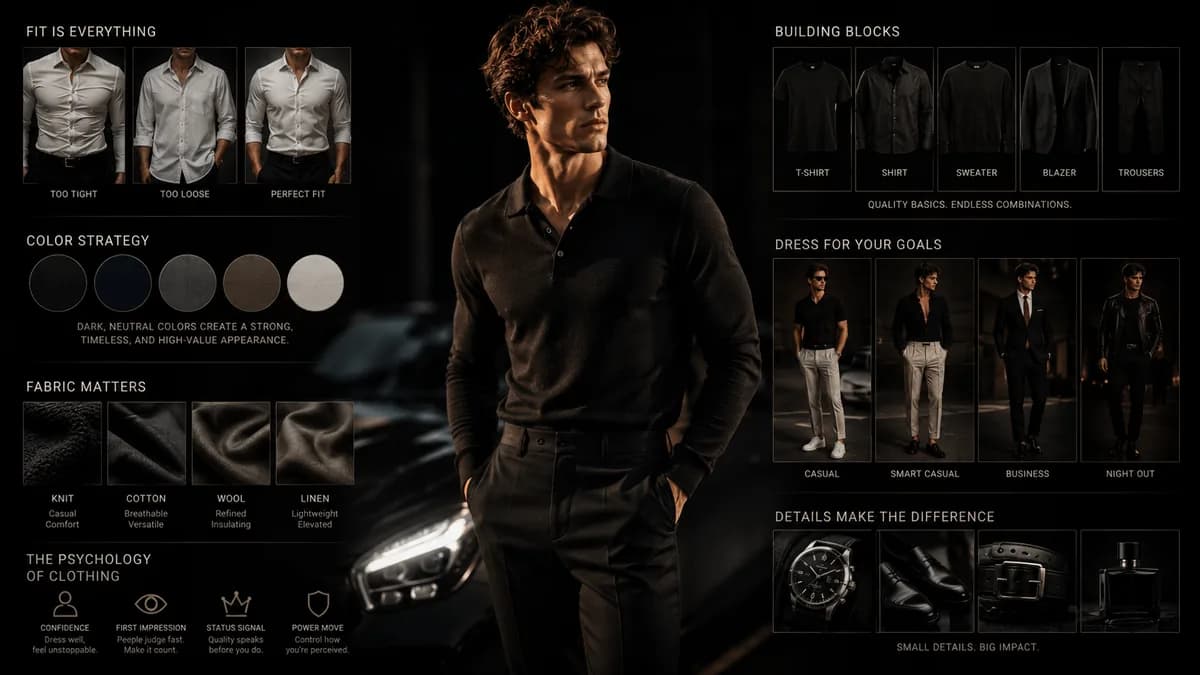
Fit is the foundation. Oversized clothes swallow a shorter frame and make you look smaller, not taller. Shirts and jackets should sit at your shoulder edge, follow your torso, and end around the middle of the fly. Jackets that are too long cut your legs short. The style guide covers fit in detail, and a cheap tailor is the best height investment you can make.
Trouser break. Fabric pooling at the ankle visually chops off the bottom of your leg. Aim for no break or a slight break, with a gentle taper. Avoid big cuffs, which add a horizontal band at the ankle.
Rise and where your waist sits. A mid or higher rise puts the visual start of your legs higher, so your legs look longer. Very low-rise trousers do the opposite. Tucking a shirt (or wearing a shorter jacket) shows where your legs start; a long untucked shirt hides it.
Monochrome and low contrast below the waist. Matching your trousers and shoes (dark jeans with dark shoes, for example) or wearing one color top to bottom makes the body read as one continuous column. A loud contrast between trousers and shoes, or between top and bottom, breaks you into segments. Contrast near the face is fine and draws the eye up.
Proportion details that add up:
| Helps (keeps you long) | Hurts (cuts you up) |
|---|---|
| Little or no trouser break | Pooled fabric at the ankle |
| Mid or higher rise | Very low-rise trousers |
| Shoes close in color to trousers | High-contrast shoes with light trousers |
| Fitted, shorter jackets | Long, boxy coats and oversized hoodies |
| Shorts ending a little above the knee | Long, baggy shorts below the knee |
| Narrow-to-medium belt in a matching tone | Wide, contrasting belt |
| Collars, details and color near the face | Busy details at the hips or shins |
Build the frame. A fitted shirt over a developed upper back and shoulders looks taller and more upright than the same shirt hanging off you. The aesthetic physique guide covers which muscles change your silhouette.
Myths: do vertical stripes make you look taller?
This is the most repeated height tip, and the research mostly points the other way.
The original finding. In 1867 Hermann von Helmholtz noted that a square filled with horizontal stripes looks taller and narrower than an identical square with vertical stripes. Thompson and Mikellidou tested this directly in 2011. A vertically striped rectangle had to be about 7.1% taller to look as tall as a horizontally striped square, and a horizontally striped rectangle had to be about 4.5% wider to look as wide as a vertically striped one. The effect held on a line drawing of a woman in a striped dress and on stereoscopic photos of mannequins in striped tops, where the horizontally striped mannequin had to be 10.7% broader to look as wide as the vertically striped one.4 Their conclusion: horizontal stripes don't make you look fatter, and vertical stripes don't make you look taller or slimmer. If anything, the reverse.
The caveats are real. These were small studies using flat shapes, drawings and mannequins, not men walking around in shirts. A 2013 follow-up found the slimming effect of horizontal stripes was stronger for a thin figure than a heavier one, varied a lot between individual viewers, and depended on which figure people saw first; for the heavier figure the average leaned slightly the other way, though not significantly.5 A 2021 study using photos of a real model found horizontal stripes and darker clothing each made the body look slightly to moderately thinner, with the strongest effect when combined, but it didn't test vertical stripes.6 All three studies used female figures.
What to take from this. Stripes are a small, unreliable effect either way, and no study shows vertical stripes adding perceived height to a man. Don't build a wardrobe around them. Fit, proportion, and color continuity do far more. Darker clothes do have some evidence for looking slimmer, which helps the long, lean column you're after.
Other myths, briefly:
- "Grow taller" stretches, supplements and hanging routines don't increase adult height. Your growth plates are closed. Hanging can temporarily decompress your spine, the same way sleep does, and that's gone within hours.
- "Posture makes you grow" is the same idea dressed up. Better posture recovers height you were losing to slouching; it doesn't add bone.
Shoes and lifts, honestly
Shoes with a natural heel. Boots, Chelsea boots and many dress shoes have a heel that adds a few centimeters without anyone thinking about it. This is the easiest, least noticeable win. Very flat shoes (some minimalist sneakers, slippers) give it away.
Lift inserts and elevator shoes. These hide extra height inside the shoe. A small insert inside a sneaker or boot is common and unremarkable. The problems start as the lift gets taller:
- Fit. A big insert pushes your heel up and out of the shoe, so you often need a half size up or a high-top shoe.
- Gait. Large lifts can make you walk on your toes slightly, which looks stiff. A natural walk matters more than the last centimeter.
- Your body. One study of 49 men and 48 women found that raising the heels 3 cm or 7 cm caused no immediate change in pelvic or spinal posture in men.7 But a small study of men in their twenties who wore 5 cm raised-heel insoles for 8 hours a day for 60 days found reduced pelvic range of motion and increased calf muscle tone, and the author concluded long-term wear could have adverse effects.8 That's one small study, so it's not proof of harm, but it's a reason to keep large lifts for occasions rather than all day, every day.
- The reveal. Lifts come off when your shoes do. If you're dating, a few centimeters is invisible; a lot of lift sets up a mismatch.
A sensible approach: pick everyday shoes with a modest natural heel, use a small insert if you like it, save bigger lifts for photos or events, and stop if you get foot, knee or back pain. If you have existing foot or back problems, ask a podiatrist before wearing lifts regularly.
Limb lengthening surgery is the only thing that changes adult height, and it's a major orthopedic procedure, not a style choice. A 2020 systematic review of cosmetic stature lengthening (11 studies, 795 patients) found a mean gain of 6.7 cm, generally good satisfaction, and a low rate of major complications, but problems along the way were common, external fixator treatment averaged about 201 days, and every included study was low-level evidence (case series or retrospective reviews).9 If you're seriously considering it, that's a conversation with a specialist orthopedic surgeon and, ideally, a psychologist, not a forum.
Photos: camera height and distance
Photos are where perceived height is easiest to change, because the viewer has no other reference.
Camera height. A lower camera makes you look taller. In one experiment, people estimated the height of a face seen from a webcam placed below the screen at about 3.9 cm taller than the same face from a camera above it.10 That was a small study with only two faces, but it matches standard photography practice. For full-body shots, a camera around waist to chest height, tilted very slightly up, lengthens your legs. Go too low (ground level) and you get a giant chin and nostrils, so keep it modest. A camera above eye level shortens you, which is why overhead selfies make you look small.
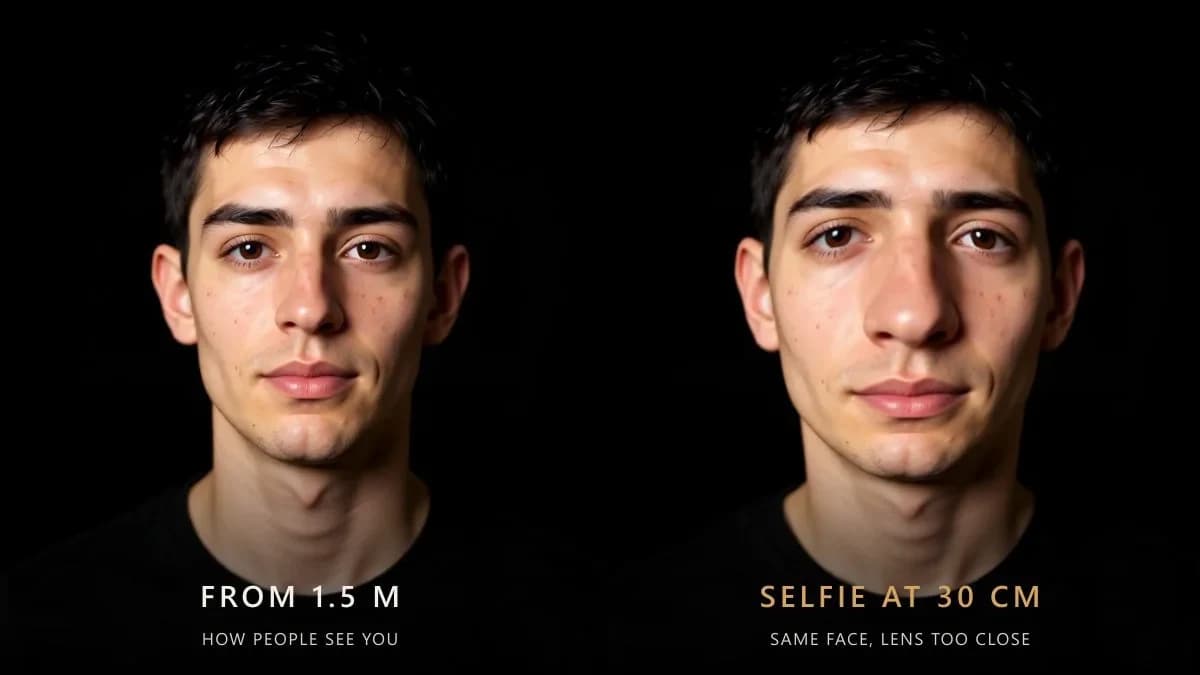
Distance and lens. Wide-angle phone lenses stretch whatever is near the edges of the frame. Putting your feet near the bottom edge of a wide shot can lengthen your legs, but it also distorts, so check the result. For headshots, step back and zoom in instead; close-up selfies warp your face. The photo guide covers distance, light and angles for your face in detail.
Group shots. Whoever is closest to the camera looks biggest. Stand half a step in front of the group, or at least not behind it, and don't stand next to the tallest person if you can help it.
Pose. Stand tall, weight on one leg, chin slightly forward. Show your shoes; cropping at the ankle or shin makes legs look shorter. Avoid crouching or sitting low next to standing friends.
Frequently Asked Questions
How do I look taller as a short guy? Stand at your full height, wear fitted clothes with a clean trouser break, keep trousers and shoes in similar colors, and choose shoes with a modest heel. Together these add maybe an inch or two of perceived height. Building your shoulders and back and keeping body fat in check make the frame look more substantial too.
How do I look taller with clothes? Keep the leg line long: mid or higher rise, little or no break, no pooled fabric, shorter fitted jackets, and low contrast between trousers and shoes. Avoid oversized, boxy pieces. Don't rely on vertical stripes; the research doesn't support them.4
How do I look taller in photos? Have the camera a bit below eye level (waist to chest height for full-body shots), include your feet in the frame, stand tall, and stand closer to the camera than the people around you. A lower camera made faces look several centimeters taller in one small study.10
How do I look taller with shoes? Boots and dress shoes with a natural heel are the simplest option. Small inserts are fine for most people. Large lifts work but can change your walk, need roomier shoes, and in one small study daily long-term wear had some negative effects on mobility and calf tone.8
Are lift shoes for men worth it? For occasions, a few centimeters can be worth it if they're comfortable and you walk naturally. For all-day, every-day use, keep the lift modest. If they hurt, stop, and see a podiatrist if you have existing foot or back issues.
What's the best short guy glow up? The same order as anyone's glow up: posture, fit, grooming, physique, then shoes. Height is one factor among many; see height and attraction for what the research shows about how much it matters.
The bottom line
You can't change your height, but you can stop losing it. Stand tall, dress so your legs read as one long, unbroken line, pick shoes with a little natural lift, and set up photos with a lower camera and your feet in frame. Treat big lifts as an occasional tool with real trade-offs, and ignore the vertical stripes advice: the research suggests it does little, or the opposite. Expect an inch or two of perceived height, and put the rest of your effort into the things that change how you look far more.
References
Footnotes
-
Sorokowski P, Szmajke A, Sorokowska A, Cunen MB, Fabrykant M, Zarafshani K, Amiri M, Çetinkaya H. Attractiveness of leg length: Report from 27 nations. Journal of Cross-Cultural Psychology (2011);42(1):131-139. https://gcris.ieu.edu.tr/entities/publication/806b5da6-c062-4787-bde7-c7cbd4c635cb/full: across 3,103 participants in 27 nations, silhouettes with short and excessively long legs were rated less attractive. ↩
-
Re DE, Hunter DW, Coetzee V, Tiddeman BP, Xiao D, DeBruine LM, Jones BC, Perrett DI. Looking Like a Leader: Facial Shape Predicts Perceived Height and Leadership Ability. PLoS ONE (2013);8(12):e80957. https://journals.plos.org/plosone/article?id=10.1371/journal.pone.0080957: facial elongation predicted perceived height, and perceived height predicted perceived leadership ability. ↩
-
Leatt P, Reilly T, Troup JG. Spinal loading during circuit weight-training and running. British Journal of Sports Medicine (1986);20(3):119-124. https://pubmed.ncbi.nlm.nih.gov/3779339/: mean circadian variation in stature was 14.4 mm, reversed during a night's sleep. ↩
-
Thompson P, Mikellidou K. Applying the Helmholtz illusion to fashion: horizontal stripes won't make you look fatter. i-Perception (2011);2(1):69-76. https://pubmed.ncbi.nlm.nih.gov/23145226/: horizontal stripes made shapes and figures look taller and narrower, not wider, in 2-D shapes, a line drawing and stereoscopic mannequin photos. ↩ ↩2
-
Ashida H, Kuraguchi K, Miyoshi K. Helmholtz illusion makes you look fit only when you are already fit, but not for everyone. i-Perception (2013);4(5):347-351. https://pubmed.ncbi.nlm.nih.gov/24349693/: the slimming effect of horizontal stripes was stronger for a thin figure, may reverse for a heavier one, and varied widely between viewers. ↩
-
Koutsoumpis A, Economou E, van der Burg E. Helmholtz Versus Haute Couture: How Horizontal Stripes and Dark Clothes Make You Look Thinner. Perception (2021);50(9):741-756. https://pubmed.ncbi.nlm.nih.gov/34397290/: with photos of a real model, horizontal stripes and darker dresses each made the body look slightly to moderately thinner. ↩
-
Colonna S, Borghi C, Galvani M, D'Alessandro A. Immediate Effect of Simulated High Heels on Pelvic and Spinal Posture in Healthy Young Subjects: A Cross-Sectional Study. Cureus (2024);16(3):e55586. https://pubmed.ncbi.nlm.nih.gov/38576640/: in 97 adults (49 men), 3 cm and 7 cm heel lifts caused no immediate significant change in pelvic or spinal posture. ↩
-
Cha YJ. Effects of wearing raised-heel insoles for 60 days on physical functions: focusing on adult males in their twenties. Journal of Men's Health (2021);17(4):198-206. https://www.jomh.org/articles/10.31083/jomh.2021.061: wearing 5 cm raised-heel insoles 8 hours a day for 60 days reduced pelvic range of motion and increased calf muscle tone. ↩ ↩2
-
Marwan Y, Cohen D, Alotaibi M, Addar A, Bernstein M, Hamdy R. Cosmetic stature lengthening. Bone & Joint Research (2020);9(7):341-350. https://boneandjoint.org.uk/Article/10.1302/2046-3758.97.BJR-2019-0379.R1: across 11 studies (795 patients), mean lengthening was 6.7 cm with low major complication rates, but all studies were level IV evidence. ↩
-
Thomas LE, Pemstein D. What you see is what you get: webcam placement influences perception and social coordination. Frontiers in Psychology (2015);6:306. https://www.frontiersin.org/journals/psychology/articles/10.3389/fpsyg.2015.00306/full: faces captured from a low webcam were estimated about 3.9 cm taller than the same faces from a high webcam. ↩ ↩2