Training for an Aesthetic Physique: The Best Splits and Routines
This is the "how to actually train" companion to the aesthetic male physique guide, which covers the why — frame, proportions, and the shoulder-to-waist ratio. Here we skip to programming: which muscles to prioritize, the principles that make a routine work, and complete, ready-to-run splits you can start this week.
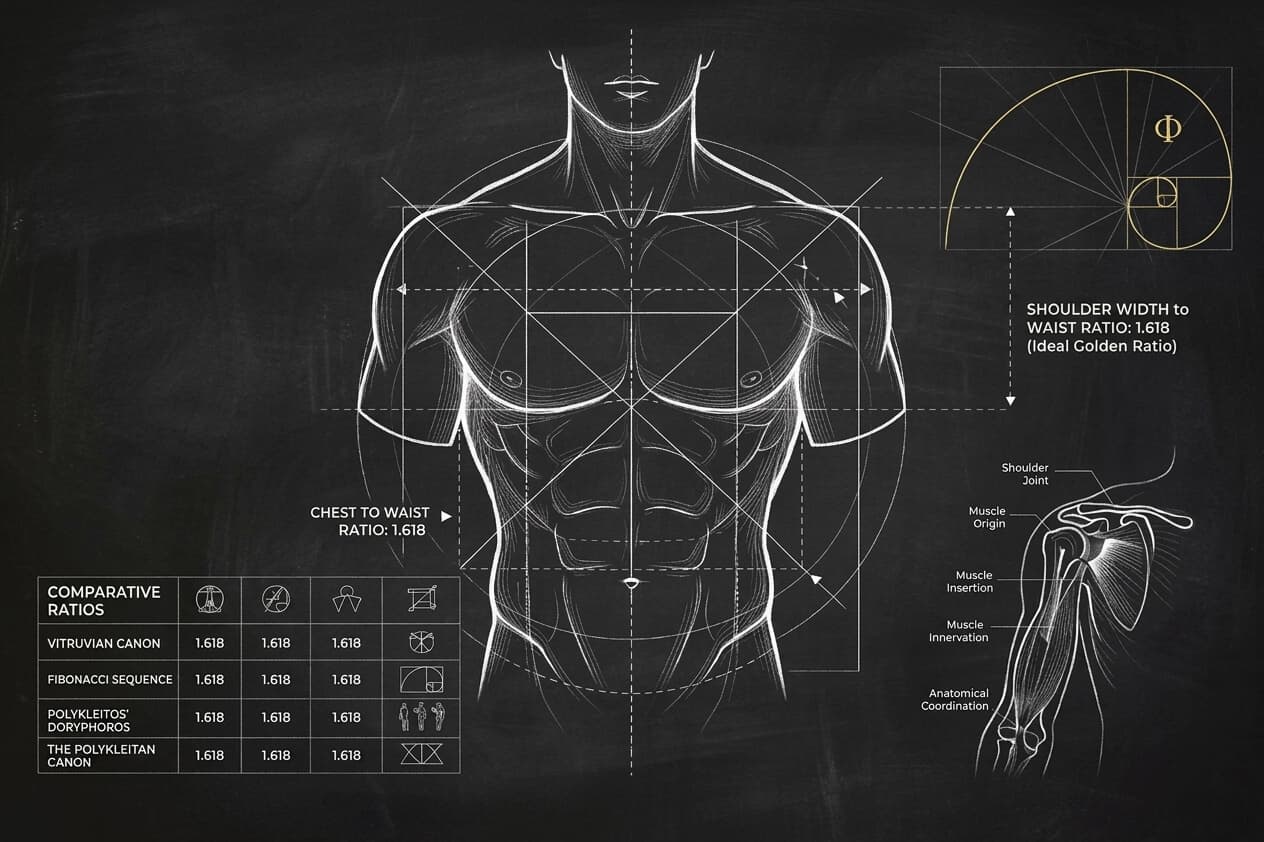
One honest note up front: there's no single "perfect" physique, and your skeletal frame sets your starting point (that's the concept guide's whole first half). What there is is a widely-agreed aesthetic look — the V-taper — and a clear set of muscles and training rules that move you toward it from any frame. Nobody can promise you a specific outcome, but the levers below are the ones that matter.
The aesthetic physique, in one paragraph
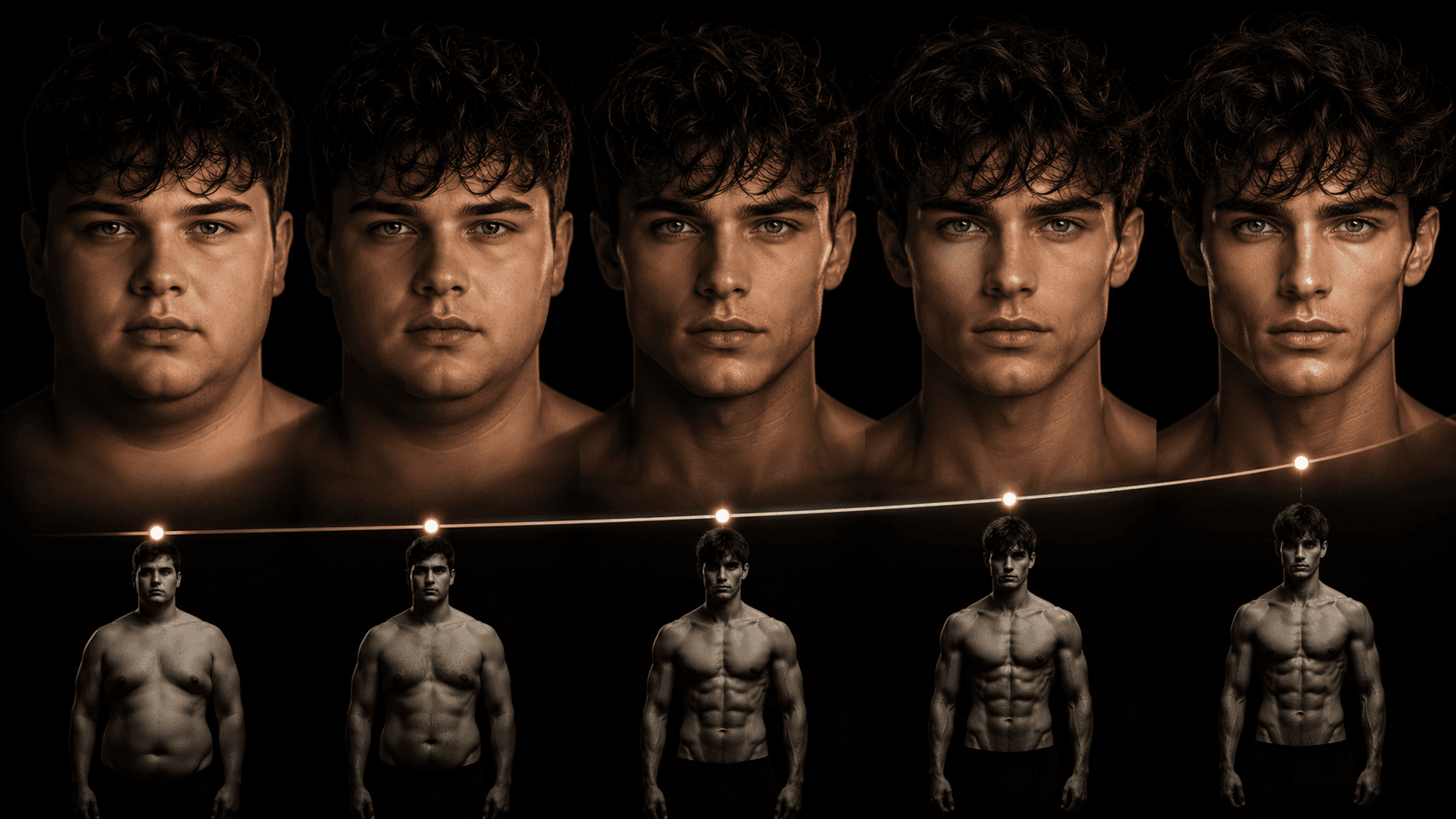
The aesthetic look is an illusion of proportion: wide at the shoulders and upper back, full in the chest and arms, tight at the waist, with proportional legs — all revealed by a reasonably lean body fat. You build it by growing the muscles that widen the top of your frame, keeping the waist from thickening, and getting lean enough to see the work. Body fat is the multiplier here; the leanest version of your current muscle almost always looks more aesthetic than a soft, bigger version (see body fat and facial/physique definition).
The aesthetic muscles: what to prioritize
Not all muscles pay off equally for the look. In rough priority order:
- Side (lateral) deltoids — the single highest-value aesthetic muscle. Capped, round shoulders create width and the shoulder-to-waist ratio that defines the V. They recover fast and no big compound trains them well, so they need dedicated, high-volume isolation (lateral raises).
- Back — lats and upper back. Lat width builds the taper (vertical pulling: pull-ups, pulldowns); upper-back thickness builds the 3D look and supports posture (rows). Both matter.
- Upper chest. A full upper chest builds the "shelf" and a balanced chest. Incline pressing is the priority over flat.
- Arms. Always on display. The triceps make up about two-thirds of arm size, so don't neglect them chasing biceps; train both, plus a little forearm work.
- A tight waist and visible abs. This is mostly not a growth goal — the waist should stay narrow, so avoid heavy weighted oblique work that thickens it. Abs show up through low body fat, not endless crunches. Keeping the waist tight is half the taper.
- Legs — quads, hamstrings, glutes, calves. Proportion matters: skipped legs ruin an otherwise good physique, and glutes/hamstrings support posture and the side profile. Aesthetic-focused lifters can bias slightly toward the upper body, but "slightly" — not "never train legs."
- Rear delts, traps, and neck round out the complete look. Rear delts and face-pull work also protect the shoulders and posture; a proportional neck adds to the masculine frame.
The through-line: build the top, hold the waist tight, get lean. Everything below serves that.
The principles that make any split work
The split you choose matters far less than getting these right. They're well supported by the resistance-training research:
- Progressive overload is non-negotiable. Over weeks, add reps or weight to your working sets. A routine you never progress won't grow you, no matter how it's arranged.
- Volume drives growth. More weekly hard sets per muscle produce more hypertrophy in a graded dose-response, with the practical sweet spot around ~10–20 hard sets per muscle per week for most people; priority muscles (side delts, back) can sit at the higher end.1 Very high volumes show diminishing returns, so more isn't infinitely better.
- Train close to failure. Growth needs real effort — take working sets to roughly 0–3 reps in reserve (near, not always to, failure). Junk sets left far from failure barely count.
- Rep range is flexible. Anywhere from about 6 to 30 reps builds muscle when sets are taken close to failure, so pick loads you can control with good form.2 In practice: heavier (≈6–10) on big compounds, moderate-to-higher (≈10–20) on isolations like lateral raises.
- Frequency is a tool, not magic. When weekly volume is equated, training a muscle more often doesn't independently add much growth.3 But hitting each muscle ~2× per week makes it far easier to accumulate quality volume with fresh, hard sets — which is exactly why the once-a-week bro split is the least efficient option for a natural lifter.
- Recover. Muscle is built between sessions. Sleep, enough protein, and rest days aren't optional — under-recovery caps everything (see sleep and appearance).
A quick programming note used in every routine below: bias extra volume toward side delts and back width, keep pressing tilted toward incline, and don't over-train the waist.
Choosing your split
Match the split to how many days a week you'll actually train, consistently:
- 3 days: Full Body or a 3-day PPL.
- 4 days: Upper/Lower (the best 4-day option) or a PPL+Upper hybrid.
- 5 days: PPL + Upper/Lower (PPLUL), or the bro split if you prefer it.
- 6 days: PPL run twice, or the Arnold split — for advanced lifters with the time and recovery for it.
All of the routines below already lean toward the aesthetic muscles. Sets are working sets (warm-ups not counted); start at the lower end of set ranges if you're newer, and add sets and load over time.
Full Body (3 days/week)
Best for beginners and busy schedules. Hits every muscle ~3× per week, which is excellent for accumulating volume with limited days. Run as A / B / C on non-consecutive days.
Day A
- Squat — 3×6–8
- Incline dumbbell press — 3×8–12
- Lat pulldown — 3×8–12
- Lateral raise — 3×12–20
- Dumbbell curl — 2×10–15
- Triceps pushdown — 2×10–15
- Calf raise — 3×10–15
Day B
- Romanian deadlift — 3×8–10
- Overhead press — 3×6–10
- Chest-supported row — 3×8–12
- Lateral raise — 3×12–20
- Face pull — 3×15–20
- Hammer curl — 2×10–15
- Overhead triceps extension — 2×10–15
Day C
- Leg press — 3×10–15
- Weighted dip or incline press — 3×8–12
- Pull-up (or pulldown) — 3×6–12
- Lateral raise — 3×12–20
- Rear-delt fly — 2×15–20
- Cable curl — 2×12–15
- Triceps pushdown — 2×12–15
- Calf raise — 3×10–15
Add 2–3 sets of ab work on two of the days.
Upper / Lower (4 days/week)
The best-value 4-day split — everything trained ~2× per week. Run Upper A / Lower A / Upper B / Lower B.
Upper A (strength lean)
- Incline barbell press — 4×6–10
- Weighted pull-up or pulldown — 4×6–10
- Overhead press — 3×8–12
- Chest-supported row — 3×8–12
- Lateral raise — 4×12–20
- Triceps pushdown — 3×10–15
- Barbell/dumbbell curl — 3×8–12
Lower A
- Squat — 4×6–10
- Romanian deadlift — 3×8–12
- Leg press or walking lunge — 3×10–15
- Leg curl — 3×10–15
- Calf raise — 4×10–15
- Abs — 3×
Upper B (hypertrophy lean)
- Incline dumbbell press — 4×8–12
- Lat pulldown — 4×8–12
- Machine or cable row — 3×10–15
- Lateral raise — 4×12–20
- Face pull — 3×15–20
- Incline dumbbell curl — 3×10–15
- Overhead triceps extension — 3×10–15
Lower B
- Front squat or hack squat — 3×8–12
- Hip thrust — 3×8–12
- Leg extension — 3×12–15
- Leg curl — 3×12–15
- Calf raise — 4×12–15
- Abs — 3×
Push / Pull / Legs (PPL)
The most popular hypertrophy split. Run 6 days (Push/Pull/Legs twice) for the best aesthetic results via frequency, or 3 days (each once) if that's what you can sustain.
Push
- Incline barbell press — 4×6–10
- Flat dumbbell press — 3×8–12
- Overhead press — 3×8–12
- Lateral raise — 4×12–20
- Cable fly — 3×12–15
- Triceps pushdown — 3×10–15
- Overhead triceps extension — 3×10–15
Pull
- Weighted pull-up — 4×6–10
- Barbell or chest-supported row — 4×8–12
- Lat pulldown — 3×10–15
- Rear-delt fly — 3×15–20
- Face pull — 3×15–20
- Barbell/dumbbell curl — 3×8–12
- Hammer curl — 3×10–15
Legs
- Squat — 4×6–10
- Romanian deadlift — 3×8–12
- Leg press — 3×10–15
- Leg curl — 3×10–15
- Leg extension — 3×12–15
- Calf raise — 4×10–15
- Abs — 3×
If shoulders are a priority (they usually should be for aesthetics), adding 2–3 sets of lateral raises to your Pull and Legs days is a cheap, high-return way to raise weekly delt volume.
Push / Pull / Legs / Upper / Lower (PPLUL, 5 days/week)
The "PPL plus upper/lower" hybrid — a strong 5-day option that hits most muscles ~2× per week while keeping the PPL feel. Run Push / Pull / Legs / Upper / Lower.
Use the Push, Pull, and Legs days exactly as above, then add:
Upper (mixed)
- Incline dumbbell press — 3×8–12
- Lat pulldown — 3×8–12
- Machine row — 3×10–15
- Lateral raise — 4×12–20
- Rear-delt fly — 3×15–20
- Biceps curl — 3×10–15
- Triceps pushdown — 3×10–15
Lower (mixed)
- Hack squat or leg press — 4×8–12
- Romanian deadlift — 3×8–12
- Leg extension — 3×12–15
- Leg curl — 3×12–15
- Calf raise — 4×12–15
- Abs — 3×
The Bro Split (5 days/week: one body part per day)
Popular and enjoyable — a full session per muscle — but be aware of the trade-off: it trains each muscle only once a week, which the evidence suggests is the least efficient frequency for a natural lifter unless weekly volume per muscle is high.3 If you run it, keep the volume up and consider sprinkling a little delt and upper-back work onto other days.
Chest
- Incline barbell press — 4×6–10
- Flat dumbbell press — 4×8–12
- Cable fly — 3×12–15
- Weighted dip — 3×8–12
- Lateral raise — 3×15–20 (added delt frequency)
Back
- Pull-up — 4×6–12
- Barbell row — 4×8–12
- Lat pulldown — 3×10–15
- Chest-supported row — 3×10–15
- Rear-delt fly — 3×15–20
- Face pull — 3×15–20
Shoulders
- Overhead press — 4×6–10
- Lateral raise — 5×12–20 (priority)
- Rear-delt fly — 4×15–20
- Cable lateral raise — 3×15–20
- Face pull — 3×15–20
Arms
- Barbell curl — 4×8–12
- Incline dumbbell curl — 3×10–15
- Hammer curl — 3×10–15
- Close-grip bench or weighted dip — 4×8–12
- Triceps pushdown — 3×12–15
- Overhead triceps extension — 3×12–15
- Wrist curl — 2–3×15–20
Legs
- Squat — 4×6–10
- Romanian deadlift — 3×8–12
- Leg press — 3×10–15
- Leg curl — 3×12–15
- Leg extension — 3×12–15
- Calf raise — 5×10–15
The Arnold Split (6 days/week)
A classic high-volume, high-frequency split: Chest+Back / Shoulders+Arms / Legs, run twice per week. For advanced lifters with the recovery and time for six sessions.
Chest + Back
- Incline barbell press — 4×6–10
- Barbell or chest-supported row — 4×8–12
- Flat dumbbell press — 3×8–12
- Pull-up or pulldown — 3×8–12
- Cable fly — 3×12–15
Shoulders + Arms
- Overhead press — 4×6–10
- Lateral raise — 5×12–20
- Rear-delt fly — 3×15–20
- Barbell curl — 3×8–12
- Triceps pushdown — 3×10–15
- Hammer curl — 3×10–15
- Overhead triceps extension — 3×10–15
Legs — use the Legs day from the PPL section.
Progressing, and what training can't do
How to progress: pick a starting weight you can hit at the bottom of the rep range with 1–3 reps left, and each week aim to add a rep or a little load. When you reach the top of the range on all sets, increase the weight and drop back down. Deload or take it easier for a few days when performance stalls or joints feel beaten up — that's part of the plan, not a failure.
Honest limits:
- Frame and genetics set your ceiling and your proportions — clavicle width, muscle insertions, and where you store fat aren't trainable. Train hard from the frame you have rather than measuring yourself against someone else's (more here).
- Body fat is the multiplier. No split reveals muscle that's buried; managing body fat is what makes the work visible (details).
- Diet does the building. Training is the stimulus; you need enough protein and roughly enough total food (a slight surplus to gain, a modest deficit to lean out). Precise numbers depend on the individual — this guide won't prescribe them, and if you want a plan dialed to your body, a registered dietitian or qualified coach is the right call.
- Time and consistency beat optimization. A decent split run hard for two years beats a "perfect" split abandoned in six weeks. Muscle is slow; patience is the real program.
- Form and recovery protect the whole project. Learn the lifts, don't ego-lift, and see a physio or coach for pain or persistent niggles rather than training through them. This is general information, not individualized medical or coaching advice.
The bottom line
Prioritize the muscles that widen your frame — side delts and back above all, then upper chest and arms — keep your waist tight, and get lean enough to show it. Then pick the split that fits the days you'll genuinely train, run it with progressive overload and enough volume close to failure, and give each muscle a couple of sessions a week where you can. The split is the packaging; effort, volume, consistency, and body-fat management are the actual product. Do those for long enough and an aesthetic physique follows from almost any starting point.
References
Footnotes
-
Schoenfeld BJ, Ogborn D, Krieger JW. Dose-response relationship between weekly resistance training volume and increases in muscle mass: a systematic review and meta-analysis. Journal of Sports Sciences (2017);35(11):1073–1082. https://pubmed.ncbi.nlm.nih.gov/27433992/ — graded dose-response; greater weekly set volume produces greater hypertrophy, with diminishing returns at the high end. ↩
-
Schoenfeld B, Fisher J, Grgic J, et al. Resistance Training Recommendations to Maximize Muscle Hypertrophy in an Athletic Population: Position Stand of the IUSCA. International Journal of Strength and Conditioning (2021). https://journal.iusca.org/index.php/Journal/article/view/81 — hypertrophy occurs across a wide loading/rep range when sets are taken close to failure; summarizes volume, effort, and exercise-selection recommendations. ↩
-
Schoenfeld BJ, Grgic J, Krieger J. How many times per week should a muscle be trained to maximize muscle hypertrophy? A systematic review and meta-analysis of studies examining the effects of resistance training frequency. Journal of Sports Sciences (2019). https://pubmed.ncbi.nlm.nih.gov/30558493/ — no significant difference between higher and lower frequency when weekly volume is equated; frequency is best used as a tool to distribute volume. ↩ ↩2