Dating Profile Pictures for Guys: How to Pick the Right Ones (and Why You Shouldn't Pick Alone)
The best dating profile pictures for guys are not the ones you like most. They're the ones other people respond to: a clear, well-lit face shot as your first photo, a full-body shot, something candid of you doing a thing, and one social photo, all recent and all recognizably you. The single most useful step is the one almost nobody takes: let someone else choose.
That last point isn't a pep-talk line. In a study of profile photo selection, images picked by strangers made better impressions than images people picked for themselves.1 You know your own face too well, and that familiarity makes you worse at seeing what a stranger sees in two seconds of scrolling.
This guide covers why that happens, how to get useful outside opinions, the photo set that works on Tinder, Bumble, Hinge and the rest, the mistakes that quietly cost you, and how your bio fits in. For the camera side (distance, light, angles), the guide to looking better in photos goes deeper.
Short answer: Take 30 to 50 photos in good light, shortlist about ten, and have people outside your friend group rank them. Lead with a solo, smiling face shot with no sunglasses. Add a full-body shot, a candid activity shot and one easy-to-read group photo. Keep everything recent and lightly edited at most.
Why you're the worst judge of your own dating profile pictures
The key study. White, Sutherland and Burton asked 102 students to pick, from 12 of their own Facebook photos, which ones they would and wouldn't use for Facebook, dating and professional profiles. Each person also made the same picks for a stranger of the same gender. Hundreds of online raters then judged the chosen photos.1
Two findings matter for you:
- Choosing helps. People's picks did shift impressions in the right direction for each site: dating and Facebook picks looked more attractive, professional picks looked more competent and trustworthy.
- Strangers chose better. Photos picked by someone else created more favorable impressions than photos people picked for themselves. A 2021 correction fixed a data error and, if anything, strengthened that main result.2
The honest caveat. In the main experiment, the stranger advantage showed up for trustworthiness and competence. For attractiveness specifically, other people's picks did not give a significant boost.1 So the study doesn't prove a stranger will find your "hottest" photo. It shows you are worse at predicting the overall impression a photo gives, and on a dating app, looking trustworthy and normal matters a lot more than people think. The effect was also small, and the participants were students choosing from Facebook photos, not daters on an app.
Why it happens. The authors argue it's not just vanity. You are so familiar with your own face that it's harder to tell your photos apart the way a stranger does.1 You remember the night a photo was taken, you notice "flaws" nobody else sees, and you're used to your mirror image rather than the unflipped version others see (the mirror vs camera guide explains that part).
Why it matters so much. Different photos of the same person vary hugely. In one study, attractiveness ratings varied more across photos of the same person than across different people.3 Another found that impressions shifted dramatically between images of the same face, and that which photo people preferred changed with the goal, such as a dating profile versus a political campaign.4 Picking well is not a small tweak. It can be the difference between your worst and best self on the same app.
How to choose with other people's help
You want honest opinions from people who see you the way a match would: briefly, without history.
Step 1: Make a big pool. Shoot 30 to 50 new photos across a couple of settings, plus any good recent ones you already have. You can't pick a great photo from five mediocre ones.
Step 2: Cut to about ten yourself. Remove anything blurry, badly lit, outdated or heavily filtered. This is the one part you can do alone.
Step 3: Get outside rankings. In rough order of usefulness:
| Who | Pros | Cons |
|---|---|---|
| Acquaintances or coworkers of your target gender | See you more like a stranger would | Can be polite rather than honest |
| Photo-rating sites and apps | Many quick ratings from actual strangers | Raters may not match the people you want to date |
| Reddit photo-feedback communities | Blunt, specific comments | Harsh, small samples, often not your audience |
| Close friends | Easy to ask | They see the person they know, not the photo |
Step 4: Ask the right question. Not "do I look good?" but "which three would you most want to message, and which one would you drop?" Ranking forces a choice and gets past politeness.
Step 5: Trust the pattern, not one vote. If a photo keeps landing at the bottom, cut it, even if it's your favorite. If one you'd written off keeps landing near the top, use it.
The photo set that works: face, full body, activity, social
Most apps let you upload around six photos. You don't need to fill every slot; four strong ones beat six with two weak ones.
Photo 1: Your face, alone, smiling. Head and shoulders, you alone, eyes visible, facing the camera, in soft light. This is the photo that decides whether anyone looks at the rest. A real smile that reaches your eyes helps: a meta-analysis found these "Duchenne" smiles were rated more authentic, attractive and trustworthy than mouth-only smiles, though the gap is smaller in posed photos.5 Get someone to make you laugh between shots.
Photo 2: Full body. Standing, in clothes that fit, shot from a few meters away at about chest height. People want to know what you look like overall, and leaving it out makes them guess. Fit matters more than brand; the style guide covers it.
Photo 3: Candid activity. You doing something you actually do: cooking, hiking, playing an instrument, on a bike. Research backs this one. Across five experiments, people were more interested in dating or befriending someone shown in a candid photo than a posed one, because candid shots looked more genuine.6 Two catches from the same study: if the photo looks staged-candid, the advantage shrinks, and for hiring (LinkedIn-style) posed photos won. Dating rewards natural; work rewards polished.
Photo 4: Social. One photo with friends shows you have a life. Keep it to a small group, make sure you're easy to identify (center, or clearly you), and never use it as your first photo.
Photos 5 and 6 (optional): Range. A second face shot in a different setting or outfit, a travel photo where your face is visible, a photo with your dog. Each one should show something new, not the same outfit and angle again.
A quick audit for the full set:
- Is your face clearly visible in at least three photos?
- Are all photos from the last year or two, at your current weight and hairstyle?
- Would a match recognize you instantly if you walked into a bar?
- Does each photo add new information?
Common mistakes: sunglasses, group-only shots, heavy filters
Sunglasses in your main photo. In a controlled study, wearing sunglasses lowered how trustworthy faces were rated.7 It was a general face-perception study, not a dating-app test, but trust is the whole game when someone is deciding whether to meet you. One sunglasses photo deep in the set is fine; a lead photo where nobody can see your eyes isn't. The same logic applies to hats that shade your eyes.
Group-only or group-first. If your first photo is a group, people have to work out which one you are, and many won't bother. There's no direct research on this; it's consistent advice from dating coaches and photographers, and it follows from the fact that people decide fast.
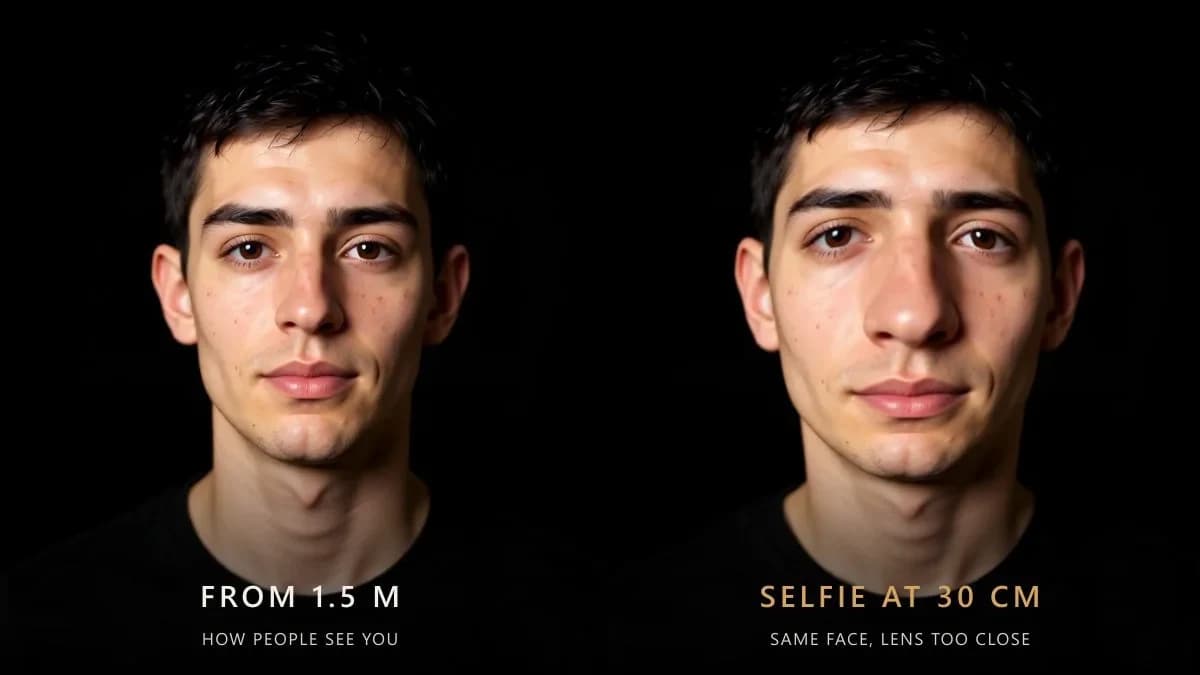
Close-up selfies. At arm's length, the lens is close enough to distort your face. Modeling work found that at 12 inches the nose looks about 30% larger relative to face width in men, with essentially no distortion at 5 feet.8 In a separate set of experiments, faces photographed from farther away were rated more trustworthy, competent and attractive, and viewers didn't notice the distance had changed.9 One good selfie is fine; a profile made only of them is not.
Heavy filters, face-reshaping and old photos. In one small study of 54 online dating photos, independent judges rated about a third as inaccurate, even though the daters themselves rated their photos as fairly accurate. Older and retouched photos were among the problems the researchers found.10 Every edit that changes your face is a promise you break on the first date. Fair edits: cropping, straightening, fixing exposure and color. Unfair: slimming your jaw, smoothing your skin to plastic, a photo from 15 pounds and a hairline ago.
Other repeat offenders:
- Gym mirror selfies with the phone covering your face.
- Photos with women who could be read as an ex or a partner.
- Holding a fish, a tiger or a car as your main personality. One is fine if it's genuinely you; none should be your first photo.
- Every photo the same: same outfit, same angle, same expression.
- Cropped-out people, a stray arm or shoulder tells everyone it was a group shot.
Lighting and distance recap
The camera side is covered properly in the photo guide, so here's the short version for a dating shoot:
| Setting | Do | Avoid |
|---|---|---|
| Distance | Someone shooting from about 1.5 m (5 ft) or more, back camera zoomed to 2x | Arm's-length front-camera selfies |
| Light | Facing a window, open shade, or the hour before sunset | Overhead ceiling lights, midday sun, direct flash |
| Camera height | Eye level or slightly above; chest height for full body | Shooting up from below your chin |
| Angle | Body turned slightly, face back to the camera, chin a touch forward and down | Square-on and stiff |
| Background | Simple and not brighter than your face | Messy rooms, bathroom mirrors |
The day before: haircut a few days earlier so it has settled, beard lined up, a decent night's sleep, and easy on alcohol and salt so you're not puffy (see why your face gets puffy).
Bios and photos together
Photos get looked at first, but text still counts. An eye-tracking study of mock dating profiles found photos were more likely to grab initial attention, and more attractive photos held more of it. But people read the text regardless of how attractive the photo was, and photo and text each shaped impressions, affecting different parts of how attractive the person seemed.11 A good bio won't rescue a bad photo set, but a lazy or sloppy one can drag down a good one.
Make them work as a pair:
- Let the bio add what photos can't. Your humor, what you're looking for, what a first date with you might look like.
- Reference your photos. If there's a photo of you cooking, a line like "Ask me about the risotto I'm still trying to get right" gives someone an easy opener.
- Be specific. "I like travel and food" describes everyone. "Trying to find the best tacos in the city, current leader is a truck by the train station" is a conversation.
- Proofread. Typos are a cheap way to look careless.
- Match the tone. If every photo is serious and posed, a jokey bio feels mismatched, and the reverse.
What you show also signals status and lifestyle, for better or worse. Flexing a rented car tends to read as trying hard; a photo of you competent at something reads better. The statusmaxxing guide covers which signals hold up.
Frequently Asked Questions
What are the best Tinder photos for guys? A clear solo face shot with a genuine smile as your first photo, then a full-body shot, a candid activity photo and one group photo where you're easy to spot. On Tinder, people swipe fast, so your first photo carries most of the weight. Have other people rank your options rather than guessing.
Are the best Bumble photos for guys any different? Not really. The same set works across apps. Because a match on Bumble often has to message you first, photos that give an easy opener (an activity, a place, a dog) are especially useful. Pair them with a bio or prompts that make starting a conversation easy.
What do Reddit threads say are the best Tinder photos for guys? The common advice on Reddit lines up well with the research: no sunglasses in the main photo, no group photo first, fewer selfies, and get outside opinions. Reddit photo-feedback communities can be a useful source of stranger opinions, but they're blunt, small samples, and the people commenting may not be the people you want to date.
How many dating profile pictures should a man have? Four to six good ones. Four strong photos beat six where two are weak, because a weak photo gives people a reason to hesitate. At least three should show your face clearly.
Should I get professional dating profile photos? They can help if a photographer shoots you in natural settings and coaches a real expression. Overly polished studio headshots can backfire, since candid-looking photos made people seem more genuine in research, while posed photos did better for professional contexts.6 A friend with a decent phone, good light and patience gets you most of the way.
Is it okay to use filters on dating profile pictures? Light color and exposure fixes, yes. Anything that changes your face, no. In one small study, about a third of online dating photos were judged inaccurate by outside judges, with older and retouched photos among the problems, and that kind of mismatch shows the moment you meet.10
The bottom line
Your dating profile pictures are a selection problem more than a looks problem. The same face can look ordinary or great depending on the photo, and you are badly placed to tell which is which. Take a lot of photos in good light from a proper distance, build a set that shows your face, your build, your life and your friends, cut sunglasses, group-first shots and heavy edits, and then let people who don't know you well rank them. Keep every photo honest enough that your date recognizes you at the door.
References
Footnotes
-
White D, Sutherland CAM, Burton AL. Choosing face: The curse of self in profile image selection. Cognitive Research: Principles and Implications (2017);2:23. https://pmc.ncbi.nlm.nih.gov/articles/PMC5391387: photos chosen by strangers made more favorable impressions than self-chosen ones, though the advantage was not significant for attractiveness specifically. ↩ ↩2 ↩3 ↩4
-
White D, Sutherland CAM, Burton AL. Correction to: Choosing face: The curse of self in profile image selection. Cognitive Research: Principles and Implications (2021). https://pmc.ncbi.nlm.nih.gov/articles/PMC8363730/: a data-processing error was corrected and the main advantage for other-selected photos was slightly strengthened. ↩
-
Jenkins R, White D, Van Montfort X, Burton AM. Variability in photos of the same face. Cognition (2011);121(3):313-323. https://research.bond.edu.au/en/publications/variability-in-photos-of-the-same-face/: attractiveness ratings varied more across photos of the same person than across different people. ↩
-
Todorov A, Porter JM. Misleading first impressions: different for different facial images of the same person. Psychological Science (2014);25(7):1404-1417. https://pubmed.ncbi.nlm.nih.gov/24866921/: impressions varied widely across images of the same face, and preferred images changed with context, such as online dating versus a political campaign. ↩
-
Gunnery SD, Ruben MA. Perceptions of Duchenne and non-Duchenne smiles: A meta-analysis. Cognition and Emotion (2016);30(3):501-515. https://pubmed.ncbi.nlm.nih.gov/25787714/: smiles that reach the eyes were rated more authentic, attractive and trustworthy, with smaller gaps for photos and posed smiles. ↩
-
Berger J, Barasch A. A candid advantage? The social benefits of candid photos. Social Psychological and Personality Science (2018);9(8):1010-1016. https://vivo.colorado.edu/display/pubid_332668: across five experiments, candid photos increased interest in dating and friendship by making people seem more genuine, while posed photos did better for hiring. ↩ ↩2
-
Graham DL, Ritchie KL. Making a spectacle of yourself: The effect of glasses and sunglasses on face perception. Perception (2019);48(6):461-470. https://pubmed.ncbi.nlm.nih.gov/31006340/: wearing sunglasses reduced ratings of trustworthiness. ↩
-
Ward B, Ward M, Fried O, Paskhover B. Nasal distortion in short-distance photographs: The selfie effect. JAMA Facial Plastic Surgery (2018);20(4):333-335. https://pmc.ncbi.nlm.nih.gov/articles/PMC5876805/: at 12 inches, the nose appeared about 30% larger relative to face width in men, with essentially no difference at 5 feet. ↩
-
Bryan R, Perona P, Adolphs R. Perspective distortion from interpersonal distance is an implicit visual cue for social judgments of faces. PLoS ONE (2012);7(9):e45301. https://journals.plos.org/plosone/article?id=10.1371/journal.pone.0045301: faces photographed from 135 cm were rated more trustworthy, competent and attractive than the same faces from 45 cm. ↩
-
Hancock JT, Toma CL. Putting your best face forward: The accuracy of online dating photographs. Journal of Communication (2009);59(2):367-386. https://academic.oup.com/joc/article/59/2/367/4098407: independent judges rated about a third of 54 online dating photos as inaccurate; women's photos were judged less accurate and were more often older or retouched. ↩ ↩2
-
van der Zanden T, Mos M, Schouten A, Krahmer E. What people look at in multimodal online dating profiles: How pictorial and textual cues affect impression formation. Communication Research (2021). https://research.tilburguniversity.edu/en/publications/what-people-look-at-in-multimodal-online-dating-profiles-how-pict-2/: photos drew initial attention, but text was read regardless of photo attractiveness and both shaped impressions. ↩