Mewing
Mewing is a technique that involves keeping the tongue pressed against the roof of the mouth, with the mouth closed and breathing through the nose. It was created by the Mew doctors and is used to improve jawline, posture, and breathing. Some people use it as part of routines to enhance facial appearance.
How Does It Help?
If you are between 13–25 years old, you can improve your facial structure and posture to prevent the jaw from moving to the wrong angle, avoid asymmetry, and maintain proper jaw posture as you age.
Why Is It Important?
Mewing works best during youth. If you are older, it can still be done but will not have the same effects as during adolescence.
How to Do It Correctly
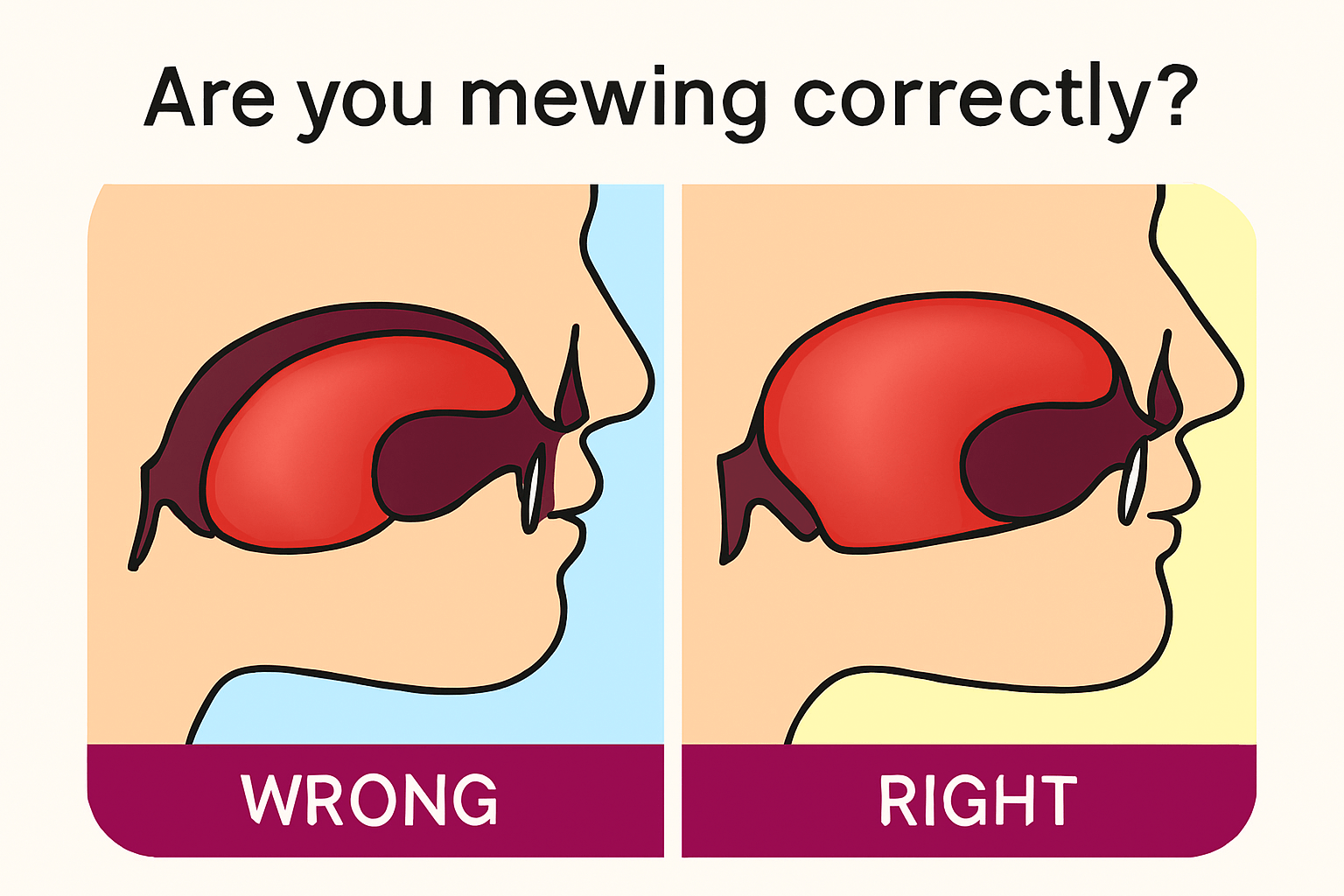
✅ Correct Technique:
- Tongue pressed against the palate (including the back).
- Lips closed, relaxed.
- Teeth barely touching, not clenched.
- Always breathe through the nose.
Long-Term Benefits
✅
- May improve jaw definition.
- Reduces double chin.
- Improves overall posture.
- Enhances profile appearance.
How to Know If You’re Doing It Wrong
-
Incorrect tongue placement
- If only the tip or middle touches the palate, it won’t activate all the muscles.
✅ The whole tongue (tip, middle, back) must be pressed to the palate from front teeth to the back.
- If only the tip or middle touches the palate, it won’t activate all the muscles.
-
Mouth breathing
- Breathing through the mouth indicates incorrect technique.
✅ Always breathe through the nose.
- Breathing through the mouth indicates incorrect technique.
-
Jaw clenching (bruxism)
- Teeth should barely touch or be slightly apart, with no pressure.
-
Tension in the neck or face
- The technique should feel natural, relaxed, and comfortable.
-
Tongue pushing the front teeth
- Pressing the tongue on the incisors can open a bite or move teeth outward.
✅ Keep the tongue on the hard palate behind the front teeth.
- Pressing the tongue on the incisors can open a bite or move teeth outward.
Tips to Improve Technique:
- Practice in front of a mirror:
- Close lips, breathe through the nose.
- Swallow saliva without moving the tongue.
- Pronounce the letter “N” to naturally position your tongue on the palate.
- Mewing is postural, not an exercise, and should be maintained all day like good body posture.
Chewing and Facial Bone Development
- Maximizes existing facial bone and may increase bone mass (Wolff’s Law).
- Jaw elevator muscles generate forces of ~70–150 N during normal chewing; maximal chewing can reach 500–700 N.
- Chewing gum can train masseters to exert >350 N, much higher than tongue forces (~60x), helping bone adaptation.
- Daily cyclic loading from chewing stresses cranial sutures, stimulating growth. After age 12, sutures mature, making them harder to stimulate; chewing can reactivate them.
Effects You Can Target With Chewing and Mewing
- Adjust mid-face length (increase or decrease).
- May improve orbital positioning (higher cheekbones).
- Forward jaw growth (projection).
- Jaw robustness and lateral width.
Chewing methods:
- Improve cheekbones: first molar → first premolar.
- Compact orbits: first molar → premolar and incisors.
- Forward growth: incisors.
- Jaw robustness: any proper chewing method.
Mechanisms
- Incisor chewing applies upward force on the front jaw (CCW rotation).
- Posterior molar chewing induces CW rotation.
- CCW rotation lifts orbital bones and zygomatic arches for higher cheekbones and compact orbits.
- Proper tongue posture enhances vertical growth, correcting natural CW rotation and maximizing forward projection.